• Submit Poetry
  • Support SCP
  • About Us
  • Members
  • Join
Tuesday, May 12, 2026
Society of Classical Poets
  • Poems
    • Beauty
    • Culture
    • Satire
    • Humor
    • Children’s
    • Art
    • Ekphrastic
    • Epic
    • Epigrams and Proverbs
    • Human Rights in China
    • Music
    • Performing Arts
    • Riddles
    • Science
    • Song Lyrics
    • The Environment
    • The Raven
    • Found Poems
    • High School Poets
    • Terrorism
    • Covid-19
  • Poetry Forms
    • Sonnet
    • Haiku
    • Limerick
    • Villanelle
    • Rondeau
    • Pantoum
    • Sestina
    • Triolet
    • Acrostic
    • Alexandroid
    • Alliterative
    • Blank Verse
    • Chant Royal
    • Clerihew
    • Rhupunt
    • Rondeau Redoublé
    • Rondel
    • Rubaiyat
    • Sapphic Verse
    • Shape Poems
    • Terza Rima
  • Great Poets
    • Geoffrey Chaucer
    • Emily Dickinson
    • Homer
    • Henry Wadsworth Longfellow
    • Dante Alighieri
    • John Keats
    • John Milton
    • Edgar Allan Poe
    • William Shakespeare
    • William Wordsworth
    • William Blake
    • Robert Frost
  • Love Poems
  • Contests
  • SCP Academy
    • Educational
    • Teaching Classical Poetry—A Guide for Educators
    • Poetry Forms
    • The SCP Journal
    • Books
No Result
View All Result
Society of Classical Poets
  • Poems
    • Beauty
    • Culture
    • Satire
    • Humor
    • Children’s
    • Art
    • Ekphrastic
    • Epic
    • Epigrams and Proverbs
    • Human Rights in China
    • Music
    • Performing Arts
    • Riddles
    • Science
    • Song Lyrics
    • The Environment
    • The Raven
    • Found Poems
    • High School Poets
    • Terrorism
    • Covid-19
  • Poetry Forms
    • Sonnet
    • Haiku
    • Limerick
    • Villanelle
    • Rondeau
    • Pantoum
    • Sestina
    • Triolet
    • Acrostic
    • Alexandroid
    • Alliterative
    • Blank Verse
    • Chant Royal
    • Clerihew
    • Rhupunt
    • Rondeau Redoublé
    • Rondel
    • Rubaiyat
    • Sapphic Verse
    • Shape Poems
    • Terza Rima
  • Great Poets
    • Geoffrey Chaucer
    • Emily Dickinson
    • Homer
    • Henry Wadsworth Longfellow
    • Dante Alighieri
    • John Keats
    • John Milton
    • Edgar Allan Poe
    • William Shakespeare
    • William Wordsworth
    • William Blake
    • Robert Frost
  • Love Poems
  • Contests
  • SCP Academy
    • Educational
    • Teaching Classical Poetry—A Guide for Educators
    • Poetry Forms
    • The SCP Journal
    • Books
No Result
View All Result
Society of Classical Poets
No Result
View All Result
Home Poetry Beauty

‘Description of the Fountain of the Thorn at the Royal Site of Aranjuez’ by María Rosa Gálvez de Cabrera (1768-1806)

February 19, 2020
in Beauty, Culture, Poetry, Translation
A A
4
poems 'Description of the Fountain of the Thorn at the Royal Site of Aranjuez' by María Rosa Gálvez de Cabrera (1768-1806)

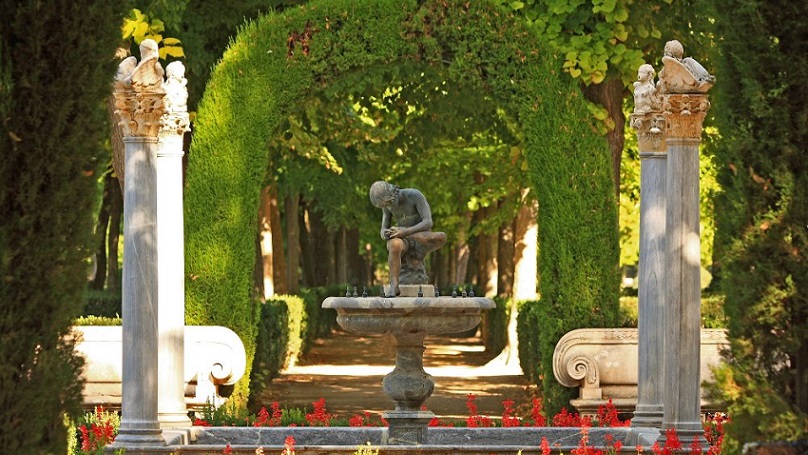
Aranjuez (ar-ON-wess) has been one of the estates of the royal family of Spain. It is near Madrid and the Tajo (TAW-hoe) River flows through it. The Fountain of the Thorn includes, as its centerpiece, a bronze statue of a young boy removing a thorn from his foot. This is surrounded by pillars topped by four harpies. The below poem on the fountain is a translation from the original Spanish by Martin Hill Ortiz.


Where, by works of art compressed, the Tajo River
flows with depths that ease the progress of its passage.
It advances onward, tamed but arrogant,
being drawn along by forceful, haughty currents.

There exists a verdant forest in its center
where both elegance and majesty reside:
celebrated hidden haven of the Graces,
the exquisite dwelling place of mythic nymphs.

Here, expansive waterways and broad cascades
amplify the luscious pleasures of the site:
roaring and performing random pirouettes,
an enrapturement to please the ear and eye.

Down a thousand paths the poplars, evergreen,
cross their branches. Their cathedral pomp aspires
first to blot and then replace the dome of air;
In what radiance remains, the stars join in.

Sundry fountains decorate the chamfered corners
of this pleasant, hanging garden. They enrich
with a scattering of crystal drops the soil
which revivifies the flowery retreat.

First, above all else, the sculptures elevate,
laud, the wellspring named the Fountain of the Thorn,
masterwork created to commemorate
Praxitéles, Lisipo, and Phidias:

In an area encompassed by four arbors,
each of which is topped at midpoint by a cornice,
these display in their design artistry and
craftsmanship: sublime and simple, unpretentious.

At the verdant center of this royal square,
where the Fountain of the Thorn presents its pool,
can be seen a statue. In its form competes
artist and material, both obstinate.

It depicts a boy whose foot has been afflicted
by a piercing thistle thorn. The pain demands
that he plucks the barb out carefully. It shows
by his stress the soreness of the wound, and yet. . .

the dispassion of the statue controverts
the ordeal presented on his anguished face
which, if it were not the golden hue of bronze,
this creation would excite the human heart.

The appealing angles that surround this fountain
are defined by pillars; they have cornices
at their peaks supporting ornamental caps
that present the image of the faithless harpies,

who from out their mouths and flowing nipples shoot,
in incessant jets of crystal, aqua pura,
streams which mingle after brief but sportive flights,
the conclusion to the trek of melted snow.

Scattered here and there around this charming site
lie some benches which have varied symmetry,
that provide a moment’s rest to weary mortals,
an occasion to relax and savor beauty.

On the trunks of robust trees, the ancient ivy
gorges to increase the vigor of its verdure
which the fevered blaze of Phoebe soon curtails,
thereby rendering the day subdued and peaceful.

Perched atop the branches dulcet little birds
with their cheerful twittering apprise you that
you have failed to heed the summons of their songs,
witcheries designed to steal the sense of sight.

So, we find that nature, acting as creator,
ruling from its lofty throne, has here united
art to its endeavors, featuring its treasures,
and provided lush delights which never cease.

I’ve admired its splendor once, a thousand times,
and I sensed a gratitude within my soul
filling me each stay in this serene enclosure,
feeling overjoyed as I observed its wonders;

In their arrogance the crowds of mortal beings
with a crazy self-importance tromped the grounds,
so Apollo stirred in me this dulcet meter,
chanting verses to the Fountain of the Thorn.


Original Spanish:

Descripción de la fuente de la Espina en el Real Sitio de Aranjuez: romance endecasílabo

Donde oprimido el Tajo por el arte
en hondo cauce el curso facilita,
mudando en mansedumbre la soberbia,
con que arrastraba su corriente altiva:

yace un frondoso bosque, cuyo centro
la majestad, y la hermosura habitan;
asilo celebrado de las gracias,
morada deliciosa de las ninfas.

Anchurosos canales y cascadas
aumentan de este sitio las delicias,
siendo su estruendo y vagaroso giro
encanto del oído y de la vista.

En sendas mil los chopos siempre verdes
cruzan sus ramos, y su pompa aspira
a eclipsar de la bóveda del aire
la luz quede los astros participa.

Varias fuentes adornan las ochavas
de este ameno pensil, y fertilizan
con desperdicios de cristal el suelo,
donde renace la estación florida:

Pero entre todas la escultura eleva
el nombre de la fuente de la Espina,
obra que diera honor a la memoria
de Praxitéles, de Lisipo y Phidias:

de cuatro cenadores rodeada,
que en medios puntos cubren sus cornisas,
muestra la arquitectura las bellezas
más sublimes del arte y más sencillas.

En el centro frondoso de este cuadro
la fuente muestra su anchurosa pila,
presentando la estatua, en que compiten
la materia y artífice a porfía.

De un joven es, que de su pie doliente
la punta de un abrojo solicita
arrancar cuidadoso, demostrando
con su actitud el daño de la herida:

desmiente lo insensible de la estatua
la aflicción, que en su rostro se nos pinta;
y a no ser su color dorado bronce,
la humana compasión excitaría.

Los ángulos hermosos de esta fuente
en columnas se apoyan; sus cornisas
sostienen al remate por adorno
el rostro engañador de las harpías,

por cuya boca y pecho se desatan
los raudales del agua cristalina,
que tejiendo cruceros agradables
quedan al fin en nieve derretida.

En torno de este sitio deleitoso
asientos hay con varia simetría,
que brindan el descanso a los mortales,
el tiempo que disfrutan sus delicias.

Robustos troncos, que la antigua yedra
cubre para aumentar su lozanía,
los ardores de Febo disminuyen,
y hacen templado y apacible el día:

en sus ramos los dulces pajarillos
con alegres gorjeos solicitan
se olvide para oírlos el encanto,
que arrebata el sentido de la vista.

En fin, naturaleza creadora,
como en su trono, en este sitio unida
del arte a los esfuerzos, sus tesoros
y sus deleites sin cesar prodiga.

Yo admiré su esplendor: una y mil veces
sentí de gratitud el alma mía
llenarse en este plácido recinto,
gozosa de observar sus maravillas;

y en tanto que engreídos los mortales
en loca vanidad su centro pisan,
Apolo me inspiraba dulce metro,
para cantar la fuente de la Espina.


Martin Hill Ortiz is a researcher and professor at the Ponce University of Health Sciences in Ponce, PR where he lives with his wife and son. He has three novels published by small presses: A Predatory Mind (Loose Leaves Publishing, 2013),  Never Kill A Friend, (Ransom Note Press, 2015), and A Predator’s Game (Rook’s Page, 2016). 
ShareTweetPin
The Society of Classical Poets does not endorse any views expressed in individual poems or commentary.
Read Our Comments Policy Here

RandomPoems

‘A New York Post Post’ by Bruce Dale Wise
Culture

‘A New York Post Post’ by Bruce Dale Wise

October 15, 2020

  “Censorship is to art, as lynching is to justice.” —Henry Louis Gates, Jr. by Caud Sewer Bile Joe’s never...

Five Translations of Aesop’s Fables (from Phaedrus, First Century AD Latin Poet)
Beauty

Five Translations of Aesop’s Fables (from Phaedrus, First Century AD Latin Poet)

November 19, 2019

Translations by Terry L. Norton. Original Latin by Phaedrus follows each. The Red Kite and the Doves When doves had...

Next Post
‘Edgar Allan Poe’s The Raven, Christmas Editition’ by Studio C

'Edgar Allan Poe's The Raven, Christmas Editition' by Studio C

‘A Truly Perfect Love’ and Other Poetry by Lee Goldberg

'A Truly Perfect Love' and Other Poetry by Lee Goldberg

‘Natural-Born’ and Other Poetry by T.M. Moore

'Natural-Born' and Other Poetry by T.M. Moore

Comments 4

  1. Peter S Bridges says:
    6 years ago

    A fine translation of a fine poem…but is the Spanish text really the original, or has it been modernized?

    Reply
  2. Leo Zoutewelle says:
    6 years ago

    Martin,
    While I don’t speak Spanish, I thought your translation was beautiful and gripping! Thanks much.
    Leo

    Reply
  3. Peter S Bridges says:
    6 years ago

    I believe the Boy with Thorn is a copy of the statue in the Capitoline Museums in Rome. He is in a lovelier setting at Aranjuez.

    Reply
  4. C.B. Anderson says:
    6 years ago

    The meter here seems to be trochaic hexameter, which is a rarity indeed. The lines with masculine endings are catalectic, which is necessary if one is to have masculine endings at all.

    Reply

Leave a Reply Cancel reply

Your email address will not be published. Required fields are marked *

  1. Joseph S. Salemi on ‘Spontaneous Conjugal Combustion’ and Other Poems by Susan Jarvis BryantMay 12, 2026

    When I was in the U.K. I heard that "poodle" could mean a henpecked or subservient husband, and by extension…

  2. Susan Jarvis Bryant on ‘Spontaneous Conjugal Combustion’ and Other Poems by Susan Jarvis BryantMay 12, 2026

    Yael, it's always lovely to hear from you. I'm thrilled you enjoyed the poems. I did have people in mind…

  3. Susan Jarvis Bryant on ‘Spontaneous Conjugal Combustion’ and Other Poems by Susan Jarvis BryantMay 12, 2026

    James, I'm hoping you enjoyed the villanelle and it hasn't worried you too much. Mike often suffers for my art…

  4. Susan Jarvis Bryant on ‘Spontaneous Conjugal Combustion’ and Other Poems by Susan Jarvis BryantMay 12, 2026

    C.B. I just love the Queen Elizabeth II and Welsh Corgis scene... I would have claimed that one had I…

  5. Susan Jarvis Bryant on ‘Spontaneous Conjugal Combustion’ and Other Poems by Susan Jarvis BryantMay 12, 2026

    Brian, thank you so much for this extremely generous and perceptive reading. I thoroughly appreciate your take on my quirky…

Subscribe to Daily Poems

Enter your email address to subscribe to this blog and receive notifications of new posts by email.

Join 1,593 other subscribers

Recent Poems

  • A Poem on Coach “Black Mike” Castronis from Athens Y Camp, by Alec Ream
  • A Poem on the Zambian National Park Mosi-oa-Tunya, by Paul A. Freeman
  • ‘Creation of Mom’: A Mother’s Day Poem by Roy E. Peterson
  • ‘Spontaneous Conjugal Combustion’ and Other Poems by Susan Jarvis Bryant
  • ‘The Man in the Moon Was a Very Round Man’: A Poem by Lauren V. Leon
  • ‘Fibromytrauma’: A Poem by Golan Shahar
  • ‘A Lonely Sliver’: A Poem by Katie Tencza
  • ‘Higher Gas Prices Are a Small Price to Pay’: An Iran War Poem by Mark F. Stone
  • ‘Always Ahead’: A Poem by Scharlie Meeuws
  • ‘Hamlet’s Lawyer’ and Other Poetry by Brian Yapko
  • ‘On An Old Photograph’: A Poem by Joseph S. Salemi
  • ‘Faust Foresees His End’: A Poem by Martin Briggs
  • ‘À la Carte’ and Other Poetry by C.B. Anderson
  • ‘Where the Sweet Bluebonnets Bloom’: A Poem by Roy E. Peterson
  • ‘The Waters’: A Poem by Margaret Brinton
  • ‘The Pinnacle of Poetry’ and Other Poems by Russel Winick
  • The First American Sonnets: An Essay on David Humphreys, by Margaret Coats
  • ‘The Holy Rollers on Poetry’: A Poem by Joseph S. Salemi
  • Sappho’s ‘Poem 1’ Translated by Bruce Phenix
  • ‘The Cautionary Tale of Phone Addicted Mimi’: A Poem by Paul A. Freeman
  • ‘Look Away’: A Poem for America’s 250th Anniversary, by Roger Crane
  • ‘Sunday Morning in Canada’: A Poem by Jeffrey Essmann
  • ‘Bean’: A Poem by Jan Mennite
  • ‘The Swan’s Song ’: A Poem for Shakespeare’s Birthday, by Susan Jarvis Bryant
  • ‘The Gravedigger’: A Poem by Marie Burdett
  • ‘Waiting for the Perfect Man’: A Poem by Janice Canerdy
  • ‘The George-A-Saurus’ and Other Poetry by Brian Yapko
  • ‘When Asked: What’s Your Favorite Season?’: A Poem by Paul Millan  
  • ‘The Last At-Bat of Lyndon Braun’: A Poem by Michael Pietrack
  • ‘The Perpetual Battle’ and Other Poetry by Adam Sedia

Categories

  • Acrostic
  • Alexandroid
  • Alliterative
  • Art
  • Best Poems
  • Blank Verse
  • Chant Royal
  • Classical Poets Live
  • Clerihew
  • Covid-19
  • Deconstructing Communism
  • Educational
  • Epic
  • Epigrams and Proverbs
  • Essays
    • Interviews with Poets
    • Poetry Reviews
  • Featured
  • From the Society
  • Great Poets
    • Dante Alighieri
    • Edgar Allan Poe
    • Emily Dickinson
    • Geoffrey Chaucer
    • Henry Wadsworth Longfellow
    • Homer
    • John Keats
    • John Milton
    • Robert Frost
    • William Blake
    • William Shakespeare
    • William Wordsworth
  • Human Rights in China
  • Limerick
  • Love Poems
  • Music
  • Pantoum
  • Performing Arts
  • Poetry
    • Beauty
    • Children's Poems
    • Culture
    • Ekphrastic
    • Found Poems
    • High School Poets
    • Humor
    • Riddles
  • Poetry Challenge
  • Poetry Contests
  • Poetry Forms
    • Curtal Sonnet
    • Haiku
  • Poetry Readings
  • Rhupunt
  • Rondeau
  • Rondeau Redoublé
  • Rondel
  • Rubaiyat
  • Sapphic Verse
  • Satire
  • Science
  • Sestina
  • Shape Poems
  • Short Stories
  • Song Lyrics
  • Sonnet
  • Symposium
  • Terrorism
  • Terza Rima
  • The Environment
  • Translation
  • Triolet
  • Video
  • Villanelle

Quick Links

  • About Us
  • Submit Poetry
  • Become a Member
  • Members List
  • Support the Society
  • Advertisement Placement
  • Comments Policy
  • Terms of Use

Welcome Back!

Login to your account below

Forgotten Password?

Retrieve your password

Please enter your username or email address to reset your password.

Log In
No Result
View All Result
  • Poems
    • Beauty
    • Culture
    • Satire
    • Humor
    • Children’s
    • Art
    • Ekphrastic
    • Epic
    • Epigrams and Proverbs
    • Human Rights in China
    • Music
    • Performing Arts
    • Riddles
    • Science
    • Song Lyrics
    • The Environment
    • The Raven
    • Found Poems
    • High School Poets
    • Terrorism
    • Covid-19
  • Poetry Forms
    • Sonnet
    • Haiku
    • Limerick
    • Villanelle
    • Rondeau
    • Pantoum
    • Sestina
    • Triolet
    • Acrostic
    • Alexandroid
    • Alliterative
    • Blank Verse
    • Chant Royal
    • Clerihew
    • Rhupunt
    • Rondeau Redoublé
    • Rondel
    • Rubaiyat
    • Sapphic Verse
    • Shape Poems
    • Terza Rima
  • Great Poets
    • Geoffrey Chaucer
    • Emily Dickinson
    • Homer
    • Henry Wadsworth Longfellow
    • Dante Alighieri
    • John Keats
    • John Milton
    • Edgar Allan Poe
    • William Shakespeare
    • William Wordsworth
    • William Blake
    • Robert Frost
  • Love Poems
  • Contests
  • SCP Academy
    • Educational
    • Teaching Classical Poetry—A Guide for Educators
    • Poetry Forms
    • The SCP Journal
    • Books

© 2025 SCP. WebDesign by CODEC Prime.