• Submit Poetry
  • Support SCP
  • About Us
  • Members
  • Join
Tuesday, June 30, 2026
Society of Classical Poets
  • Poems
    • Beauty
    • Culture
    • Satire
    • Humor
    • Children’s
    • Art
    • Ekphrastic
    • Epic
    • Epigrams and Proverbs
    • Human Rights in China
    • Music
    • Performing Arts
    • Riddles
    • Science
    • Song Lyrics
    • The Environment
    • The Raven
    • Found Poems
    • High School Poets
    • Terrorism
    • Covid-19
  • Poetry Forms
    • Sonnet
    • Haiku
    • Limerick
    • Villanelle
    • Rondeau
    • Pantoum
    • Sestina
    • Triolet
    • Acrostic
    • Alexandroid
    • Alliterative
    • Blank Verse
    • Chant Royal
    • Clerihew
    • Rhupunt
    • Rondeau Redoublé
    • Rondel
    • Rubaiyat
    • Sapphic Verse
    • Shape Poems
    • Terza Rima
  • Great Poets
    • Geoffrey Chaucer
    • Emily Dickinson
    • Homer
    • Henry Wadsworth Longfellow
    • Dante Alighieri
    • John Keats
    • John Milton
    • Edgar Allan Poe
    • William Shakespeare
    • William Wordsworth
    • William Blake
    • Robert Frost
  • Love Poems
  • Contests
  • SCP Academy
    • Educational
    • Teaching Classical Poetry—A Guide for Educators
    • Poetry Forms
    • The SCP Journal
    • Books
No Result
View All Result
Society of Classical Poets
  • Poems
    • Beauty
    • Culture
    • Satire
    • Humor
    • Children’s
    • Art
    • Ekphrastic
    • Epic
    • Epigrams and Proverbs
    • Human Rights in China
    • Music
    • Performing Arts
    • Riddles
    • Science
    • Song Lyrics
    • The Environment
    • The Raven
    • Found Poems
    • High School Poets
    • Terrorism
    • Covid-19
  • Poetry Forms
    • Sonnet
    • Haiku
    • Limerick
    • Villanelle
    • Rondeau
    • Pantoum
    • Sestina
    • Triolet
    • Acrostic
    • Alexandroid
    • Alliterative
    • Blank Verse
    • Chant Royal
    • Clerihew
    • Rhupunt
    • Rondeau Redoublé
    • Rondel
    • Rubaiyat
    • Sapphic Verse
    • Shape Poems
    • Terza Rima
  • Great Poets
    • Geoffrey Chaucer
    • Emily Dickinson
    • Homer
    • Henry Wadsworth Longfellow
    • Dante Alighieri
    • John Keats
    • John Milton
    • Edgar Allan Poe
    • William Shakespeare
    • William Wordsworth
    • William Blake
    • Robert Frost
  • Love Poems
  • Contests
  • SCP Academy
    • Educational
    • Teaching Classical Poetry—A Guide for Educators
    • Poetry Forms
    • The SCP Journal
    • Books
No Result
View All Result
Society of Classical Poets
No Result
View All Result
Home Poetry Beauty

Four Poems on the Theme of Lost Love, by James A. Tweedie

April 20, 2021
in Beauty, Love Poems, Poetry
A A
11
poems Four Poems on the Theme of Lost Love, by James A. Tweedie

.

Poet’s Note: These poems are non-autobiographical.

.

When Love is Lost

To see the summer sun and wish for rain;
To smell the springtime flowers and wish for snow;
To wake at dawn and wish for night again;
To trade today for dreams of long ago.

To grieve the present and embrace the past
Remembering the love that worked its way
Into our hearts and bloomed but did not last;
A fallen blossom doomed to fade away.

And what is there to do when love is lost?
When broken promises betray our trust?
When star-crossed lovers’ love is double-crossed
And life’s tomorrows crumble into dust?

The path we choose shall be the path we keep,
To love again or to forever weep?

.

.

Love Betrayed

The scattered shards of shattered hopes and dreams
Lie strewn across the unswept floor of my
Distempered heart. Each splintered fragment screams
In silence, doomed to neither live nor die.

Yet in that silence echo memories
Of what once was and one day might have been,
Ere love’s embrace and night-sung ecstasies
Fell mute before the soul-less scythe of sin.

For failed faithfulness once sown, will reap
A bitter harvest of despair and grief.
And innocence betrayed is left to weep
Insufferable tears of misbelief.

Yet in the midst of suffering and pain
I dare to dream that I shall dream again.

.

.

I Call Your Name

A Mirror Poem

The stillness of the night, I call your name.
I wake from dreams of long ago, and in
The darkness of my brokenness and shame . . .
I weep for what I’ve done, what might have been.

I weep for what I’ve done, what might have been.
The darkness of my brokenness and shame . . .
I wake from dreams of long ago, and in
The stillness of the night, I call your name.

.

.

Eating Dust

“I’m leaving. It’s been fun,” she said. “Goodbye!”
And she was gone. I didn’t say a thing.
I didn’t have the wherewithal to cry:
A ten-count knockout in life’s boxing ring.

As for my towel, I would have thrown it in
A long, long time ago except for pride,
Which filled me with delusions that I’d win
Her back—my love, my life, my self-asundered bride.

But off she went, and left me eating dust—
A sad reward for all the love I had
For her who, in return, betrayed my trust
And ran off with some interloping cad.

She sucker-punched me with a 10-ounce glove;
A low-blow loser in the game of love.

.

.

James A. Tweedie is a retired pastor living in Long Beach, Washington. He has written and published six novels, one collection of short stories, and three collections of poetry including Mostly Sonnets, all with Dunecrest Press. His poems have been published nationally and internationally in The Lyric, Poetry Salzburg (Austria) Review, California Quarterly, Asses of Parnassus, Lighten Up Online, Better than Starbucks, WestWard Quarterly, Society of Classical Poets, and The Chained Muse.

ShareTweetPin
The Society of Classical Poets does not endorse any views expressed in individual poems or commentary.
Read Our Comments Policy Here

RandomPoems

‘Obsession’: An Alfred Dorn Sonnet and Other Poetry by Tamara Beryl Latham
Beauty

‘Obsession’: An Alfred Dorn Sonnet and Other Poetry by Tamara Beryl Latham

January 15, 2022

. Obsession an Alfred Dorn sonnet As candles gently glow in amber light The picture centered high upon the wall...

‘Amen and Awoman’ and Other Poetry on the State of the U.S.
Beauty

‘The Second Roman Empire’ and Other Poetry by Sally Cook

March 18, 2021

. The Second Roman Empire Those were the days, when Julius Caesar Saw a country and would seize her, And...

Next Post
Two Poems on Transgenderism by Susan Jarvis Bryant

Two Poems on Transgenderism by Susan Jarvis Bryant

An Open Letter to Librarian of Congress Carla Hayden, by Dusty Grein

On the George Floyd Verdict and Other Poetry by Richard Lackman

‘The Madcap, Rambler-Driving Poet of Ogden’ by Tonia Kalouria 

'The Madcap, Rambler-Driving Poet of Ogden' by Tonia Kalouria 

Comments 11

  1. Donald McCRORY says:
    5 years ago

    BEAUTIFUL SENTIMENTS THAT ALL CAN RELATE TO AND SHARE: POETRY AT ITS BEST.

    Reply
    • James A. Tweedie says:
      5 years ago

      Thank you Donald. They say “Love is kind and Justice is blind.” But in life, both sometimes fall short of that promise.

      Reply
  2. Julian D. Woodruff says:
    5 years ago

    Very fine, Mr. Tweedie. I especially admire the rhetorical quality of “Lost.”

    Reply
  3. BRIAN YAPKO says:
    5 years ago

    A marvelous quartet, James. My favorite is When Love Is Lost which is infused with such longing. And yet the wit is there — especially in a line like “when star-crossed lovers’ love is double-crossed.” It’s especially pleasing that you explicitly brought Shakespeare into what reads very much like a Shakespearian sonnet.

    Reply
  4. Jeff Eardley says:
    5 years ago

    Mr Tweedie, these read like the lyrics to four great songs of lost love and are crying out for melodies.
    I love “the soul-less scythe of sin” and “a low-blow loser in the game of love.” If these are non-autobiographical, I shudder to think how good the biographical ones could be. As ever, great poetry. Thank you.

    Reply
  5. Paul Freeman says:
    5 years ago

    Enjoyed the poems very much.

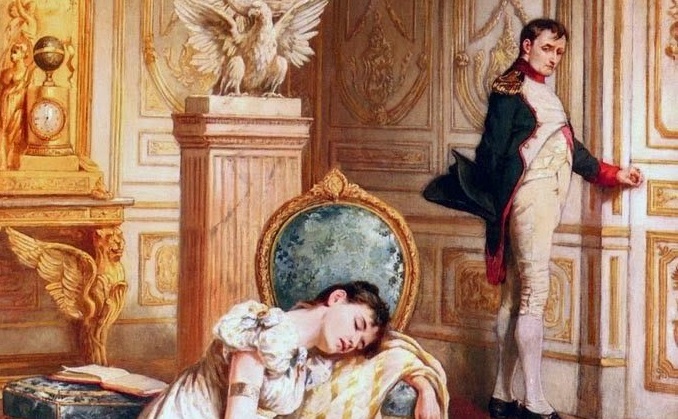
    Perhaps it’s lucky they’re not autobiographical – otherwise (according to the picture) you’d be Napoleon.

    Reply
  6. Margaret Coats says:
    5 years ago

    Last poem first! The last line there is best interpreted as referring to “she” in the previous line. This makes the unfaithful woman the “low-blow loser in the game of love”! That line would ordinarily be in apposition to what comes immediately before–but we can hardly see the glove as loser. The glove, however, is the woman’s means of taking action, and that entire next-to-last line is about nothing but her sucker-punching. The man only shows up as “me,” a barely noticeable two-letter direct object. He may have loved and lost, but he still loves, and she is losing him by walking out. I consider this a great surprise-ending line to the poem.

    The mirror poem is magnificent. I’m putting it in my collection of pattern poems. Young students love this kind of thing–but every sort of pattern poem tends to have some little hitch where the pattern doesn’t work. What you’ve done in “I Call Your Name” is take advantage of the flaw to create a tighter pattern. We notice the flaw in the first line: it should begin with a preposition. But the poem works just fine after that, and when we get to the last line, we see how skillful the set-up was. The hitch at the beginning prepared not just a flawless ending, but a pattern just short of perfect!

    The first two poems are both “betrayed love” poems, rather than ones where love is lost through death, distance, societal pressure, or something else not involving the “scythe of sin.” In “When Love Is Lost,” betrayal lurking in the background only comes out after the turn, in that third quatrain which is simply splendid at making the revelation.

    The illustration caught my attention. Josephine lost her first husband to the guillotine during the Reign of Terror, and she had given him the son she and Napoleon weren’t able to have. That stepson (one of Napoleon’s ablest relatives) had a daughter named Josephine who became Queen of Sweden. The name of Josephine remains traditional in the Swedish royal family, borne at present by more than one princess, including 3-year-old Princess Adrienne Josephine Alice. As well, the deserted Josephine was grandmother of Emperor Napoleon III, who was only a nephew to Napoleon I. In this case, the deserter Napoleon never got the descendants he wanted, but his deserted wife lives on in Europe’s current royalty and in Bonapartist would-be royalty.

    Reply
    • James A. Tweedie says:
      5 years ago

      Thank you, Margaret. As is often the case you ferret out the occasional nuances I work into my poems.

      As in, for example, the last poem where you address the final line at length. The grammar is intentional to allow the reader to apply the final line to both actors in the drama. Each is a “loser” in their own way but the one who threw the “low blow” and KO-ed her partner leaves the scene both discredited and disqualified–the bigger loser in spite of leaving the ring still on her feet.

      I’m glad you liked the mirror poem which does, indeed, have that minor flaw at the beginning so as to lead to an effective ending on the flip side. And you are also right in saying that creating such a poem is more difficult that it looks!

      For me, the concept of “lost love” embraces a number of sub-sets including love lost through death, betrayal, mutually agreed divorce, extended separation, cognitive collapse, etc. In each case there is some measure of loss, grief, and brokenness wherein “echo memories of what once was . . . ”

      Your comments elevate my poetry and for that, I am most grateful.

      Reply
  7. Yael says:
    5 years ago

    Great poems, every one of them. I particularly enjoy When Love Is Lost and the Mirror Poem. All 4 poems are thought provoking and a joy to read, thank you.

    Reply
  8. David Watt says:
    5 years ago

    James, your group of four poems are all well crafted. I particularly enjoyed your expression of the descent from warmth and light into darkness and cold in the first stanza of ‘When Love is Lost’.

    Reply
  9. David Bellemare Gosselin says:
    5 years ago

    Dear James,

    I really like these poems! These are among my favourite of the pieces you’ve written.

    “I Call Your Name” is really beautiful and really shows the power of even the simplest strophic poem, when well composed. I could definitely see this piece set to music beautifully.

    Great stuff.

    Thank you for sharing.

    Reply

Leave a Reply Cancel reply

Your email address will not be published. Required fields are marked *

  1. Brian Yapko on ‘Archaic Torso of Apollo’ by Rainer Maria Rilke, Translated by Mary Jane MyersJune 30, 2026

    Mary Jane, this is a wonderful translation of Rilke's original German. I love how you maintained the rhyme-scheme and the…

  2. Zumwalt on ‘Archaic Torso of Apollo’ by Rainer Maria Rilke, Translated by Mary Jane MyersJune 30, 2026

    Wow! Very impressive, and imaginatively creative, translation feat!

  3. James Sale on ‘Then and Now’: A Sonnet by James SaleJune 30, 2026

    Good advice Nathan - totally agree.

  4. Russel Winick on ‘Not Small At All’ and Other Short Poems by Russel WinickJune 29, 2026

    Thanks Margaret. Speaking of Langston Hughes, it’s an endless fascination to me that my (and many other people’s) two favorite…

  5. Margaret Coats on ‘The Council of Infinite Opinions’: A Poem by David LeeJune 29, 2026

    "A system built to leave no lasting trace" sounds like structuralist literary criticism. Contrary to the entertaining Council you describe,…

Subscribe to Daily Poems

Enter your email address to subscribe to this blog and receive notifications of new posts by email.

Join 1,592 other subscribers

Recent Poems

  • ‘Archaic Torso of Apollo’ by Rainer Maria Rilke, Translated by Mary Jane Myers
  • ‘The Council of Infinite Opinions’: A Poem by David Lee
  • Odyssey Audiobook Serialization Begins: First Fully Dramatized Version
  • ‘Not Small At All’ and Other Short Poems by Russel Winick
  • ‘The Roommate’: A Poem by Jeffrey Essmann
  • ‘Pouting Polly’: A Poem by Robert Nachtegall
  • Two Satirical Sonnets by Joseph S. Salemi
  • ‘Then and Now’: A Sonnet by James Sale
  • ‘The Ministry of Twee’: A Poem by Susan Jarvis Bryant
  • ‘Breath of Night’: A Poem by Paulette Calasibetta
  • A Song Inspired by Edward Rowland Sill’s ‘Among the Redwoods’, by Gunny Markefka
  • ‘Kaddish for My Father’: A Poem by Brian Yapko
  • ‘Canceled’ and Other Limericks by Joseph Mason
  • ‘The Diamond’: A Marriage Proposal Poem by Adam Sedia
  • ‘The Dancer’ and Other Rondeaux by David Murphy
  • ‘Chastity’: A Sonnet Sequence by Justin Dasher
  • Horace Odes I.11 and III.30, Translated by Mary Jane Myers
  • ‘The Bird with the Ugly Voice’: A Poem by Scharlie Meeuws
  • ‘The Dryads’: A Poem by Patricia Rogers Crozier
  • ‘Stories of Saint Anthony’: Poems by Margaret Coats
  • ‘An Englishman to World Cups Past’: A Poem by Paul A. Freeman
  • ‘Faux Pas’ and Other Poetry by C.B. Anderson
  • ‘Trip to Italy: A Poetry Travel Journal’ by James A. Tweedie
  • ‘Spring Song’: A Poem by Rohini Sunderam
  • ‘The Eagle’: A Poem by Bruce Dale Wise
  • ‘Good Night’ and Other Poetry by Kevin Ahern
  • ‘Mothiavelli’ and Other Poetry by Susan Jarvis Bryant
  • ‘Poetic Justices: The Poetry of United States Supreme Court Justices’: An Essay by Adam Sedia
  • ‘Blur’ and Other Poems by Anna J. Arredondo
  • ‘The Cottage on the Ridge’ and Other Poetry by Martin Rizley

Categories

  • Acrostic
  • Alexandroid
  • Alliterative
  • Art
  • Best Poems
  • Blank Verse
  • Chant Royal
  • Classical Poets Live
  • Clerihew
  • Covid-19
  • Deconstructing Communism
  • Educational
  • Epic
  • Epigrams and Proverbs
  • Essays
    • Interviews with Poets
    • Poetry Reviews
  • Featured
  • From the Society
  • Great Poets
    • Dante Alighieri
    • Edgar Allan Poe
    • Emily Dickinson
    • Geoffrey Chaucer
    • Henry Wadsworth Longfellow
    • Homer
    • John Keats
    • John Milton
    • Robert Frost
    • William Blake
    • William Shakespeare
    • William Wordsworth
  • Human Rights in China
  • Limerick
  • Love Poems
  • Music
  • Pantoum
  • Performing Arts
  • Poetry
    • Beauty
    • Children's Poems
    • Culture
    • Ekphrastic
    • Found Poems
    • High School Poets
    • Humor
    • Riddles
  • Poetry Challenge
  • Poetry Contests
  • Poetry Forms
    • Curtal Sonnet
    • Haiku
  • Poetry Readings
  • Rhupunt
  • Rondeau
  • Rondeau Redoublé
  • Rondel
  • Rubaiyat
  • Sapphic Verse
  • Satire
  • Science
  • Sestina
  • Shape Poems
  • Short Stories
  • Song Lyrics
  • Sonnet
  • Symposium
  • Terrorism
  • Terza Rima
  • The Environment
  • Translation
  • Triolet
  • Video
  • Villanelle

Quick Links

  • About Us
  • Submit Poetry
  • Become a Member
  • Members List
  • Support the Society
  • Advertisement Placement
  • Comments Policy
  • Terms of Use

Welcome Back!

Login to your account below

Forgotten Password?

Retrieve your password

Please enter your username or email address to reset your password.

Log In
No Result
View All Result
  • Poems
    • Beauty
    • Culture
    • Satire
    • Humor
    • Children’s
    • Art
    • Ekphrastic
    • Epic
    • Epigrams and Proverbs
    • Human Rights in China
    • Music
    • Performing Arts
    • Riddles
    • Science
    • Song Lyrics
    • The Environment
    • The Raven
    • Found Poems
    • High School Poets
    • Terrorism
    • Covid-19
  • Poetry Forms
    • Sonnet
    • Haiku
    • Limerick
    • Villanelle
    • Rondeau
    • Pantoum
    • Sestina
    • Triolet
    • Acrostic
    • Alexandroid
    • Alliterative
    • Blank Verse
    • Chant Royal
    • Clerihew
    • Rhupunt
    • Rondeau Redoublé
    • Rondel
    • Rubaiyat
    • Sapphic Verse
    • Shape Poems
    • Terza Rima
  • Great Poets
    • Geoffrey Chaucer
    • Emily Dickinson
    • Homer
    • Henry Wadsworth Longfellow
    • Dante Alighieri
    • John Keats
    • John Milton
    • Edgar Allan Poe
    • William Shakespeare
    • William Wordsworth
    • William Blake
    • Robert Frost
  • Love Poems
  • Contests
  • SCP Academy
    • Educational
    • Teaching Classical Poetry—A Guide for Educators
    • Poetry Forms
    • The SCP Journal
    • Books

© 2025 SCP. WebDesign by CODEC Prime.