


Garden Goddess
I.
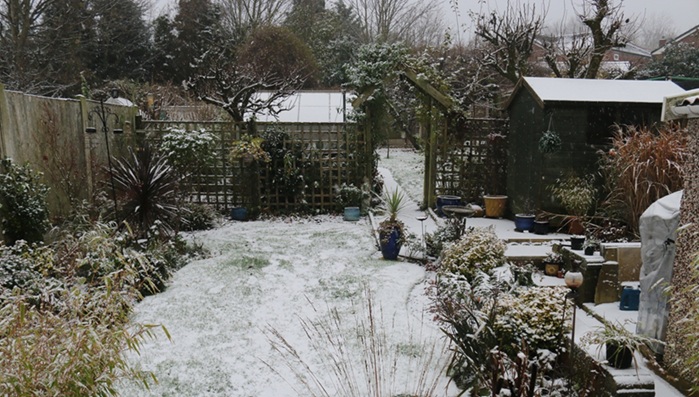
This humble plot of land is bogged in snow
And ice, with twigs and brushy sweeps of pine;
But soon, the giant marigolds will grow,
Emerge from littered leaves and broken vine;
For yonder’s where I sprinkled heads of seed
In no specific order or design;
But for the random sowing to succeed,
A fibrous band of roots must first take hold
And out-compete the straight and knotted weed;
Until, come summer, budding swells unfold,
Attracting butterflies and bees around
Expanding petal frills of sunlit gold.
I hope to see what now is fallow ground
Become a yard with marigolds be-crowned!
II.
I’ll know that it’s the time of spring’s rebirth,
When bulbs like hyacinth and daffodil
Break through the crusted cracks of warming earth,
Virescent with the green of chlorophyll;
And when the nimbus clouds release their rain,
The drainage ditch becomes a rushing rill;
When touching stamens leaves behind a stain;
And as for dandelions everywhere—
Their fragrance oh so soft—I shan’t complain.
From flow’ring trees—magnolia, apple, pear,
To bright forsythia sprays that always whelm—
It’s blossom time. There’s magic in the air!
I stroll the sward, where Nature’s at the helm
As fairy queen of this enchanted realm!
III.
I bid warm welcome to the honeybee
That sucks the bell, the cup, the star, the ray;
That laps the lipped and bearded fleur-de-lis
As warblers trill a sweet melodic lay
From boughs on high in praise of dawning light,
Then quarrel at the bath throughout the day—
To watch them ‘plash and play is quite the sight!
And while I love the lilac and the laurel,
And woodland lady slippers bring delight,
It gives me joy to cultivate a floral
Display; to see the bed and baskets teem
With blooms so full of loveliness, so aural;
Where I, as garden goddess, reign supreme.
A fantasy? Perhaps, but I can dream!
Cheryl Corey is a poet who lives in Connecticut. “Three Sisters,” her trio of poems about the sisters of Fate which were first published by the Society of Classical Poets, are featured in “Gods and Monsters,” an anthology of mythological poems (MacMillan Children’s Books, 2023).



















Cheryl, this is an enchanting poem about spring. I can sense your feelings of being the “garden goddess.”
Thank you, Roy. Year after year, I can only try.
I too imagine myself a garden goddess. Thank you Cheryl for these beautiful poems about my favorite subject and activity. Nothing brings more joy and peace than being in a garden with the birds and bees and your poetry of the day.
Norma, when I see how stores have already put out the seeds, pots, etc., I can’t help but start to plan.
You are certainly a “Garden Goddess” in an oral and aural sense if
we choose to read your poem’s future delights out loud.
Your charming poem is just what I needed to read while surrounded by filthy mounds of snow refusing to vacate.
Thanks, jd. I always read my poetry aloud during composition. If I don’t like the way it sounds, why would the reader? And yes, snowbanks are pretty until they turn into black, filthy mounds.
These are three lovely sonnets in linked tercets. They seem to follow the pattern of Winter, Spring, and Summer. And certain words put the trio in the class of high ritual: fallow, virescent, nimbus, rill, sward, trill… as if these were a
preliminary invocation of a garden goddess.
There were several ancient garden goddesses: Antheia (for flowers) in Greece, Pomona (for fruits) in Rome, along with general fertility-vegetation goddess like Demeter and Ceres.
Yes, I did have a seasonal pattern in mind from over-wintering into summer. I knew about Demeter, having once attempted a poem about Persephone, but was ignorant as to the other goddesses, so thank you for that introduction.
This is not only amazingly, nostalgically charming, Cheryl — it strikes me as well-nigh perfect. I feel as if I discovered this gem in a 19th Century lady gardener’s book. It’s just lovely.
I’m so glad that you enjoyed it, Brian.
Honestly, Cheryl, I think you’ve gotten everything right, but still I fear to walk out into my yard, lest I break my neck from slipping on the icy pavement. As bad as winter can get, there is never any doubt that fruit trees will still blossom at their appointed times, or that we will eventually sit, wearing short sleeves, in our cultivated gardens. New England is the very confluence of despair and hope.
C.B., I have no idea whether or not the marigold seed I scattered will grow. I think it was an African variety. I’m five feet tall and some of the plants grew over my head. When it came time for fall clean up, the stems were so thick and strong that they were like bamboo. I had to use a shovel to dig them up! It was crazy! I thought what the heck and sprinkled the seed around the edge of the yard.
Looks like, Cheryl, we could spend all day and all night swapping garden tales. That’s why, when I grow them at all, I grow semi-double French marigolds. In another life, maybe I’ll get to see your garden.
I do not have a green thumb, but everyone is involved in some attempt to out-compete the straight and knotted weed to try and make something beautiful emerge from what would otherwise be a chaotic jumble. You’ve definitely done that here. You’ve made even me appreciate the appeal of taming a garden. I hope you reign supreme this year.
I don’t think that a garden is every truly tamed. As much as we prune and weed, we can only do so much. Some years we’re more successful than others; but I’m fortunate to live in a place where I can have a small flower bed, hang baskets from the deck and place planters around a swimming pool area. It makes me happy to create islands of beauty around the house.
I love that you’ve combined the sonnet form with terza rima! It weaves each one, and the set of three, together into such a tight and intricate whole, moving through the seasons. Chlorophyll / daffodil is a delightful rhyme; and I’m fascinated to see — for the first time that I can recall — the word “whelm”. It’s funny how I’d never thought of it as a word by itself, without “over” attached. Absolutely beautiful poetry, Cheryl.
“Whelm” was the original verb, and the preposition “over” was later attached to it. I remember the novelist Gore Vidal in the 1960s being asked in a TV interview if her were “overwhelmed” by something reported in the news. He replied, with cool indifference, “Well, I was whelmed by it.” This was a sarcastic way of saying that he didn’t think the matter was important at all.
Good terza rima sonnets for your garden of fair forms, Cheryl. I have the form listed in my catalogue of sonnet types, but without an example, so yours stand as reference. Quite the blooms to make you garden goddess while Nature is merely queen!
I only intended this as a terza rima. It’s only by accident that each is fourteen lines, as I needed to conclude each section with a couplet; otherwise, one could carry the rhyme scheme ad infinitum; but I can see why some would arrive at the sonnet interpretation.
Very enjoyable, Cheryl. You’ve made the desert bloom!
Thanks for the read.
Cheryl, I just love these mellifluous marvels and the mention of marigolds reminds me of my grandmother who used to grow French marigolds for her English garden every year. Apparently they have bug-repelling capabilities that keep pests at bay. The beauty of the exquisite “Garden Goddess” is inspiring. I appreciate the work that has gone into this. It has certainly paid off. Thank you!