


The Cautionary Tale
of Phone Addicted Mimi
A girl called Mimi thought it best
to give her active brain a rest.
She bought the latest mobile phone,
the same as her BFF, Joan,
and all day long would browse and scroll,
which soon became her single goal.
At school she found, as time went by,
she got reliant on AI.
Her homework scores were super-good,
and yet her teachers understood
her faculties had ossified
and neurone cells had upped and died.
And then, without her mobile phone,
the same as her BFF, Joan,
she flunked her finals, one and all,
and got work in the local mall,
where you will see her serving fries
and burgers till the day she dies.
Paul A. Freeman is the author of Rumours of Ophir, a crime novel which was taught in Zimbabwean high schools and has been translated into German. In addition to having two novels, a children’s book and an 18,000-word narrative poem (Robin Hood and Friar Tuck: Zombie Killers!) commercially published, Paul is the author of hundreds of published short stories, poems and articles.
















Thank you, Paul. A delightful addition to the ‘cautionary tale’ genre – and so true! I know there’s a lot of skill and experience behind the easy and natural flow of your lines and rhymes. I like the echoing of lines 3-4 in lines 13-14. Best wishes, Bruce
Thanks, Bruce. Alas, where I work now, everyone seems to be scrolling all day long. My students, meanwhile, are AI-ing their homework unless I make them write in class and monitor them like a hawk.
Hilarire Belloc would be proud of you:)
warmest regards,
Karen
Thanks, Karen. If only spotlighting the problem could solve it.
Every aspect of this poem is spot on. Thanks for a great read, Paul.
Cheers, Russel.
Perfect light verse. Delivers narrative and charm! Now I want to read “Robin Hood and Friar Tuck: Zombie Killers!” Best wishes on all your writing!
Thanks, Zumwalt. Ah, the halcyon days of Robin Hood and Friar Tuck, Zombie Killers. Six weeks on a sofa, 500 words of narrative poetry a day.
Glad you liked my cautionary tale. Unfortunately, I feel like one of the few King Canutes trying to roll back the tide.
A very timely cautionary tale, Paul. Too often technology is used to teach us not to think for ourselves or even possess a memory of our own.
I can’t help but wonder sometimes, Morrison, as I use a dictionary or a thesaurus, whether we are the first victims / utilisers of shortcuts. Mind you, at least I’ve never used a rhyming dictionary!
Thanks for reading and commenting.
An excellent little cautionary tale, and as Karen says, it is just the sort of thing Belloc would have composed if he were alive today. I assume “BFF” stands for “Best Female Friend,” though I am just guessing.
It started with the small electronic calculators in the 1970s. They could do practically any mathematical computation you desired, in a split-second. But pretty soon the consequence was that no students learned their multiplication tables, or even simple addition, subtraction, and division. Today, it’s reached the point where there are many students in their twenties who CANNOT READ A SIMPLE ANALOG CLOCK, but only a computerized digital clock.
As for submitted written assignments, they are almost all done by AI now, and it is impossible at this point to determine if a paper has been produced that way. I have to laugh, because some nitpicking professors were once so obsessed with the possibility of plagiarism that they used a computerized search-program called “Turn It In” to find out if any student paper had been copied from somewhere else. Now that entire procedure is a joke — because an AI-generated paper is, for all practical purposes, a unique composition that is not traceable to any other source. It might as well be an original thing composed by your room-mate.
There were a few “Star Trek” episodes that were prophetic on this subject. Captain Kirk and his crew visited some planets where technology had become so advanced and self-sustaining that the planet’s inhabitants had mentally degenerated to being as stupid as rocks.
BFF is Best Friend Forever, Joseph, so yes an equally moronic initialism for the era.
I’ve seen workers in little grocery stores adding numbers like ten plus twelve on calculators, mental maths is so poor these days. However, on the subject of learning to tell the time, in Zimbabwe in the 1990s, a student was late, so I showed him my analogue watch, asked him what time it was and he said, “I don’t know. I only read digital time.” And it was true,. No one seemed to have an analogue watch.
Yesterday I wrote an article / comprehension passage about London bridges, using my own knowledge and checking information on Google. This is becoming a lost art. Teachers these days put a prompt to ChatGPT, get a sterile piece of writing and use that with their students.
Unfortunately, I’m feeling more and more like King Canute.
You took the disgust right out of my thoughts, Paul. My wife and I too often irritate ourselves by counting the number of people, young and old, so focused on their F’n phones their meals grow cold before they realize they’re there. This is a real treat for me and Connie… cool piece.
I know the feeling, Mark. Here, about 70% or more of drivers (yes, drivers!) are operating their vehicle with a mobile phone in the other hand. It’s against the law, but as the saying goes, ‘Everyone’s doing it’ – so it’s alright, then.
Glad you liked the piece. It’s a topic close to my heart.
Dead on, Paul. I am glad I no longer teach.
Ah, it’s not that bad. I’ve got a new group. Just seeing them transform from careless proponents of the ‘whatever’ culture into serious students who want to create a masterpiece rather than something slapdash, gives me a great feeling.
Paul, your poem is so enjoyable to read, despite the depressing subject matter. I predict there will be a lot of painful neck and shoulder problems in the future. Hopefully I’m wrong.
Yes, it is depressing, Norma. We’ve become a planet of shortcut takers, at the expense of cranial development!
You have an eye for cultural trends, Paul, and this is a deplorable one, all right, deserving ridicule. You make good fun of it, yet it is most regrettable how the young, in particular, are captivated by electronic banality. It doesn’t bode well for their future in employment or simply in culture. Why read when the jabbering little gadget will do everything for them? Everything, that is, except learn, which requires attention to the actual, not virtual, world. Meanwhile you are paying attention, and with good humor. Thanks for pointing out this modern absurdity.
Thanks for reading and commenting, Bhikkhu Nyanasobhano. Gradually countries are coming round to the dangers to young people of these technologies – lets hope money doesn’t get in the way of morality.
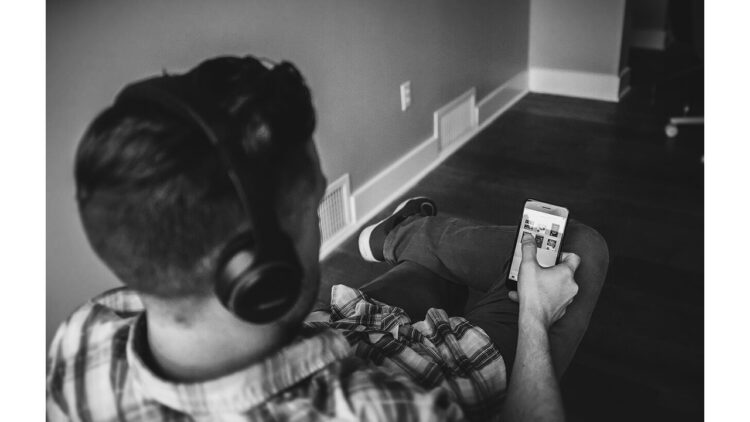
Paul, you’ve made a clever repetition that deepens the level of your message. The first time you say “the same as her BFF, Joan,” it means Mimi bought the same kind of phone as Joan. When you repeat the line, it could mean that Joan also flunked her finals for lack of help from the phone. But equally likely is that Mimi’s phone has taken Joan’s place as her Best Friend Forever. Not only does the phone absorb all the mental faculties of many users, but makes human friendship unnecessary and ultimately unmissed. If Mimi and Joan still get together, their interaction is probably to direct one another’s attention to the phone. But Evan chose the illustration for this poem well: a person alone with headphones.
The headphones really annoy me when people wear them outside the house. Joggers not listening for traffic, kids out with parents and not interacting.
Yes, and these phones do become our BFFs. I have students I virtually have to pry their phones out of their hands, they’re so addicted.
The good thing is that I can still joke about it while I’m still holding the line.
This was waiting to be said, Paul, so thank you for saying it. It should be posted above the entrance to every school everywhere. And students who use AI should be made to copy it out 100 times using pen and paper, or until their fingers ache, whichever happens sooner.
We have an AI workshop, tomorrow with some NATO (sorry about the four-letter word) colleagues, on AI. The main speaker got annoyed at me posting a limerick in the chat at a previous workshop that was lambasting AI, so maybe I’ll email him this one.
See, it’s not only here I sometimes rile up a hornet’s nest.
Send the main speaker the stuff, Paul. It’s always good to let the defenders of idiocy know that there are some of us who see through their bullshit.
I’ve sent it to all the presenters.
Meanwhile, this one I may have put in the limerick thread.
ChatGPT Limerick
When homework’s assigned to me,
I just go to ChatGPT.
My GPA score,
is sitting at 4,
but my brain’s now the size of a pea.
(You can share both poems far and wide)
A cautionary tale indeed, and a very readable one. If Ogden Nash had lived to see mobile phones and AI, he might have penned this piece.