


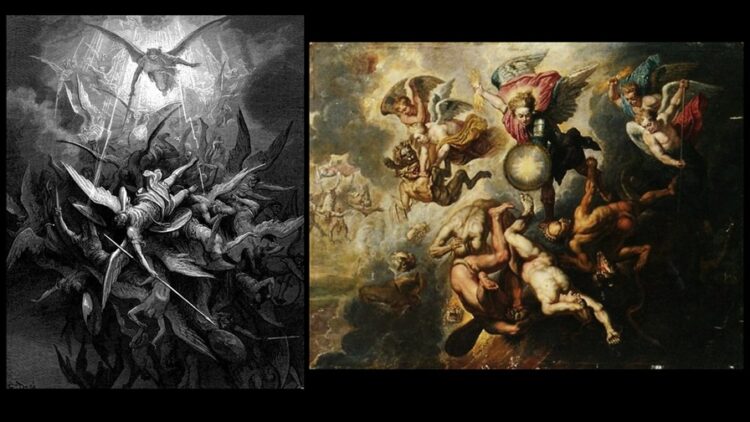
The War in Heaven
—for the IDF
But stranger still and most sublime of all
A second vision sweeps across the skies.
The ancient war in Heaven before the Fall
Is now arrayed for modern London eyes.
Primeval paladins with arms adorned
Appear across the firmament in flight;
Dark citadels of wickedness are stormed
By hosts of glittering champions of light.
Then suddenly a mass of fiends emerge:
They surge from hidden holes like teeming rodents!
As packs of wolves on helpless prey converge,
They target weak and vulnerable opponents.
Now crested warrior chariots appear
With steeds of burnished gold and jewelled bridles:
All thundering hooves and finely chiseled gear
Ascending heavenwards in gleaming spirals.
Colossal forces lock in cosmic struggle
As angels battle angels, good with bad.
Gigantic stars are mined and turned to rubble
By hordes of hidden trolls diseased and mad.
Demonic warlike engines thus created
Hurl jagged thunderbolts of scorching fire,
Whilst seraphim with courage unabated
Press back against both heat and fiendish ire.
Like mighty clouds they buffet on the wing,
And myriads with myriads contend;
Across the skies the sounds of warfare ring:
A scale beyond what Man can comprehend.
Titanic flashes as before are witnessed,
But these are now of light-devouring black:
Tartarean ordnance of the very grimmest
And terrifying weapons of attack!
And subterranean tunnels, too, are seen:
A network like the branches of a tree;
A rabbit warren, hellish and unclean,
Where naked demons wait with hateful glee.
For darkness is their natural element;
Away from light they ply their filthy trade.
Their sacrament as foul as excrement,
They practise it unseen in deepest shade.
Dishonour twists and writhes in every breast
And cruelty worse than Man has ever seen,
While all to vice and viciousness attest
And wickedness unnatural and obscene.
Depravity unknown attends these demons;
No act too base nor wickedness too vile,
But these recruits of Satan’s squalid legions
Won’t greedily indulge themselves and smile.
Yet Goodness always fights by this advantaged:
Though Evil may outwit its guileless foe,
As if by buried conscience still commanded,
It loathes itself for causing only woe.
For though rejoicing in this pain and anguish
Such barrenness is like the desert sands:
Devoid of hope where every joy must languish
And nothing for a moment ever stands.
And never did adversaries so differ.
While Satan’s legions lust to kill and maim,
Their foes to God alone their souls deliver
With Purity of Arms their sacred aim.
No thought of self disturbs these warriors’ courage,
But only comrades’ safety their concern.
And all each other in their fight encourage,
Thus honour in each other’s sight they earn.
And so they battle at the Gate of Heaven,
The rebel angels trying to seize it all.
They war for absolute and sole possession
Nigh fourteen billion years before the Fall….
Poet’s Note: In Jerusalem, the Gate of Heaven refers to Temple Mount, regarded as the point of connection between heaven and earth.
Paul Martin Freeman is an art dealer in London. His book of whimsical verse, A Chocolate Box Menagerie, is published by New English Review Press. This poem forms part of The Number 292: Apotheosis, from the author’s unpublished work, The Bus Poems: A Tale of the Devil.
















Terrific image, Evan. Thank you.
Inspired to have the two together with all that black!
In the spirit of Milton. Very well done, Paul.
Thank you, Paul. But Milton wrote in blank verse. Here, courtesy of Evan, we
aspire
higher!
Battles scenes on “a scale beyond what Man can comprehend,” Paul Martin, but well imagined, nonetheless. I like those quoted words as a reminder about our own comprehension. You present an excellent application of the conflict, which we can take to earthly battles, when outlining the grand advantage of Good over Evil, saying that regardless of its terrifying power and temporary victories, Evil “loathes itself.” “Wickedness unnatural and obscene” provides no weapon ultimately worth using. Also intriguing to find subterranean tunnels as part of the War in Heaven, until you explain that darkness is the natural element of the demons. I much appreciate your dedication of this descriptive apocalyptic work to the IDF, but on lighter tone, I will plan to avoid Bus 292 whenever in London again!
Thank you, Margaret. This section of a longer poem was adapted after October 7. Hence the tunnels. “a mass of fiends” is of course Hamas. “hordes of hidden trolls diseased and mad” you’ll probably also have recognised. Likewise “Purity of Arms”.
The adaptation, especially if it included “Tartarean ordnance,” added appropriate descriptive and symbolic details, as well as further characterizing the diabolical foes.
Yes, as I write in the poem, I doubt there has ever been a conflict in which the two sides were more opposed in their moral outlook, or provided a better example of the difference between good and evil which so few appear willing to understand.
This is an amazing description of the war of all wars (in the spirit of Milton, as Paul said above), being recalled in the wars the IDF has and is fighting. (I hope I’ve interpreted your intentions correctly.) I love the emphatic phrases like “angels battle angels” and “myriads with myriads contend.” Flashes of “light-devouring black”, and “Their sacrament as foul as excrement” (wow!) are such a great descriptive phrases, also. If the IDF has occasion to see this poem, I can only imagine they would be grateful.
That’s a very appreciative comment, Cynthia, and very much appreciated.
The poem was developed out of a section in the main story of my book, which concerns the visit to London by the Devil, located at the point following his defeat in philosophical debate by my main character, Nora. Following October 7, I wanted to capture something of the gulf dividing good and evil which so many seemed to want to ignore and which I view as a manifestation of evil.
‘Milton’ pops up occasionally in the work, not always in a flattering way!
Paul, this is a powerful portrayal of the fight between good and evil on both a mortal and celestial level. There are so many inspired phrases in your poem that I hesitate to quote any of them here in my comments. I admire your linguistic skills and this wonderful poem that to me far outdistances Milton.
Thank you, Roy. But such is too exalted praise even for my inflated strutting ego! However, that my words should have put such a thought in the mind of one who is himself both poet and military man is enough to have me beaming like an idiot at my computer screen!
So thank you again, my friend.