


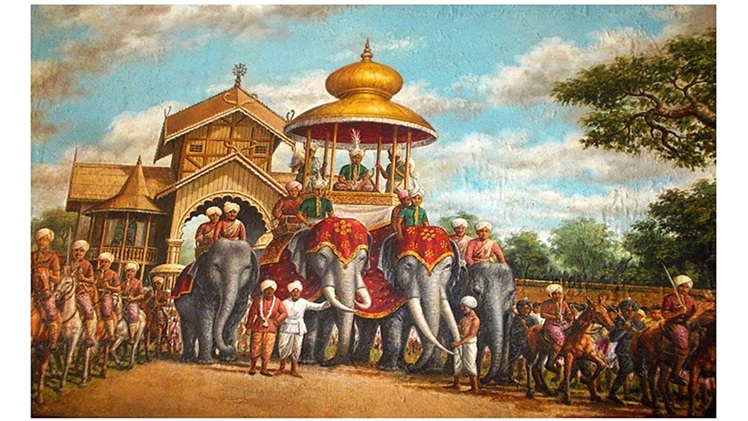
Old Bengal
A Mystic Play
—for Shivani Muvva
Shivani longs for old Bengal,
_For palaces and kings,
For servants at her beck and call
_And all expensive things.
Her father is the powerful raj;
_Her mother is his queen,
Surrounded by an entourage
_No finer ever seen.
And sometimes they will leave their world,
_Parading into town:
The king in opulence unfurled,
_His love her richest gown.
They choose a bright auspicious day,
_No smallest thing neglect,
To stage an ancient mystic play
_In choicest garlands decked.
They ride on massive elephants
_High up above the ground:
A vision of power and elegance
_In howdahs jewelled and crowned.
With tusks of gold-tipped ivory,
_Resplendent in the sun,
Attired in patterned finery
_The creatures move as one.
Mahouts astride each noble beast
_Direct them as they go,
Whilst eyes from far upon them feast,
_Held captive by the show.
Then suddenly the giants bellow!
_They trumpet their approach!
The courtiers scatter saffron yellow,
_Their skill beyond reproach.
The king and queen are recognised––
_They calmly wave to all;
And senses all are vitalised
_At every port of call.
It seems as though the gods have come
_To share these mortals’ day;
And all in wonderment succumb
_With all around asway.
The beasts are like a mighty sea
_Of ships before the wind;
No finer sight might e’er one see
_As far as distant Sindh.
Excitement now is everywhere:
_It grips the town’s bazaar!
The startled traders stop and stare,
_Oblivious where they are.
The children gape, transfixed with joy,
_And marvel at the sight;
And none among them, girl or boy,
_Will sleep a wink tonight.
For all revere this noble lord
_Whose rule is firm but just:
No fear evokes his flashing sword
_In those who earn their crust.
And wise he is as well as kind
_To those whose lives he rules;
To all but human worth he’s blind:
_All else the food of fools.
No worldly thing divides them now,
_All gazing up as one.
Now shines a light on every brow:
_With this his work is done.
And there they gather, young and old,
_And wordlessly attend;
Their petty squabbles put on hold:
_Together, foe and friend.
For just a moment all forget
_Their lives of grinding care,
Their daily hardships, toil and sweat,
_And in the beauty share.
For now the goddesses of joy
_Hold sway within each heart
Where all their powers divine deploy,
_Thus conjured by his art.
And so she longs for old Bengal:
_A world of class and caste;
A world where all belonged withal,
_A world that long has passed.
Poet’s Note: An earlier version of Old Bengal was published by New English Review. I am indebted to Professor Salemi for suggesting “Mahouts” and “Sindh.” Bengal and Sindh are on opposite sides of the Indian subcontinent.
Paul Martin Freeman is an art dealer in London. The poem is one of the portraits of baristas at the Design Museum from his unpublished work, The Bus Poems: A Tale of the Devil. His book of whimsical verse, A Chocolate Box Menagerie, is published by New English Review Press.
















Paul, this is a magnificent poem of grandeur and finery that makes me wish I were in attendance for such a display. The wording–how perfect, the meter–like a song, and the setting how splendid.
Thank you, Roy. I always appreciate your comments.
This is one of the poems I wrote for the girls who make the coffee in the Design Museum Cafe where I go. When I told her I had written a poem about her, Shivani said she was so excited she wouldn’t sleep that night, which is exactly what happens to the children in the story! So I must have got something right!
This is in absolutely perfect ballad meter, and the rhymes are fresh: “raj / entourage,” “elephants / elegance,” “ivory / finery,” “bazaar / are,” “caste / past”.
It reminds me of what I have read about the old “Imperial Durbar” gatherings that were held during the British Raj (the last, I believe, was in 1911).
Thank you, Joe. Most kind. I couldn’t have done it without you.
A Kipling-esque feast of a poem, Paul, with some fine touches and obviously well researched. ‘His love her richest gown’ was one of those touches and the unusual image of elephants as a fleet of ships, also comes to mind.
The final stanza had an Ozimandais feel tinged with melancholy to it.
Good stuff!
Thanks for the read.
Thank you, Paul. I’m afraid you will think me a fraud. The little research I do comes on the back of where the words and ideas take the poem. But I think we all have a store of images and memories we can draw on to tell the story we want.
I had written a poem for another girl in which the first line ended “dreams of India”. So this one, intended to be its pair, had to be “longs for old Bengal”. The rest of the poem came out of that with me dipping into Wikipedia whenever the necessity arose.
When it was published on New English Review, Professor Salemi suggested “Mahouts” rather than “handler” as adding local colour. This led to “ships before the wind” – a nice old nautical expression – and Sindh.
I’m glad it convinced you though!