• Submit Poetry
  • Support SCP
  • About Us
  • Members
  • Join
Tuesday, May 12, 2026
Society of Classical Poets
  • Poems
    • Beauty
    • Culture
    • Satire
    • Humor
    • Children’s
    • Art
    • Ekphrastic
    • Epic
    • Epigrams and Proverbs
    • Human Rights in China
    • Music
    • Performing Arts
    • Riddles
    • Science
    • Song Lyrics
    • The Environment
    • The Raven
    • Found Poems
    • High School Poets
    • Terrorism
    • Covid-19
  • Poetry Forms
    • Sonnet
    • Haiku
    • Limerick
    • Villanelle
    • Rondeau
    • Pantoum
    • Sestina
    • Triolet
    • Acrostic
    • Alexandroid
    • Alliterative
    • Blank Verse
    • Chant Royal
    • Clerihew
    • Rhupunt
    • Rondeau Redoublé
    • Rondel
    • Rubaiyat
    • Sapphic Verse
    • Shape Poems
    • Terza Rima
  • Great Poets
    • Geoffrey Chaucer
    • Emily Dickinson
    • Homer
    • Henry Wadsworth Longfellow
    • Dante Alighieri
    • John Keats
    • John Milton
    • Edgar Allan Poe
    • William Shakespeare
    • William Wordsworth
    • William Blake
    • Robert Frost
  • Love Poems
  • Contests
  • SCP Academy
    • Educational
    • Teaching Classical Poetry—A Guide for Educators
    • Poetry Forms
    • The SCP Journal
    • Books
No Result
View All Result
Society of Classical Poets
  • Poems
    • Beauty
    • Culture
    • Satire
    • Humor
    • Children’s
    • Art
    • Ekphrastic
    • Epic
    • Epigrams and Proverbs
    • Human Rights in China
    • Music
    • Performing Arts
    • Riddles
    • Science
    • Song Lyrics
    • The Environment
    • The Raven
    • Found Poems
    • High School Poets
    • Terrorism
    • Covid-19
  • Poetry Forms
    • Sonnet
    • Haiku
    • Limerick
    • Villanelle
    • Rondeau
    • Pantoum
    • Sestina
    • Triolet
    • Acrostic
    • Alexandroid
    • Alliterative
    • Blank Verse
    • Chant Royal
    • Clerihew
    • Rhupunt
    • Rondeau Redoublé
    • Rondel
    • Rubaiyat
    • Sapphic Verse
    • Shape Poems
    • Terza Rima
  • Great Poets
    • Geoffrey Chaucer
    • Emily Dickinson
    • Homer
    • Henry Wadsworth Longfellow
    • Dante Alighieri
    • John Keats
    • John Milton
    • Edgar Allan Poe
    • William Shakespeare
    • William Wordsworth
    • William Blake
    • Robert Frost
  • Love Poems
  • Contests
  • SCP Academy
    • Educational
    • Teaching Classical Poetry—A Guide for Educators
    • Poetry Forms
    • The SCP Journal
    • Books
No Result
View All Result
Society of Classical Poets
No Result
View All Result
Home Poetry

‘Remains’: A Deep Sea Poem by Martin Briggs

March 25, 2026
in Poetry
A A
13
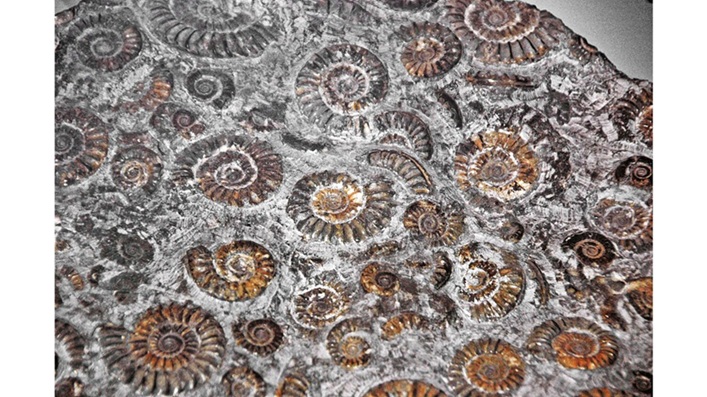
fossil ammonites from the Jurassic of Britain (public domain)

fossil ammonites from the Jurassic of Britain (public domain)


Remains

No-one saw them tumble empty down the fathoms,
somersaulting gently on their way, at random
caught and wafted by some subaquatic breeze.
Answering the tenderest of gravities,

in untold multitudes they lightly fell and fell,
each an untwinned bivalve, exoskeletal
remains in drifts and shoals, from sunlit upper zones
plumbing lonelier, colder deeps of monochrome;

they swelled the debris of their disappearing breed,
myriad millions layered thickly, freed from tide
to mass on sunken banks and plains of sediment,
shell-armour buried in a muddy cerement;

and there in pressure’s lifeless reaches they remained.
Until today. For after ages preordained
at last I came, and idly prising strata open,
found imprinted exiles from a vanished ocean:

grey spiralings, photographic negatives
of enigmatic beauty, destined to outlive
the suffocating shale, each embossed depiction
both a perfect secret and its own decryption.

Oblivious, in accretions of geology
no-one guessed them hidden: I am first to see
a work of aeons; first to feel the fascination
of holding in my hand a fragment of Creation.


Martin Briggs lives in Suffolk, England. He only began writing in earnest after retiring from a career in public administration, since when he has been published in various publications on both sides of the Atlantic.
Tags: Martin BriggsThe Sea
ShareTweetPin
The Society of Classical Poets does not endorse any views expressed in individual poems or commentary.
Read Our Comments Policy Here

RandomPoems

‘The FBI—Then and Now’ and Other Poems by Russel Winick
Culture

‘The FBI—Then and Now’ and Other Poems by Russel Winick

February 3, 2025

. The FBI---Then and Now So respected when I was a kid, For the things we all read that they...

‘My Wish Fulfilled by Practicing Medicine’ by Dr Rong Shu
Culture

‘My Wish Fulfilled by Practicing Medicine’ by Dr Rong Shu

December 3, 2013

  I look upon how much people suffer Wishing Bian Que and Hua Tuo* were now here Predestiny links us...

Next Post
A Reading of the First Chapter of Michael Pietrack’s New Verse Novel ‘Boone’

A Reading of the First Chapter of Michael Pietrack's New Verse Novel 'Boone'

‘Upon Meeting a Crane’: A Poem by Jenna Tedesco

'Upon Meeting a Crane': A Poem by Jenna Tedesco

‘Replication and Cessation’: A Poem by Kevin Farnham

'Replication and Cessation': A Poem by Kevin Farnham

Comments 13

  1. Roy Eugene Peterson says:
    2 months ago

    Martin, I am virtually certain there is a story behind this detailed poem of a lost world beneath the ocean. If my surmise is correct, I for one would love to read it.

    Reply
    • Martin Briggs says:
      2 months ago

      Yes Roy. Once, walking on the coast of Yorkshire, I discovered an opening at the base of a crumbling cliff. Entering, I found myself in a cavity hollowed out of muddy shale, in which were embedded many millions of uniform fossils. I exhumed some (further weakening the unstable structure) and, controversially, survived.

      Reply
  2. Joseph S. Salemi says:
    2 months ago

    The complex elegance of this poem’s diction is enchanting. There is a treasure of wonderful scientific words, used in the most expert manner, to describe this vision of fossilized ammonites.

    The ammonites went extinct 66 million years ago, after the huge meteoric impact in Central America that wiped out the large dinosaurs and many other species, both plant and animal. This cataclysmic event make possible the spread of mammalian life on earth.

    I normally dislike near-rhymes, but i don’t object to them here because in a very sophisticated poem such as this, rhyme plays second fiddle to the sheer exuberance of hypnotic language. One minor thing: I would get rid of the capital “C” on the word “Creation” in the last line. It adds an unnecessary touch of pietism.

    Reply
    • Martin Briggs says:
      2 months ago

      Thank you, Joseph. I am well on the way to fossilisation myself, and appreciate your positive reaction.

      Reply
  3. jd says:
    2 months ago

    Beautiful poem for all the reasons so well articulated by Dr. Salemi but I love the “touch of pietism”.

    Reply
    • Martin Briggs says:
      2 months ago

      Thank you, jd. The capital C was indeed a deliberate choice; but, majuscule or minuscule, the difference is only subjective.

      Reply
  4. Paul Freeman says:
    2 months ago

    Your focus on meter rather than rhyme allows for rich use of multisyllabic scientific words, and imagery not often seen in such profusion in a poem, Martin.

    You’ve captured well the idea of mass extinction and legacy, a very pertinent topic as Man accelerates the latest mass extinction.

    So glad you avoided your own demise to bring us this wonderful piece.

    Reply
    • Martin Briggs says:
      2 months ago

      Thank you, Paul, for reading and commenting. I feel particularly extinct this morning…..

      Reply
  5. Susan Jarvis Bryant says:
    2 months ago

    Martin, thank you for this exquisite piece with its beautifully chosen words, woven together perfectly. I admire your wordsmithery and I am particularly moved by the tender and very human heart of the poem revealed in the closing stanza. Glorious!

    Reply
    • Martin Briggs says:
      1 month ago

      Thank you, Susan. Your approval means a lot.

      Reply
  6. Margaret Coats says:
    1 month ago

    An exceptionally beautiful description and appreciation of Creation, Martin. The scientific vocabulary and the attention to graceful detail reveal a mind contemplating the wonders of number and order and shape and time in one small portion of the universe–a portion seemingly saved for him individually by a beneficent Providence. Overall, it expresses the happy qualities of thought inspired by Intelligent Design. There is one word “aeons” that might have a special meaning. If it means simply long ages of time, then the poem is a shining tribute to Progressive Creation. But if it has the spiritual meaning of aspects and singular forces within Creation, the ideas here are still more profound–and emotional, because the aeons may represent an indistinct longing for recognition achieved in the discovery you describe. It may be you will not say which meaning of “aeons” is intended. But please accept from me an intense appreciation for the double possibility.

    Reply
    • Martin Briggs says:
      1 month ago

      Thank you, Margaret, for your appreciative and interesting response. Interesting because the second meaning of aeon is one that had not occurred to me: I intended simply the temporal, geological sense, and can claim no credit for the deeper significance you read into it. But I’m pleased that it set off this train of thought.

      Reply
      • Margaret Coats says:
        1 month ago

        Glad you’re pleased, Martin. This is yet another example of how we write more than we know when we employ the great treasures of our language and culture, containing so much that may not be uppermost to our thinking at the time.

        Reply

Leave a Reply Cancel reply

Your email address will not be published. Required fields are marked *

  1. Susan Jarvis Bryant on ‘Spontaneous Conjugal Combustion’ and Other Poems by Susan Jarvis BryantMay 12, 2026

    Awww, what a beautiful comment, Mark. It's lovely to hear of the joys of marital bliss after 53 years. Congratulations!…

  2. Susan Jarvis Bryant on ‘Spontaneous Conjugal Combustion’ and Other Poems by Susan Jarvis BryantMay 12, 2026

    C.B., it's always interesting to read your take on my poems, and I've got to say I agree with you…

  3. Roy Eugene Peterson on A Poem on Coach “Black Mike” Castronis from Athens Y Camp, by Alec ReamMay 12, 2026

    Alec, this is a touching tribute to a camp coach/counselor. I had my own at Camp Paisano near Alpine, Texas.…

  4. Roy Eugene Peterson on ‘Creation of Mom’: A Mother’s Day Poem by Roy E. PetersonMay 12, 2026

    Margaret, I was thinking about the vast variety of Moms when I wrote it. Thank you for pointing that out…

  5. Alec Ream on A Poem on Coach “Black Mike” Castronis from Athens Y Camp, by Alec ReamMay 12, 2026

    Margaret, thank you for the read and remarks. First Presbyterian is still there. As is Emmanuel Episcopal, which started at…

Subscribe to Daily Poems

Enter your email address to subscribe to this blog and receive notifications of new posts by email.

Join 1,593 other subscribers

Recent Poems

  • A Poem on Coach “Black Mike” Castronis from Athens Y Camp, by Alec Ream
  • A Poem on the Zambian National Park Mosi-oa-Tunya, by Paul A. Freeman
  • ‘Creation of Mom’: A Mother’s Day Poem by Roy E. Peterson
  • ‘Spontaneous Conjugal Combustion’ and Other Poems by Susan Jarvis Bryant
  • ‘The Man in the Moon Was a Very Round Man’: A Poem by Lauren V. Leon
  • ‘Fibromytrauma’: A Poem by Golan Shahar
  • ‘A Lonely Sliver’: A Poem by Katie Tencza
  • ‘Higher Gas Prices Are a Small Price to Pay’: An Iran War Poem by Mark F. Stone
  • ‘Always Ahead’: A Poem by Scharlie Meeuws
  • ‘Hamlet’s Lawyer’ and Other Poetry by Brian Yapko
  • ‘On An Old Photograph’: A Poem by Joseph S. Salemi
  • ‘Faust Foresees His End’: A Poem by Martin Briggs
  • ‘À la Carte’ and Other Poetry by C.B. Anderson
  • ‘Where the Sweet Bluebonnets Bloom’: A Poem by Roy E. Peterson
  • ‘The Waters’: A Poem by Margaret Brinton
  • ‘The Pinnacle of Poetry’ and Other Poems by Russel Winick
  • The First American Sonnets: An Essay on David Humphreys, by Margaret Coats
  • ‘The Holy Rollers on Poetry’: A Poem by Joseph S. Salemi
  • Sappho’s ‘Poem 1’ Translated by Bruce Phenix
  • ‘The Cautionary Tale of Phone Addicted Mimi’: A Poem by Paul A. Freeman
  • ‘Look Away’: A Poem for America’s 250th Anniversary, by Roger Crane
  • ‘Sunday Morning in Canada’: A Poem by Jeffrey Essmann
  • ‘Bean’: A Poem by Jan Mennite
  • ‘The Swan’s Song ’: A Poem for Shakespeare’s Birthday, by Susan Jarvis Bryant
  • ‘The Gravedigger’: A Poem by Marie Burdett
  • ‘Waiting for the Perfect Man’: A Poem by Janice Canerdy
  • ‘The George-A-Saurus’ and Other Poetry by Brian Yapko
  • ‘When Asked: What’s Your Favorite Season?’: A Poem by Paul Millan  
  • ‘The Last At-Bat of Lyndon Braun’: A Poem by Michael Pietrack
  • ‘The Perpetual Battle’ and Other Poetry by Adam Sedia

Categories

  • Acrostic
  • Alexandroid
  • Alliterative
  • Art
  • Best Poems
  • Blank Verse
  • Chant Royal
  • Classical Poets Live
  • Clerihew
  • Covid-19
  • Deconstructing Communism
  • Educational
  • Epic
  • Epigrams and Proverbs
  • Essays
    • Interviews with Poets
    • Poetry Reviews
  • Featured
  • From the Society
  • Great Poets
    • Dante Alighieri
    • Edgar Allan Poe
    • Emily Dickinson
    • Geoffrey Chaucer
    • Henry Wadsworth Longfellow
    • Homer
    • John Keats
    • John Milton
    • Robert Frost
    • William Blake
    • William Shakespeare
    • William Wordsworth
  • Human Rights in China
  • Limerick
  • Love Poems
  • Music
  • Pantoum
  • Performing Arts
  • Poetry
    • Beauty
    • Children's Poems
    • Culture
    • Ekphrastic
    • Found Poems
    • High School Poets
    • Humor
    • Riddles
  • Poetry Challenge
  • Poetry Contests
  • Poetry Forms
    • Curtal Sonnet
    • Haiku
  • Poetry Readings
  • Rhupunt
  • Rondeau
  • Rondeau Redoublé
  • Rondel
  • Rubaiyat
  • Sapphic Verse
  • Satire
  • Science
  • Sestina
  • Shape Poems
  • Short Stories
  • Song Lyrics
  • Sonnet
  • Symposium
  • Terrorism
  • Terza Rima
  • The Environment
  • Translation
  • Triolet
  • Video
  • Villanelle

Quick Links

  • About Us
  • Submit Poetry
  • Become a Member
  • Members List
  • Support the Society
  • Advertisement Placement
  • Comments Policy
  • Terms of Use

Welcome Back!

Login to your account below

Forgotten Password?

Retrieve your password

Please enter your username or email address to reset your password.

Log In
No Result
View All Result
  • Poems
    • Beauty
    • Culture
    • Satire
    • Humor
    • Children’s
    • Art
    • Ekphrastic
    • Epic
    • Epigrams and Proverbs
    • Human Rights in China
    • Music
    • Performing Arts
    • Riddles
    • Science
    • Song Lyrics
    • The Environment
    • The Raven
    • Found Poems
    • High School Poets
    • Terrorism
    • Covid-19
  • Poetry Forms
    • Sonnet
    • Haiku
    • Limerick
    • Villanelle
    • Rondeau
    • Pantoum
    • Sestina
    • Triolet
    • Acrostic
    • Alexandroid
    • Alliterative
    • Blank Verse
    • Chant Royal
    • Clerihew
    • Rhupunt
    • Rondeau Redoublé
    • Rondel
    • Rubaiyat
    • Sapphic Verse
    • Shape Poems
    • Terza Rima
  • Great Poets
    • Geoffrey Chaucer
    • Emily Dickinson
    • Homer
    • Henry Wadsworth Longfellow
    • Dante Alighieri
    • John Keats
    • John Milton
    • Edgar Allan Poe
    • William Shakespeare
    • William Wordsworth
    • William Blake
    • Robert Frost
  • Love Poems
  • Contests
  • SCP Academy
    • Educational
    • Teaching Classical Poetry—A Guide for Educators
    • Poetry Forms
    • The SCP Journal
    • Books

© 2025 SCP. WebDesign by CODEC Prime.