


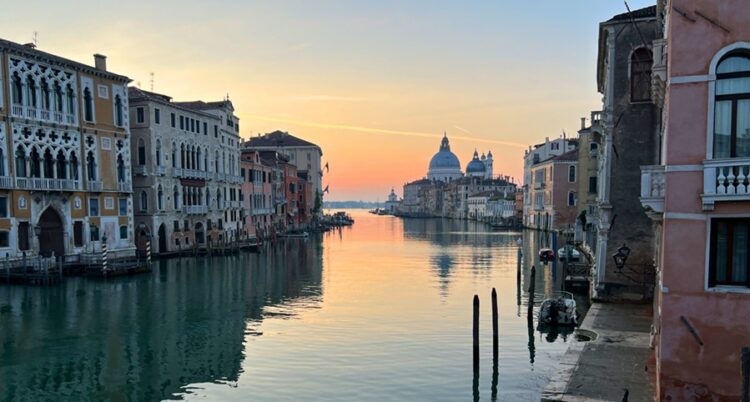
Trip to Italy
A Poetry Travel Journal
by James A. Tweedie
The trip begins on April 8 with a two-week trans-Atlantic cruise
from Miami, Florida to Civitavecchia, Italy, with stops in
the British Virgin Islands (Tortula), the Canary Islands (Tenerife),
Barcelona, Spain, and Cannes, France.
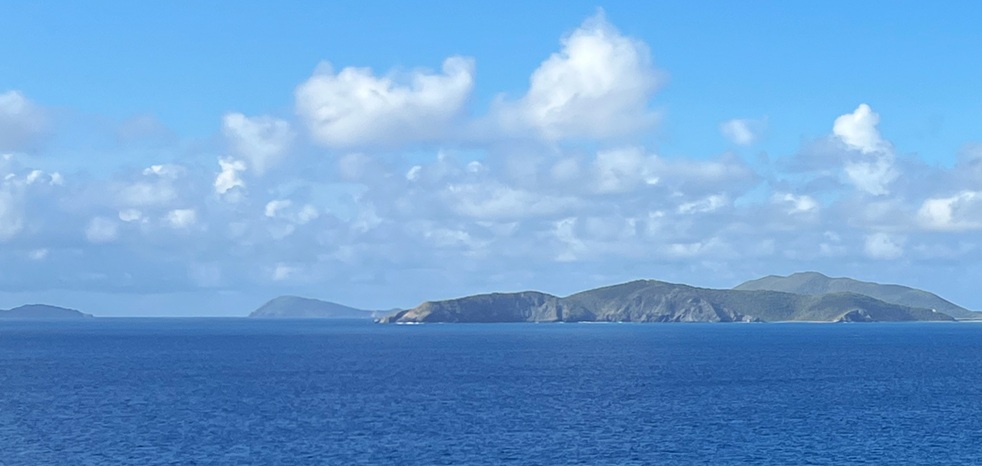
View from the Center of a Flat Circle
Horizon lines at sea are level-headed.
At least that’s what they always seem to me.
They’re straight and true with no part being dead-ended.
A compassed circlet of eternity.
Except when I see something that’s intruding;
Quite often with a line of clouds attached.
“Land ho!” I cry. An island is protruding!
For mariners, a sign of hope unmatched.
Perhaps an atoll with a single palm tree.
Perhaps part of an archipelago.
Perhaps a coral beach to soothe and calm me.
Perhaps a reef where I don’t dare to go.
If nothing else, it breaks up the monotony
Of endless skies at rest upon an endless sea.

Going in Circles
Cruise ship power walkers own the upper deck.
Endless hordes of counter-clockwise counter-culture
Fitness freaks—obsessed, compulsive fast-paced, break-neck—
Each a pilgrim going nowhere (like a vulture
Circling in search of gourmet red meat roadkill)
While they hydrate, noting luncheon’s preparation
In the ship’s buffet just two decks down where they will
Eat the calories they lost in perspiration.
As they seek the fountain of eternal youth
I’m content to sit and watch, and that’s the truth.
The adventure continues with a two-week rail trip
looping clockwise around Italy beginning with Venice.
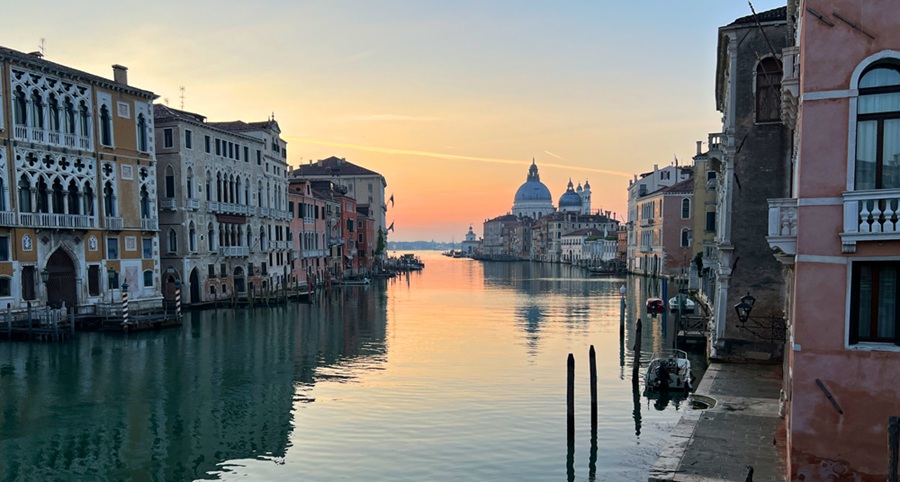
Venice—Sunday Morning—6:00 a.m.
The Doge asleep; the Campanile mute
Before the dawn; the empty streets untrod;
The dome of Santa Maria della Salute
A silent silhouette in praise of God.
With musty mold and rose, a mingled scent;
The Grand Canal a silvered, mirrored frieze
Of decadent, decayed palazzi bent
And wizened like a string of old men’s knees.
A peaceful calm before the day appears
With water taxi’s, vaporetto’s roar,
The whispered swish and swash of gondoliers;
And hidden mysteries behind each door.
While tourists sleep Venetians walk their dogs;
And with the sun, an early-riser jogs.
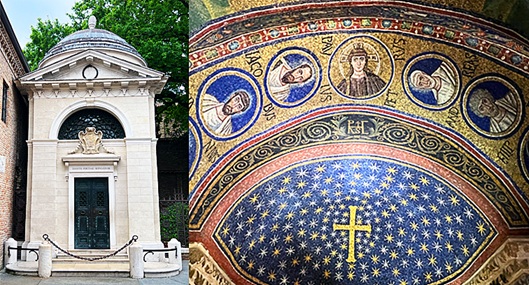
Ravenna and Dante (1265-1321)
When Florence exiled Dante, off he went,
And in Ravenna he then lived and died.
When he was dead and famous Florence sent
To get his body back—request denied.
The Pope said Florence had a rightful claim.
Ravenna’s priests replied, “No way, José,”
And hid his sorry bones (but not his fame)
And then forgot where they’d been tucked away.
In eighteen sixty-five, by accident,
They found where his remains had long been hid,
And built a proper tomb more permanent
To honor who he was and what he did.
Ravenna has some nice mosaics, too,
Which Dante no doubt saw, and so should you.
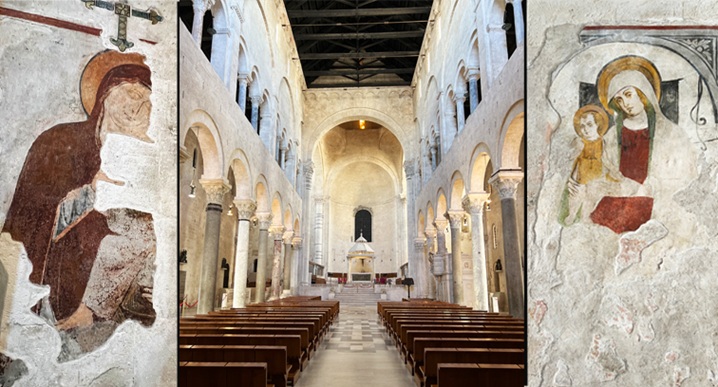
Bare-Boned Bari
With clean-stone walls both colorless and bare,
The round-arched Romanesque cathedral soars,
But in a cold and sterile manner where
Its thirteenth-century architecture bores.
No doubt the space is spiritual to a
Degree, as echoed footsteps mimic prayers
And chants in memory that weave their way
Amongst the empty, lifeless lines of chairs.
Yet hidden in the corners are remains
Of flaked and faded frescos on the wall,
Recalling times when painted tapestries
Of Mary, saints and martyrs once stood tall.
A past more lively, colorful and bold
Than what, today, seems little more than “old.”
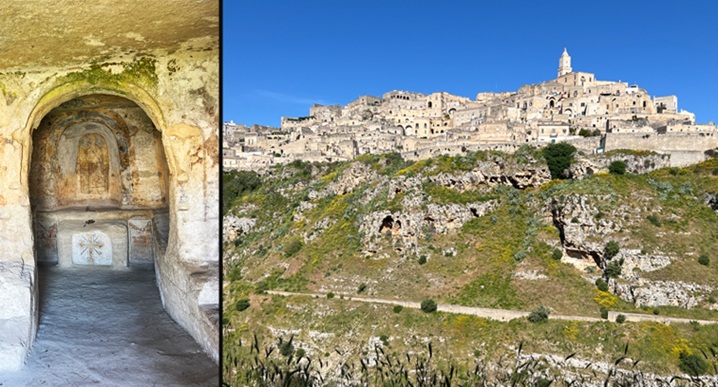
Matera Then and Now
The Same and Not
“Matera” doesn’t rhyme with “cave” but it’s
A synonym, for sure, since monks hid out
In the Eighth Century and used their wits
To paint their caverned rock-hewn church redoubts.
With time, the monks moved out and folks moved in.
They turned the caves into their humble homes
Where life was hard and most, both kith and kin,
Were poor, and built their town with hard, grey stones.
“Diseased!” “A shame!” The government agrees,
Cave houses are “A national disgrace!”
“Condemn!” “Evict!” By Nineteen Seventies
The so-called Sassi’s a deserted place.
Today—restored and semi-gentrified—
A tourist mecca, now a source of pride.
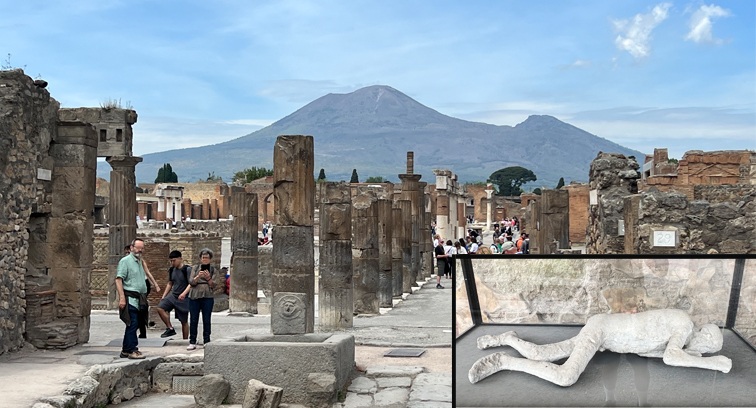
Pompeii—What Was and Is
How sobering to see the ruins of what men
And women called their daily lives. The booths where food
Was sold; the temples where their gods were worshipped. Then—
Back then—when life in Pompeii was considered good.
How sobering to see the tombs of those once famed
But now forgotten. Sobering as well to see
The twisted plaster casts of those who died unnamed.
And sobering how quickly it all ceased to be.
How sobering to think that Mount Vesuvius,
That looms so peacefully above the town today,
Did one day prove to be so unsalubrious
As to, in one fell blow, sweep all that life away.
How sobering, to suddenly be smoldering;
And in the ash be turned to ash. How sobering.
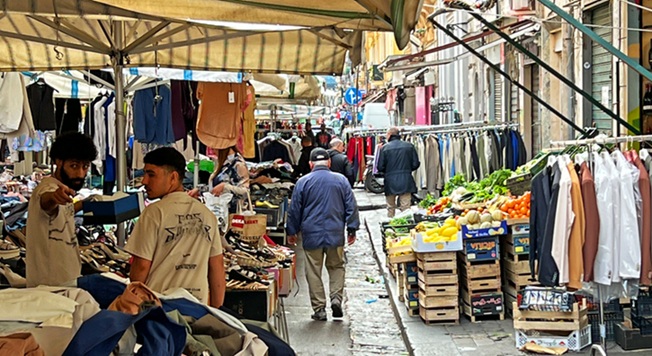
Napoli
Though known for those who pickpocket and rob,
I felt quite safe. For food? A bakery
And halal hybrid “Pizza and Kabob.”
My double locks gave good security.
Italian food was prevalent as well.
Spaghetti Luciana made me smile.
And sidewalk vendors had fresh fruit to sell.
Compared to home, far better by a mile.
With Ethiopians, Algerians,
And Turks, Somalis, Neapolitans,
Moroccans, Kenyans, and Nigerians;
A melting pot of cosmopolitans.
Or else, perhaps, a time bomb slowly ticking
With cultural diversity conflicting.
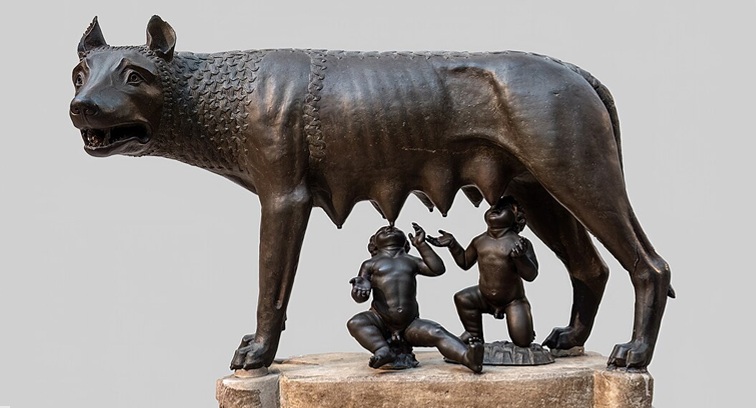
Re: Romulus and Remus
Eternal City, set on Seven Hills.
Its ancient statues feature nudity,
Which offers pre-teen tourist boys a thrill.
For most, it’s art; for prudes, it’s crudity.
But that aside, twin boys gave Rome its name.
Raised by a wolf, they grew and multiplied
And somehow founded Rome, inspired a fam-
ous statue, after which, I guess, they died.
That’s not to say that there are not a lot
Of memorable things to see and do.
Like visiting St. Peter’s which has got
A dome to climb where there’s an awesome view.
But as for Rome, itself, as in a dream,
I wonder why they didn’t call it, “Reme?”
Ciao!
James A. Tweedie is a retired pastor living in Long Beach, Washington. He has written and published six novels, one collection of short stories, and four collections of poetry including Sidekicks, Mostly Sonnets, and Laughing Matters, all with Dunecrest Press. His poems have been published nationally and internationally in both print and online media. He was honored with being chosen as the winner of the 2021 SCP International Poetry Competition.















Amazing tour, James, with words of great imagery and imagination.
This gorgeous, impressionistic travelogue was a joy for me to re-read, aloud the second time. Your stunning photo confirms that “The Grand Canal (is) a silvered, mirrored frieze.” The poem is a perfect companion to Longfellow’s “Venice.”
Some wonderful flights of fancy in this poem, James.
Very fine writing. The range is clear from the rhyming: the simple ‘a/way’, surprising in itself, to the more complex, ‘Vesuvius/unsalubrious’ (worthy of Andrew Benson Brown himself) and then to cap it all, the genius non-word (do I mean neologism?) of Reme to dream! I love Italy – this certainly brought back some memories – wonderfully evocative, and curiously ‘lazy’ as it flits from one scene to another. Love it.
Very kind words. I wish the pictures had turned out better. This was my fault Even worked very hard and even had me resubmit them so they would be as clear as possible. But I had mis-formatted them for posting and in any case, you get the idea!
By the way, when in Rome, Naples, Ravenna, Bari, Tuscany, Milan, Padua, (even Pompeii!), nearly anywhere you go in Italy you know you are in Italy. But when in Venice or Matera, you know you are in Italy, of course, but at the same time you have the feeling that you are also in another world altogether. At least this is my experience. Has anyone else had a similar experience?
Magnificent voyage sequence, James, thinking of “voyage” with the root word “see” in there. Your photographs, whatever you consider the quality, add a very personal touch to the poems since you’ve selected the views. “View from the Center of a Flat Circle” is to me the most intriguing poem. With it as the beginning of the lyric sequence, you deftly conclude your set of poems with the view from Saint Peter’s dome. However, of the poems, I find the one on Pompeii to have the most striking conclusion. “How sobering.” And you’ve got a bit of disorienting “Going in Circles” with the fellow voyagers energetically seeking health before they get to any destination, while they pursue travel experience.
In answer to your “in Italy” or “also in another world” question, I can only say I have to think about it. Venice did not seem to me any different than any other Italian region–except that it is Venice built on the sea and dependent on the shore region where all its food comes from. You didn’t mention the ravenous pigeons in Saint Mark’s Square. Haven’t been to Matera. Ciao for now!