


The Ladies on the Floor Above
—for the pianist NW and her daughters, and AGM, aged just one
“And therefore is Love said to be a child” —A Midsummer Night’s Dream
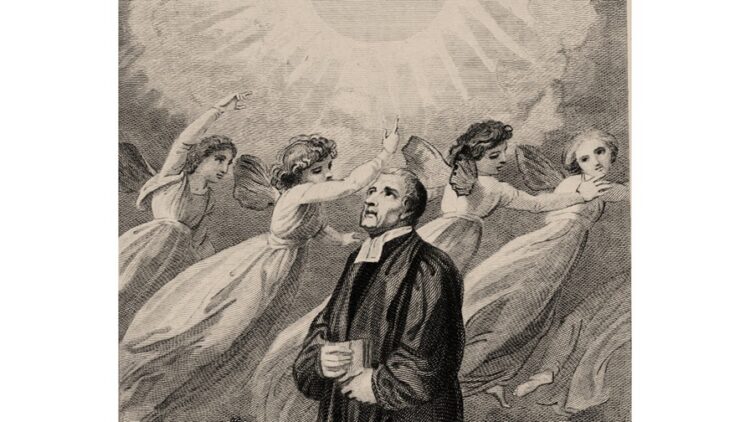
The ladies on the floor above
_Are not what they pretend;
They all possess a secret love
_And very special friend.
They disappear at dead of night
_To reappear at dawn,
When, soaring high in giddy flight,
_On powerful wings they’re borne.
For these are gentle sorceresses,
_And spirits of romance,
Who seek out Love’s divine caresses
_Across the world’s expanse.
O’er stormy seas and squally oceans,
_Astride a flying horse,
Bedewed with subtlest mystic potions,
_They nightly hold their course.
Vast distances these spirits travel
_With humankind asleep,
And time and space themselves unravel
_As through the skies they sweep.
O’er baying wolves they make their way,
_And wild nocturnal scenes;
O’er hills and dales and fields of hay
_And cavernous ravines.
Traversing darkened continents,
_Which fall away below,
Surrendering all to Providence,
_For Love they all forgo.
O’er rivers, rivulets and creeks,
_Escarpments, cliffs and crags;
O’er mountain tops and icy peaks,
_Their focus never flags.
And now, far from the madding crowd,
_From worldly matters free,
They start their climb through mist and cloud,
_Beyond what eyes can see.
And nothing slows this upward flight,
_For Love is not controlled,
But up they race to join the night
_Where there’s no growing old.
Then higher still these spirits climb,
_Now riding wind and rain,
To find again that realm sublime
_Where Death itself is slain.
Still higher yet they pierce the sky,
_Where time and space are one;
Where such ideas no more apply,
_Their fabric there undone.
For Love is like a child at play:
_He knows no time nor age,
But all is one eternal day
_Upon a wondrous stage.
Hence, nightly though they make their journey,
_It’s ever fresh and new,
As, far removed from hurly-burly,
_Their purpose they pursue.
And so they climb, and never tire,
_Beyond the realm of Man,
Where earthly things and all expire
_Before where all began.
And never do they cease to yearn
_For that unearthly peace
Where mortal care and all concern
_For self forever cease.
At last, they reach their destination,
_The object of their flight:
That joyous final consummation
_And place of pure delight.
Here, finally at journey’s end,
_They know themselves complete:
Unborn, undying—all such transcend,
_Illusion in retreat.
The god awaits them wordlessly,
_With whom they merge in bliss,
And find again Eternity
_Upon a single kiss.
And all with silence guard their secret,
_Of which they never tell,
For should just even once one speak it,
_Those words would break the spell.
And if that ever came to pass,
_They’d tumble from the sky,
And land upon the waiting grass,
_The same as you or I.
No more for them those mystic powers;
_Those potions take effect;
Hence, hiding how they spend their hours,
_All earthly lives affect.
Yet sometimes up above you’ll hear
_The Music of the Spheres:
Such perfect sounds as vanquish fear
_And flood your eyes with tears.
And thus you’ll know they’re safe at home,
_Still lost in wondrous dream,
Till once again at night they roam,
_These never what they seem.
previously published in the New English Review
Paul Martin Freeman is an art dealer in London. His book of whimsical verse, A Chocolate Box Menagerie, is published by New English Review Press.















What a beautiful poem to start a Monday morning with! Love the forward motion and musicality.
Thank you, Zumwalt.
I am indebted to Evan Mantyk for the line:
“And now, far from the madding crowd,”
Wondrous, enchanting, eventful, exciting, stimulating, creative, imaginative, and the list of accolades goes on and on! Each verse drove me onward with anticipation and admiration. Great, Paul!
That’s fulsome praise indeed, Roy! Thank you very much. The poem was written for my neighbours upstairs. In case it’s of interest, this is how I described its genesis in an email to them.
“The germ of the story came from bumping into K one evening when I was coming home and she was leaving the building. From that I had the idea of a woman going to meet her lover. It may be also that I had already been thinking of doing something for the three of you. At any rate, initially the poem was going to be about you all on horseback meeting secret lovers.
Once clear, this idea quickly turned into something mystical. Not three individual horses, but one horse. Not three individual lovers, but one lover, the god of love himself. In other words, you were secret votaries of Eros pictured as a child, hence the quote from Helena’s monologue.
As it developed, the nightly journey came to be in two parts. It was necessary first to travel across the world of time and space in order to transcend it. That is the significance of the journey: leaving behind all worldly things to see into the eternal or divine order.
For dramatic interest it was essential to keep secret what you were doing. Hence you couldn’t reveal it without losing your mystic powers. But this allowed me to end the story bringing you safely back home.
“The Music of the Spheres” is of course you playing the piano. With the poem in alternate lines of iambic tetrameters and trimeters, the six syllables fitted the meter perfectly.
Lastly, pictured as the little god of love, I included the child of a dear friend whose first birthday was Friday. He shares the dedication with you as AGM.”
This is excellent ballad meter, with very satisfying rhyme and choice diction. The poem reads smoothly and there is a definitely expressed upward movement.
If I have one cavil, it is this: it’s not clear exactly who these ladies are. They are called “sorceresses” and “spirits of romance,” and they can rise up and fly over the earth. What they do, and where they go, suggest that they are disembodied spirits, but they seem to make their journey repeatedly every night. Could they be a personification of thoughts, or dreams?
I did have the same problem as Dr. Salemi, regarding who are the ladies. A footnote or being more explicit would have helped the reader. and certainly me
They are my upstairs neighbours. It’s in the dedication. NW is an accomplished pianist. Hence the line “The Music of the Spheres”.
You’re right. I should have made this clearer in a note. Sorry for the confusion.
Thank you, Joe. I’m really glad you like it.
As I’ve explained below the ladies are my neighbours upstairs. In my reply to Roy above I have described the poem’s genesis.
After all the otherworldly stuff it was important to introduce a more human note to end the poem. So the challenge of the last part was to make the ladies more relatable. Otherwise it’s Macbeth!
“As I’ve explained below”: that should have been “above”.
I should probably also have subtitled the poem “A mystical fantasy”.
That might have avoided some of the confusion.
Perhaps, Joseph, they are succubi.
Could be. They’re all female.
I assure you, they’re quite benign.
Well done in creating this narrative journey. It must be difficult to write such long poems and keep rhyme and meter intact. Thanks for sharing.
Thank you, Paul.
Just practice, really. The advantage with a narrative poem is that, to some extent, you can allow the rhymes to dictate the direction while still keeping control of the whole thing. You may even find the rhymes give you ideas you didn’t have before.
The point is to be open to where the rhymes take you, which means not being too rigid about what you want the poem to say.
This is my experience, in case it helps.
Since one of your upstairs neighbours, Paul, is a pianist, I would say you hear music from their flat at night, and the lovely music corresponds to the behaviour of these ladies, which appears purely motivated by a transcendent Love. Perhaps the music goes forth into the night (often coming your way). Whatever you know of their behaviour implies that “for Love they all forego.” They don’t speak of the “secret love they all possess,” because “words would break the spell.” You, however, try your very best to put that love into words describing a mysteriously beautiful journey–paying tribute to them in a poem that seems to travel throughout the world for the better. You give us a feeling for the emotion they can inspire to uplift a neighbour–and it’s all the more impressive, knowing that one of them is a child of one year old, who can nonetheless be called a lady. You have done well for them and for us who are able to receive the poem as you intend.
Hello, Margaret. Thank you for commenting. You’ve intuited some important parts of the story, so I’ll fill in the rest.
For the past few years my wife and I have lived in an apartment building where there are two flats on each floor. On the floor upstairs, on the other side of the hall, lives a lady with her two grown-up daughters.
As explained above, NW is an accomplished pianist. She was a student of a celebrated interpreter of Chopin, and it is indeed the Romantics she plays with these lovely sounds wafting through the building.
She may play in the evening, but we notice the music during the day. So that part of the poem is based on fact.
For the past few years at Christmas we’ve exchanged small gifts. The order goes like this. They leave something outside our door with a note, then we respond with something of our own to which I add a bit of light verse to do with their gift.
Last Christmas, I had the idea of doing something more substantial, when, coming home one evening, I met one of the daughters leaving the building. As I explained in the email quoted in my reply to Roy, this gave me the germ of the idea for the poem.
The poem was intended as a fantasy around the mystical tradition of love. But you’re probably right. Having been first suggested by that chance meeting, the music ensured that would be its theme.
As you’ll see, there are classical, eastern and other allusions. In the version published by New English Review, I called the ladies “witches of romance”. In the correspondence with Evan, together with “And now, far from the madding crowd” from “And now, removed from madding crowd”, this got changed to “spirits of romance”.
AGM is in fact the child of another friend for whom I’ve written other poems.
I was reminded of a coterie of Queen Mabbs.
As said above, ‘enchanting’.
Thank you, Paul.