


Mother’s Loom
—after Li Bai’s poem “Midnight Song of Wu”
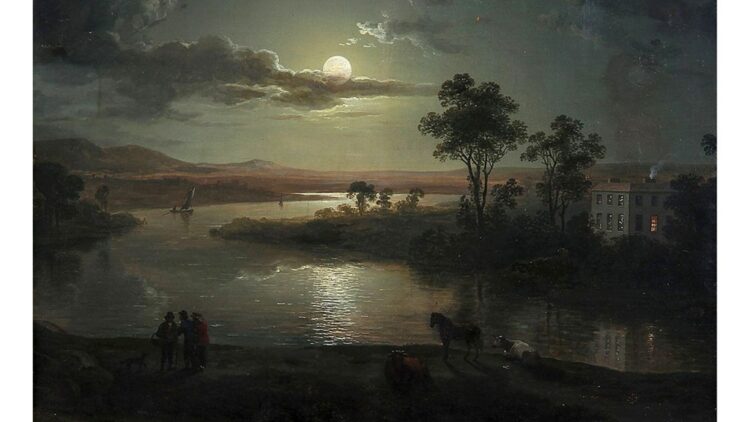
The moon above the palace,
Reigns bright within the gloom,
And mothers seeking solace,
Work quietly at the loom.
Cold autumn breezes shear
Away their fondest tears,
“Oh when’ll my sons be home
From deserts where horses roam?”
Poet’s Note: The above poem is adapted from the Tang Dynasty Poet Li Bai’s “Midnight Song of Wu.” The “palace” refers to the royal capital of Chang’an. Li Bai (701-762) is also known as Li Po.
Original Traditional Chinese Text
of ‘Midnight Song of Wu’ by Li Bai
長安一片月,
萬戶搗衣聲。
秋風吹不盡,
總是玉關情。
何日平胡虜,
良人罷遠征。
of ‘Midnight Song of Wu’ by Li Bai
長安一片月,
萬戶搗衣聲。
秋風吹不盡,
總是玉關情。
何日平胡虜,
良人罷遠征。
.
(Pinyin):
Cháng’ān yī piàn yuè,
Wàn hù dǎo yī shēng.
Qiū fēng chuī bù jìn,
Zǒng shì yù guān qíng.
Hé rì píng hú lǔ,
Liáng rén bà yuǎn zhēng.
Cháng’ān yī piàn yuè,
Wàn hù dǎo yī shēng.
Qiū fēng chuī bù jìn,
Zǒng shì yù guān qíng.
Hé rì píng hú lǔ,
Liáng rén bà yuǎn zhēng.
Yoshikaze Kawakami studied classical Japanese literature in Tokyo. He has published translations of classical Japanese poetry in Classical Japanese Poetry of Love and Nature: An Anthology.

















I liked the interesting use of “Reigns” given that the scene was in a palace. I have known Li Bai (Po) poetry for its sensitivity and beauty including this one of a mother’s hopes and prayers.
Thanks for sharing this poem. It’s a vivid picture of the mother trying to keep herself busy while she has all these pre-occupations about her son’s safety. I’m still learning poetry, but know I should add Classical Chinese poets to my reading list at one point. Have a good week.
Your derivation did not stray too far from the original sense. I especially enjoy how you preserve a sense of the rhyme and meter of the original. Your choice of quatrain-couplets conveys the sense of a compressed sonnet.
The title in English draws attention to the human emotion of the poem. The poem itself becomes a kind of loom, with nature and feeling working regularly in contrast, expressing and containing the mothers’ anxieties about their sons.
A lovely tableau that has been repeated down the ages.
Thanks for the read, Yoshikaze.