


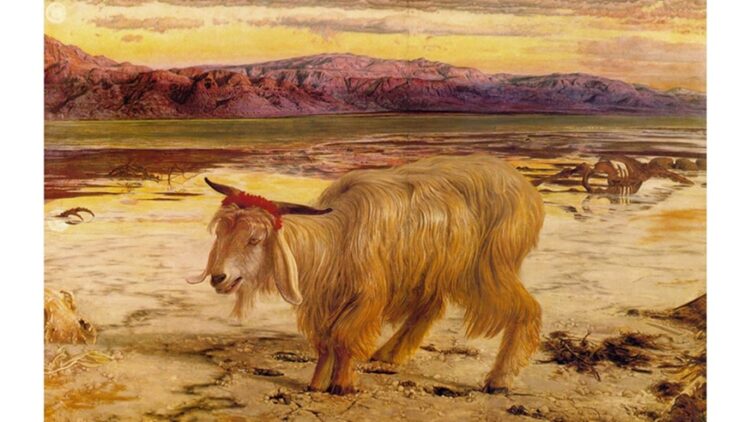
The Scapegoat
Their memories select the bad, forget
The good. Their hypersensitivity
And need for higher maintenance won’t let
Their feelings dwell on positivity.
They lay you out and flay you out to save
Their cultic souls from self-reflecting doom,
Ignoring facts, inventing ways to tar
And feather you, although you never gave
Them any cause to bar you from their room
Of friends. How they forget how much we are
Alike!
Eric v.d. Luft, Ph.D., was Curator of Historical Collections at SUNY Upstate Medical University from 1987 to 2006 and has taught at Villanova University, Syracuse University, Upstate, and the College of Saint Rose. He is the author, editor, or translator of over 700 publications in philosophy, religion, librarianship, history, history of medicine, politics, humor, popular culture, and nineteenth-century studies.
















This poem surprises us with that final word “Alike!’ in the last line. We’re expecting a sonnet or something in that vein, since we read a perfect ABAB quatrain, followed by an CDECDE sestet. But the final word hits us with the force of a reversal — the poem is not just about those who make scapegoats of others, but how those same persons can be scapegoated as well. It’s an effective twist.
Nice poem, Eric. Perhaps it’s human nature to look down on others, with the implicit sense of “I’m better than that.” It takes some of us a lifetime to learn to consider the other person’s point of view.
A thought-provoking curtailment of the poem makes us reflect what we might expect to be a final couplet being replaced by an outcast word.
This well-spoken set of lines and rhyme return me to the devotional I gave my fraternity, in 1994. Leviticus 16. Thanks for the fine transport; well said.
How friends forget! And satisfy high maintenance selves . . . It’s a good picture of scapegoaters, Eric. You cut-off conclusion reminds me of the Shirley Jackson story, “The Lottery,” in which a woman approves and participates in the process right up to the moment in which she becomes the scapegoat.