


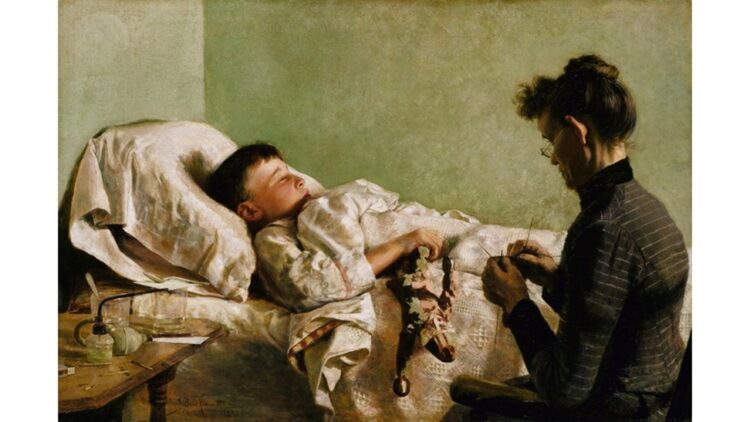
Thoughts at Daybreak
At break of day, you rise up quietly
To check on our young daughter, who lies ill.
From out the corner of my eye, I see
You tie your robe, while I keep lying still.
You slip out of our room, and soon I hear
The soft, consoling murmur of your voice;
Its warm, maternal tones caress my ear
And make my wakened, grateful heart rejoice.
I can’t make out a word you say, and yet,
I’m filled with peace to hear the lovely sound
Of you, through whom my own felt needs were met,
When I was lost and needing to be found.
You came to me, when I was sick with grief
And cheered me then, as now you cheer our child.
Your healing words brought my sore heart relief
And stilled its gale with breezes, soft and mild.
I feel at length the movement of our bed,
As you lie down beside me as before.
You softly sigh and turn away your head,
As on your side you fall asleep once more.
You notice not my keen attentiveness
To all your movements and the tender grace
With which you daily give yourself to bless,
Through loving service, those whom you embrace.
Nor do you see the smile that dawns like day
And spreads its wings across my brow, as I
Think thoughts of you that sweep the night away
And make my face shine like the morning sky!
On Paola’s Illness
When you are ill and feeling low,
The one good thing that brings in tow
Is the effect it has on me–
To fill my heart with sympathy.
I would not have you lying still
In such a state, so pale and ill,
But if such things must be, then may
I be transformed by them today.
May every chill that shakes your frame
Send forth a wind to fan the flame
Of tender love within my breast,
That I might serve at love’s behest.
As fire consumes all dross from gold
And makes it lovely to behold,
May fever’s flames that burn your brow
Consume my selfish blindness now!
May every sigh and quiet moan
Dislodge me from my comfort zone,
That I may come to meet your needs
And ease your pain with helpful deeds.
May those pure droplets on your face
Impart to me a cleansing grace
To wash away self love, that I
Might love you, as to self I die.
May every symptom you display
From self-absorption draw away
My errant thoughts, that I might be
No longer so wrapped up in me!
Sleeping Children
—to the Medical Staff of Arkansas Children’s Hospital
The children are not here. Though down the hall,
In room past room, their sleeping bodies lie,
Tied down to earth with tubes and wires and all
They need, while nurses keep close watch nearby,
Beyond the glow of bright cherubic faces,
Beyond the fields of drooping eyelid-petals,
There lies a pillowed dream world that erases
All earthly things that hurt like stinging nettles.
Beyond this border, past the placid sea
Of chests that rise and fall with every sigh,
The children are at play, as merrily
They run and laugh and sing and never cry.
Some soar as free as birds through skies of blue
While riding on the backs of unicorns.
Some slide down rainbows; others climb up to
The clouds on leafy beanstalks free of thorns.
Some sail away on cotton candy clouds
Or chase bright butterflies through fields of green.
Some fly in rocket ships among the crowds
Of twinkling stars that shine with brilliant sheen.
While back on earth, their heaven-sent attendants,
Sent forth to heal frail bodies made of sod,
With love look on their slumbering dependents,
And stretch forth hands that bear the gift of God.
Martin Rizley grew up in Oklahoma and in Texas, and has served in pastoral ministry both in the United States and in Europe. He is currently serving as the pastor of a small evangelical church in the city of Málaga on the southern coast of Spain, where he lives with his wife and daughter.




















Martin,
These are tender and heartfelt tributes to the caregivers we’ve known. My wife does similar work for the elderly and dying. I am always amazed at how natural it comes to her and the peace she brings to others. It is as if another Will is directing hers and she offers no resistance.
Robert, Thank you for your response to the poem. Caring is a privilege open to all, but there appear to be some, like your wife, who seem unusually gifted in this area. The Bible speaks of some who are especially gifted to “show mercy” (Rom. 12:8). I have no doubt that the presence in this world of unusually gift caregivers is indeed owing to a higher Will at work than their own. They are a gift of God to a world full of suffering.
These are beautiful poems with touching sentiments shown in the attention to small deeds and thoughts connected with caring for the sick. In the suffering of others, and in their goodness as well, we perhaps may be moved to set aside selfishness and call up yet more sympathy in ourselves. Everybody benefits, as we can see from the poet’s believable gratitude and resolve for self-improvement. These poems are good works with good thoughts behind them. I’m glad to see them.
Thank you Bhikku for your feedback and your thoughtful reflections on the benefits that flow to all when the sight of another´s afflicted condition calls forth a sympathetic response from those who are in a position to serve.
Martin, these are such sensitive and truly touching poems from the heart borne to us by one who understands the wonderful world of caregivers who impart so much love and comfort to their patients.
Thank you, Roy, for your feedback. I think it is often in times of illness, when we feel so keenly our human frailty, that we are made so aware, through the loving care that others give us, of the goodness of Him who is “the God of all comfort,” who ministers to our needs through the kindly deeds of others.
What a tender poem is “Thoughts at Daybreak”.
Three rarely beautiful poems, Martin, on different aspects of the great good that attentive caregiving can bring to a suffering soul, or to one who simply observes the process, not to mention the good with which a caregiver grows, on his or her own part. I especially like the well-worded catalog of amusements available in the sleeping children’s dream world.
Thank you for your appreciate comments, Margaret. Perhaps because the third poem was written in a moment of great personal distress, when our young daughter´s life was in serious danger because of an advanced case of pneumonia that put her in the hospital, from which she thankfully recovered, it is the poem that evokes in me the greatest emotional response when I read it aloud– especially the last line, which brings to memory the keen awareness I had at the time that her medical caregivers were truly “heaven-sent.”
Three poems on caregiving that touch on the positive aspects of what can be a difficult, even heartbreaking situation, stretching out over years.
All three poems observe caregiving from a different perspective, from a husband giving thanks to his wife who’s caring for their sick child, to a caregiver examining the effect the task has on him, to an appreciation of the nursing staff in a hospital looking after sick children.
All three are touching in their way, and I take my hat off to you, Martin. Such topics can be difficult to write on, particularly if the subjects of the caregiving in the poems are based on real people who are close to the poet, and if their conditions are not likely to improve.
Thanks for the reads.
Thanks, Paul, for your feedback. All three poems are based on actual experiences in my life, and I am pleased to say that in each case, the sick person recovered! The third poem, dedicated to the medical staff at the Arkansas Children´s Hospital, was originally written in free verse years ago when our own daughter was in the hospital with a very bad case of pneumonia involving a “pleural effusion” outside the lung; thankfully, her doctors were able to remove the fluids surgically before it was too late. Recently, I rewrote that poem in metrical form– along with the first poem, which was also written in free verse originally. I then sent the poems to Evan as a trio of poems, since they seemed related in theme.
The reader can feel the authenticity in these poems, Martin. So glad all three had positive outcomes, and I hope you kept the original versions. Freeman verse often make good performance pieces.
Martin, thank you for sharing the different angles of caregiving in poetry.
Each poem touched my heart in a different place.
Evelyn, Thanks for sharing with me you response to the poems. I am glad that you were able to related to them on an emotional level.
Your second poem affected me the most — I look at my elderly parents and think that I may soon be in the position of needing to be a caregiver.
Cheryl, I suspect that most of us, at some point in our lives, will find ourselves in the position of being caregivers, and for some, that will be much more challenging than to others, based on the nature of the illness that is in view. Caregiving can be extremely taxing and emotionally distressing, but it can also serve as an opportunity for spiritual growth, I believe, if the task of caring for others is embraced with reliance on God´s strength to sustain us and wisdom to guide us in the decisions that must be made. Thanks for your feedback.