


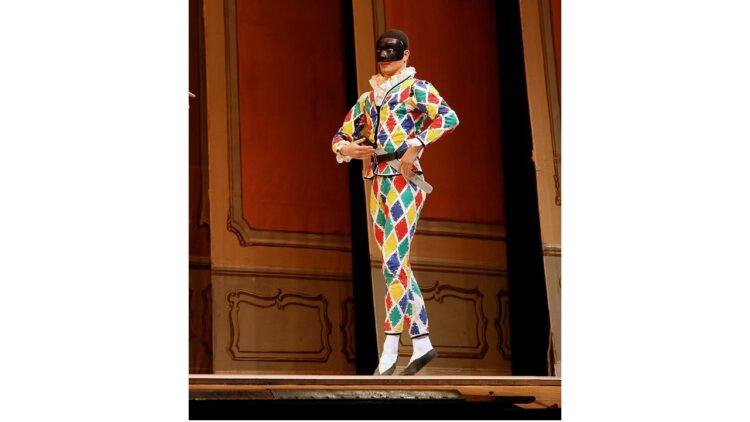
Carnival Quintilla
Subtly startling Harlequin,
Mutely miming tenderness,
Yang you are and I am yin,
Thrilled to feel your eyes’ caress
Flashing as you nimbly spin.
What appeal do you intend,
Speechless dancer with a smile?
Near and clearly to commend
Sympathy as you beguile
Ardor toward an early end?
Conjuror inconsequent,
Lithe you sway in sinuous
Circularity content,
With a bow obsequious
Leaving love’s entanglement.
Margaret Coats lives in California. She holds a Ph.D. in English and American Literature and Language from Harvard University. She has retired from a career of teaching literature, languages, and writing that included considerable work in homeschooling for her own family and others.



















I enjoyed this poem very much Margaret. I felt the music and the mystique of confusing entanglement.
Thanks so much, Linda! Identities tend toward loose ends at carnival, with colors as apparently confused as on Harlequin’s suit. But there is an order in it all, and I’m glad you enjoyed it.
Margaret, there is such great depth embedded in your beautifully wrought poem. The imagination soars with each verse “beguiling” us each step and “leaving” us with the enchantment of “love’s entanglement” unspoken and yet persuasive. Is it that opposites attract? Is it the silence pierces the inner soul? Is it the gaze that stimulates the senses? These and other detailed observable features pull us into the depths of your poem.
Thanks for these perceptive comments and questions, Roy. Opposites often attract, and silence can speak volumes. Wordly poets rarely observe how much a talented harlequin says with eyes and motion. You are quite right to think of communication that involves senses and soul, bypassing the mind’s mediating activity when words are not used–yet aiming for authentic affection. I’m glad and grateful you notice the poem’s potential depths.
Very nice, Margaret. Your poem is fun to read….I feel like I’m right there at the carnival!
It’s carnival season, Paul! Glad you had fun.
This is brilliant! I love the way your poem spins us around. You are indeed a master conductor of poetry
Many thanks, Rohini. Glad you find the motion spinning!
An interesting technical point is the extent to which you were able to incorporate polysyllabic words into two relatively consice metres; in the last stanza in particular, the two lines of trimeter are filled by just two words. And those two words are grammatically inverted, which demonstrated the room for rhetorical flourish in the most restrictive of circumstances.
Not trimeter but catalectic trochaic tetrameter (I think).
Tetrameter was the intent, as I had chosen the quintilla stanza form. In Spanish, this would be octosyllabic, which prescription I didn’t follow. The lines each have seven syllables, but since “octosyllabic” in Romance languages usually corresponds to “tetrameter” in accentual English, I could make sure of four accents in each line. The clearest way of doing this is accenting syllables 1, 3, 5, and 7, and I believe you are right, Daniel, in calling that line “catalectic trochaic tetrameter.”
I learned, and began to like, the seven-syllable line from the poetry of Christine de Pisan. She is mistress of a considerable variety of syllabic line lengths. Though octosyllabic and decasyllabic are standard in her medieval French, she also writes many successful poems in six- and seven-syllable lines, and a few (if I remember correctly) in four- or five-syllable lines. She only had to worry about French conventions of syllable count sometimes requiring elision. When I translated one of her seven-syllable poems, in order to render the form accurately, I had to be strict about seven syllables, because otherwise the tetrameter would appear the same as in her many octosyllabic works. The best solution was the meter I’ve used in “Carnival Quintilla.”
I will have to read de Pisan. My own knowledge of French poetry only goes back as far as la Pléiade. What I do appreciate about French literature is how intelligible older writers remain to the modern reader (all the way back to Montaigne, more or less). English and Italian, by contrast, seem to have evolved quite a bit more over the same span of time. Thanks, Margaret.
For one work of seven-syllable lines, try Ballade XXVII from Christine’s Cent Ballades. Many of the ballades are decasyllabic (some with cut lines as part of the structure), but the final one is octosyllabic. There is also interesting use of line lengths in the lyrics of Le Dit de La Pastoure.
Thanks, Daniel. I like the challenge of using polysyllabic words, and having decided on the music of a rather restrictive meter, making a polysyllabic flourish was all the more challenging. There is a certain freedom in thinking with the meter! “Conjuror inconsequent” was one of those inspirations that arose naturally from meter and theme.
The concision and precision of this poem are what most beguile me. Dr. Coates here has created a pearl, or maybe a diamond. Either way, it’s an ass-kicker.
Thanks, C. B. My unspeaking partner Harlequin would probably choose “diamond” as the word, pointing to the shapes on his traditional garb. I truly value your opinion, especially insofar as it complements Roy Peterson’s on the depths within the gem.
This has a mesmerizing feel to it, which reflects the harlequin’s effect on his audience. The alliteration is lovely, too.
Thank you, Cynthia. Just thinking of Harlequin (and of my experience of a local gentleman who occasionally appears in his guise) paradoxically brought me a variety of sound echoes from the silent performance. Glad you like the effect!
Margaret C.
Your poem is as startling and sensuous as the Harlequin who is depicted .
From Margaret B.
Thank you, Margaret B., and please excuse me for the delay in acknowledging your comment. This week, my Harlequin is more courteous.
My only exposure to Harlequins when I was growing up was the romance novel series of the same name. I had no idea until reading your fantastic poem that there was a long-lived and much more nuanced history behind Harlequins. The meter was hypnotizing, and the word choice was other-worldly.
Great way to start the day.
Thanks, Warren, for admiring the music of my little contribution to harlequin lore. He is a type character who could play varied roles in a romance novel series!
Sounds like a labor intensive form, Margaret. This morning
I happened to be reminded of a certain higher-up at the
Vatican and your poem seems to suit him perfectly. Thank you for it.
I suppose Vatican officials, like many of us, need a break at carnival time. But if his mode of relaxation was dancing away and avoiding comments, I am very glad you didn’t follow his example, jd!
For the quintilla form, see more typical ones at Cheryl Corey’s “Five Quintilla Poems” in February 2025. They are ordinarily less labor intensive: octosyllabic in Spanish or tetrameter in English, with two rhyme sounds per stanza or per single-stanza poem. The two sounds can be arranged in any rhyme scheme that does not allow three lines in a row to rhyme.
I really admire the succinctness of this piece, Margaret. It’s a perfect little snapshot which manages to evoke the spirit of the commedia dell’arte, and does so using an attractive (I almost wrote infectious) metre. Thank you.
Thank you for this praise, Martin, and I regret it took me so long to acknowledge it. Glad my speaker could express something that just might be said by Colombina from the Commedia.
Your harlequin whirled like a Dervish, Margaret. Seven syllables per line and only 15 lines, the imagery and speed of your poem packed a punch.
Thanks for the read.
My Harlequin is speedy indeed, Paul, but I am grateful you waited all this time for an acknowledgement of your comment. I wanted to post at least one answer on classic Carnival Monday, and hoped you would not be too punchy to tolerate the delay. If you have carnival season where you are at present, my best wishes for enjoying the masquerade.
Margaret,
This poem was especially sweet to me. As a child, I had some kitschy art (circa late 60’s) depicting harlequins, and the images were both a curiosity and magical to me. Your poem brought some light into the harlequin life for me.
Happy I could do that, Laura. And thank you for a comment on my carnival poem to which I can reply, “Joyeux mardi gras!”
The irony and genius of this work is in the title. Normally it would just be indicative of the structure of the piece but the words almost try too hard to convince you that it’s not a Carnival quintilla. There’s lots of whimsy in the word pairings like conjuror inconsequent. Someone who makes magic that has no real effect and that’s exactly the genius. The foreshadowing of the penance and abstinence of lent to come is concealed exactly in the tension of the word pairings. Bravo Dr. Coats. Bravo.
Thank you, Ken! The play-acting and masquerades that used to characterize the Carnival period immediately before Lent had their place in foreshadowing penance and abstinence, as you say. I’m glad to have such a profound comment. Tension holds these words and lines together. Whimsy in anticipation almost naturally leads to serious thought of the upcoming fast, so beneficial to everyone who can participate seriously in it.