


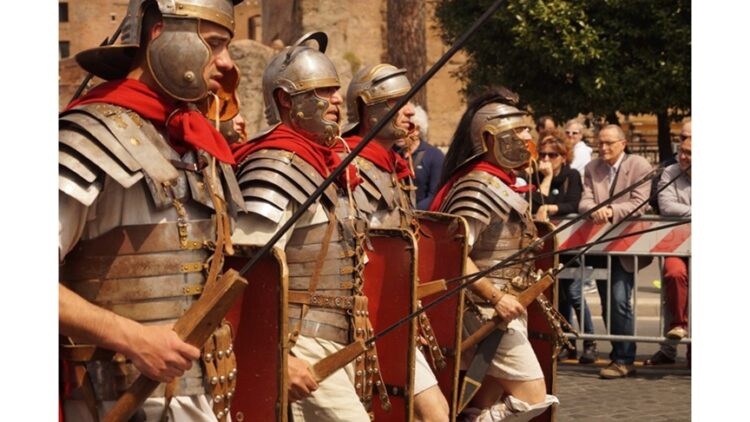
The Triumph
—on the three lost legions, and the abrupt
end to expansion under Augustus
The lovely face of recent progress made
On far-flung savage shore, by loyal arms…
And yet as though another roadway laid
Away from Rome somehow, that now alarms
As though behind the lovely mask you bear
Connection to your woodland home’s remains;
Now freed from all the feral fashions there
In silks, the wine you offer for my pains
Suggests I should not sip as some have done:
It tugs upon your lips, some infant smile,
As waiting on the hour just begun,
A forest, dark, unknown, through which to file.
A Philadelphia native, Dave Blanchard has had poetry published in The Sandpaper, Wings of Freedom (the magazine of the Delaware Valley Historical Aircraft Association) and The Schuylkill Valley Journal. He has also authored poems published in the programs of the Volvo Leukemia Cup Regatta. He is a Haverford College graduate and a resident of Phoenixville, Pennsylvania.











Thank you so much for this poem, Dave. I enjoy the wording and the mystery of it. I also enjoy almost anything about Rome!
P.S. My mother went to Bryn Mawr a long time ago.
Thanks, Marguerite–it’s on a clash of cultures, a conqueror (for now) and a captive–not exactly the story of, say, Snow White and Prince Charming. As they contemplate each other alone, late, the speaker is wondering if the woman’s beauty is a trap for him, and that though her silks (replacing native bearskins or what have you) certainly seem to suit, she may be planning to poison him. Second thoughts can crowd in on the brink of any big new relationship. Can’t decide if he’s thinking these thoughts or saying them, to gauge her reaction. Either way he’s almost sure to proceed, naturally. PS Mine did too, class of ’57.
This poem is well constructed metrically, its rhymes are perfect, and the diction is mature.
I do have a problem with its syntax and its narrative line. The epigraph makes the subject of the poem clear (the defeat in A.D. 9 of the legions of Quintilius Varus at the Teutoberger Forest), but the syntax and references in the poem are vague and murky. There is a first-person speaker, but who or what is he? Someone wearing a mask is being addressed (lines 5, 8, and 10), and he has a “woodland home.” The middle quatrain is particularly obscure, with the words “feral fashions,” “silks,” and an offer of wine being basically impenetrable.
All I can speculate on is this: archaeologists discovered a Roman mask during their excavations at the site of the battle, along with a lot of weapons and other Roman military gear. Is this the “mask” being mentioned in the poem? Also, the poem’s title is counterintuitive: there certainly was no “triumph” for any Roman commander after this major military catastrophe. Is the poet describing a prior triumph, just before the legions of Varus advanced into Germany? Or is the title meant to be ironic?
We don’t know who the speaker is, we don’t know who the addressee is, we don’t know what the mask is, and we don’t clearly understand what is being suggested. Meter and rhyme can be perfect, and wording can be elegant, but without clarity of meaning we are left with surrealism.
Thank you, Joseph, I agree that clarity of meaning is vital–almost always. But here everything is clouded. And being a recent expert at marching through a forest doesn’t give the narrator much training for unwinding greater unresolved issues–even though he may think it does. And yes, absolutely the title is ironic, particularly if he doesn’t survive the next hour. But even if his lovely captive and he instead come to enjoy wedded bliss–how does it go? “Aisle. Altar. Hymn.” (I’ll alter him). Some triumph!
Your poem’s triumph, Dave, exists mainly in the mood you create. There is a sense that the “Triumph” of the title lies in the past history of many triumphs by Roman legions, with the speaker being perhaps a recent recruit. Whether he is a German (to whom the Romans introduced wine), or an Italian uncomfortable with the distance from home, the mood is uncertainty about the future, corresponding to the moment of history you write about. Rather than “all roads lead to Rome,” the speaker sees himself marching on “another roadway laid away from Rome,” and the feeling “alarms.” Like Joseph Salemi, I would prefer fewer uncertainties of meaning in the soldier’s dark, unknown forest, though the eerie emotion in the poem is certainly appropriate.
Thanks, Margaret, I agree completely. Would add that I saw Elizabeth Taylor in Cleopatra recently–never a big Liz fan till I see that again, once in blue moon. So the poem’s conception may be well before any lost legion, and the narrator, a lot higher up the food chain.
Hi, Dave. I enjoyed the dark, evocative mood of the poem and got the ‘feral fashion’ (brilliant alliteration, by the way), though you did give it away in your answer to the first comment.
Some parts still remain impenetrable, like the forests of your, but I ‘got’ enough to enjoy coming back to the poem.
Thanks for the read.
Thank you too, Paul. It’s always a challenge leaving enough out to allow for different ‘takes’, while shedding enough light to avoid head-scratching. Probably a bit of a cheat, choosing that setting, already obtuse/obscure in the mists of time. Thanks again and enjoy the big game!