


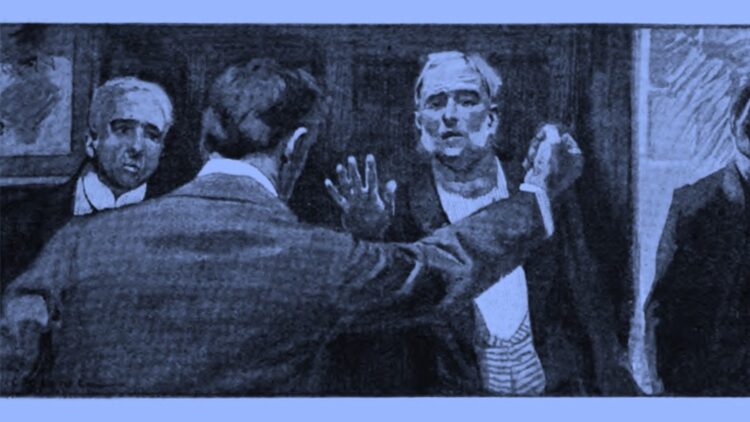
Undone
Decisions made in haste are doubts deferred.
The need to come off confident, to seem
As though in charge, is really quite absurd
When self-control remains a bootless dream.
Those sudden unexpected bouts of rage
Belie the promises you whispered in
A semblance of remorse and turn the page
On every nascent hope there might have been.
Decide now, whether you would like to leave
This company or stay—abiding doubt
May guide you to a freshening reprieve
From old destructive urges hiding out.
The pardons granted by forgiving folk
May help you trade your shackles for a yoke.
Mercenary
I let my lawyer go, and was deprived
Not only of my mouthpiece, but as well
The stiff retainer paid up-front. “Survived”
Is how I’d put it, going through the hell
Divorce is larded with, with only me
To litigate my case. His suits are silk,
For win or lose he always gets his fee
And then consorts with others of his ilk
Involved in cases pending. I admire
His crafty style—the conscience of a thief!—
The sharpest shyster anyone could hire,
With shady methods beggaring belief.
He’s got me seven ways to Sunday. If
I hire him back he’ll charge me bundles more,
But if I don’t I’ll never get a whiff
Of that big settlement I’m hoping for.
C.B. Anderson was the longtime gardener for the PBS television series, The Victory Garden. Hundreds of his poems have appeared in scores of print and electronic journals out of North America, Great Britain, Ireland, Austria, Australia and India. His collection, Mortal Soup and the Blue Yonder was published in 2013 by White Violet Press.

















There is so much to highly commend about these two morose poems of practical living and surviving despite the results and cost involved. Such a wonderful choice of words is embedded.
I like “morose,” Roy, but sometimes it simply reflects what is accurate and relevant. Nothing is free (not even lunch), and there is a cost for everything, as you well know. Our wonderful English language provides a plethora of choices, and all that’s asked is that we try to make the right ones.
I really enjoyed your sonnet, C.B., and your “shyster” poem really made me smile– my third daughter and her husband are both attorneys, and I think they’d say they’d never want to emulate your “shyster lawyer”!! Reminds me of the dialogue between Groucho Marx and Thelma Todd in Monkey Business (1931):
Groucho: Oh no, you’re not gonna get me off this bed.
Lucille: I didn’t know you were a lawyer. You’re awfully shy for a lawyer.
Groucho: You bet I’m shy. I’m a shyster lawyer.
Makes me want to watch it again!!
I think, Theresa, that you know a little something about sonnets. If you really enjoyed mine, I can only say that turnabout is fair play. I’ve sometimes wondered which of the Marx Bothers I would prefer to have been — maybe there could be a fifth one, Kippo. There are lawyers, and then there are lawyers. Let us pray that the ones closest to us remain human.
I don’t know if these two poems were deliberately paired — the first about over-hasty decisions, and the second about the regretted dismissal of a divorce lawyer — but they both are clearly laments over mistakes.
The sonnet “Undone” is clearly about someone with a bad temper, who feels remorse fitfully and is forgiven by others, but who can’t seem to break free from his choleric habits. “Mercenary” is about a different kind of enslavement — to predatory lawyers whom we can’t stand, but who are necessary for navigating our litigation-ridden lives.
These poems, Joseph, were indeed deliberately paired, if only because they were among the last remaining in my slush bucket. Someone once wrote that we hate all lawyers, except our own lawyer. Good luck with that.
Someone once said or wrote, Joseph, that we all hate lawyers, except for our own lawyer (if that lawyer is a good effective one). The times we live in are conducive to bad temper. Just notice how the Dimocrats reacted to last night’s SOTU address. Houston, we have a problem. Lunacy is alive and well here on earth.
Terrific poetry, Kip, which made me both laugh and squirm. Both hit a little too close to home for me. “Undone” (great title with many layers) reminds me of too many times I’ve acted or said things on impulse that I later regretted. And it’s a complex thing. I like to think of myself as both decisive and cautious. I imagine there’s a time and place for both — something only experience can teach.
As for “Mercenary”… Ow, that hurts. But you’ve nailed it and I’m happy to describe myself as a “retired” lawyer rather than as one of the active shysters you write about. The profession does seem to be a magnet for an inordinate number of venal, ethically challenged people who are drawn to the ideas of money, power and prestige. Temperamentally, it was a bid fit for me from the start. I remember going to court about 20 years ago and a solitary woman was picketing in front of the building with a sign that said “Lawyers Stink” and she kept shouting “lawyers are shysters, shysters arae lawyers.” She was still out there two hours later when I left. From her tireless dedication to sharing her message, I infer that her lawyer must have really disappointed her.
There are plenty of retired lawyers who contribute to this venue, Brian, and most of them are fed up with business as usual. What does it say about our country that a hefty plurality of members of both houses of Congress are lawyers? As someone once told me: Shit rolls downhill, but there’s always an asshole at the top.
C. B., “abiding doubt may guide you to a freshening reprieve” splendidly expresses practical reality. The yoke of being forgiven is a light one. Too many folk neither grant it nor wear it.
Your divorce shyster resembles the few I’ve known of. Among lawyer acquaintances with a care for their own integrity, they seem to prefer estate planning or even criminal cases to “family law.”
Shackles of course, Margaret, imply enslavement or imprisonment, whereas a yoke connotes cooperation or partnership. Lawyers will be lawyers.
I enjoyed ‘Undone’ and the fact that the narrator sees both leaving and staying at a company similar in outcome, where you ‘trade your shackles for a yoke’.
Ironically, in Arabic, ‘lawyer’ is ‘maharmi’, while ‘thief’ is ‘harami’, much like ‘lawyer’-‘liar’. Could this just be a mere coincidence?
Thanks for the reads, CB.
Maybe, Paul, there are coincidences, and maybe not. Some comparative linguist once tried, but failed, to show that the Indo-European languages and the Semitic languages were part of the same group.
C.B., I just love this couplet: “The pardons granted by forgiving folk / May help you trade your shackles for a yoke.” Its wisdom has impressed me… and my Muse. Thank you!
Very well done with both poems. I particularly like your use of an ABAB scheme to support a more serious tone to your satire, and the natural feeling to the rhymes, making the satire more grounded and ultimately more effective.