


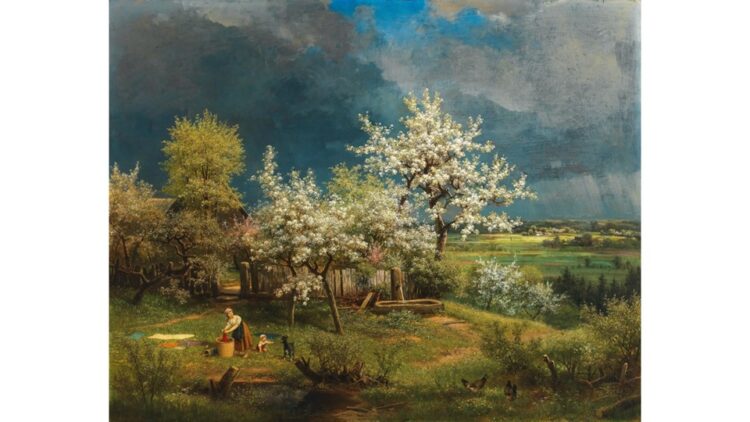
Spring Storm
A stirring in the pine, a tomblike pause,
and then a rhythmic misty harmony
is tapping on the leaves, as if applause
were heralding some heavenly esprit
for boughs awakened by the breeze. A veil
of steamy gloom obscures the forestland,
and droplets in neurotic fits impale
me to the pathway seeking reprimand,
and from the heavens plummet raucous sheets
of rushing tumult in a foamy swell
of whiteness as a vengeful god excretes
a burst of venom to the depths of hell.
In awe I watch this act of Providence:
it renders impotent my every sense.
Paul Buchheit is an author of books, poems, progressive essays, and scientific journal articles. He recently completed his first historical novel, 1871: Rivers on Fire. His poetry has appeared in The Lyric, Illinois State Poetry Society, Poets & Patrons of Chicagoland, Maria W. Faust Sonnet Contest, Society of Classical Poets, and other publications.











Paul, in writing of a “Spring Storm,” you meet the challenge of why and how it’s different from a storm at any time. Above all (and coming down rapidly!) it’s the “foamy swell of whiteness,” with drenched white blooms losing their flowery identity. You make horror of it, anticipating the rain with “a tomblike pause,” and attributing the sense-subduing act of Providence to a vengeful god. Surprising mood!
Thanks for your always-insightful comments, Margaret.
Paul, your description of this storm is exquisite. Phrases like, “a tomblike pause”; “droplets in neurotic fits impale me….”; “raucous sheets of rushing tumult” (great alliteration there, too!); “a vengeful god excretes….” show your powerful use of every part of speech (I particularly like your use of “impale” and “excrete”.) I can hear the “applause” of the rain on the leaves; I can feel the rain impaling the poet to the pathway. And your final couplet concludes the sonnet profoundly.
Thanks for your kind words, Cynthia. They mean a lot.
A poem full of vivid imagery that takes me out of the desert, back to times in England when I experienced such a sense-heightening event.
Thanks for the read, Paul.
Thanks, Paul, glad you liked it!
The language, at times, might be a little bit florid, but here it seems appropriate. Though it isn’t always clear what is happening, it’s a nice ride. Imaginative, in all the best senses of the word.
Thanks for your feedback, C.B.
Paul, I admire your vivid use of personification and pathetic fallacy in a mellifluous and mystical sonnet that has swept me up in its magic. Thank you!