


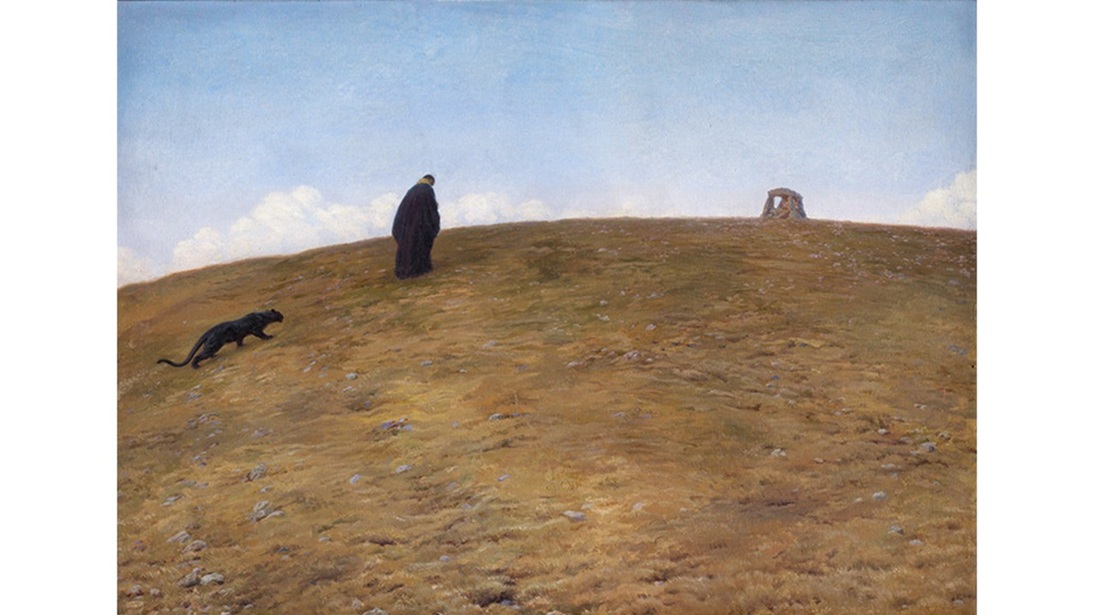
Unexploited Providence
“Why am I here?” I was afraid to ask,
While walking—half asleep—this land of wonders.
So, stumbling on, I took myself to task
And totted up my many glaring blunders.
Creation offered me its very best
To satisfy my least advertent leaning,
But tendencies of wastrels never rest
And rarely lend a life sufficient meaning.
A universe that’s made of scattered dust
Will not suffice to keep the trains on track,
And transits way off schedule, as they must,
Ensure that ennui keeps on chugging back.
But if the world should suddenly stand still,
With me, before all others, at its center,
Then more than likely I’d have time to kill
When facing pathways posted: DO NOT ENTER!
I’ve failed to take advantage of the gifts
Profusely strewn along my winding path,
But if the fog of self-absorption lifts,
I might behold a brighter aftermath.
C.B. Anderson was the longtime gardener for the PBS television series, The Victory Garden. Hundreds of his poems have appeared in scores of print and electronic journals out of North America, Great Britain, Ireland, Austria, Australia and India. His collection, Mortal Soup and the Blue Yonder was published in 2013 by White Violet Press.


















C.B. You touched my feelings of what I could have been in life from my age and time for introspection. Your poem is insightful, creative, age-sensitive, and noteworthy.
Well, Roy, I’ve been having these intimations of missing out for decades now, but at this point I realize that the past is set in stone. I’d advise you not to get old, but I’m sure it’s too late for that now. The joke is on us, and we have to make the best of it.
These are quatrains that cut to the quick for any elderly person. What did I miss? What did I not do? What blunders did i commit, and what opportunities did I let pass by?
The middle quatrain, which uses the imagery of a train and railroad tracks, and the “chugging” of ennui, is very effective. It summons up the truth that life, like a scheduled train, arrives and departs at fixed times mostly, and does not wait for stragglers.
You, Joseph, being a couple of years older than I am, know the situation better than I do. This situation, as with most existential circumstances, has been dealt with many times over in the annals of poetry and other genres of writing. But every generation has the right — nay, the duty — to cast this theme anew in the idiom of its own time.
Your poem nicely expresses the universal sentiment of those with any sensitivity to their position as fallen creatures inhabiting a fallen world. We are underachievers at realizing the positive opportunities with which providence presents us, overachievers at missing them. I, too, like the train imagery in the third stanza, and “wastrel” in line 7 is a homerun! But I find glimmers of hope in this lament: first in the word “providence” in the title, since providence is the opposite of a world that is merely “made of scattered dust;” second, in the closing couplet that holds out the possibility of “a brighter aftermath” if “self-absorption” is dispelled, a condition already at least partially realized in the recognition that to loose one’s life is to find it (to put it in biblical idiom). The more I read your poem, the more I like it. Thank you for writing and sharing it.
Ideas, words and phrases, Duane, are the mortar, bricks and site plans from which we build our structures, and from there on everything is improvised. The walls are not always plumb and well pointed, because the creative word is always steeped in imagination, which, in aggregate, might be seen as a sort of freemasonry where, for a little while, we are masters of a small universe.
Now that I’ve heard your voice on the Classical Poets Live podcast, I heard your scratchy voice when I read this. I really enjoyed this one. It felt like a quiet, honest reckoning with wasted opportunity and that nagging sense that you’ve been given more than you’ve made of. I liked that the ending leaves room for hope without pretending it’s easy.
Scratchy voice, Michael? Yeah, that’s the consequence of too many cigarettes. Life goes on (for a while), and it’s never easy, but, as you say, there’s always the possibility of hope.
We’ve all had too much of something…
I’m sure we all question what we have achieved in life, but on reflection have affected so many of those things and folk around us – hopefully for the better.
Thanks for an introspective read, on a day I’ll be doing everything from picking up my laundry to typing up Chapter / scene 14 of a book I’m currently writing. Achievement comes in many forms!
Thanks for the read and the reminder to remain active.
You can’t teach an old dog new tricks, Paul, but an old dog can certainly repurpose old tricks learned when the world was young. I never collected Boy Scout merit badges, but I think I have written a decent poem here and there, which is an achievement, and, as you write, “Achievement comes in many forms.” There’s the sonnet, the villanelle,….
A most enjoyable poem, Kip, which I would describe as reflectively rueful. I’ve yet to meet a soul who is not at least a little bit challenged by that “fog of self-absorption.”
If you take joy, Brian, in reflective ruefulness, then I don’t know what to say to you. When the fog lifts, we will see nothing but blue sky — or at least that’s whey tell me.
C.B., this beautifully composed wake-up-call of a poem speaks to me where I am at in my life right now. I am backtracking and (for the umpteenth time) I’m asking myself the question in the opening line of your poem. The second stanza is my favorite, especially: “Creation offered me its very best / To satisfy my least advertent leaning,” – oh, if only I had taken full advantage of the gifts of creation I have been blessed with! Your words hearten me… I’m ready for change. Maybe there’s a fog-of-self-absorption zapper going cheap on Amazon.
Not you too! Most of us are fairly convinced that you have done well with the gifts that have come to you, and why would we not be? Of course your own judgment about this is the only opinion that matters. The only thing available on Amazon is probably a UV bug-zapper.
A beautiful expression, C. B., of how perspective matters. At times, to all of us, the world is Creation with its very best, and at other times a universe of scattered dust. You identify the unhappy view as one of self-absorption. Wishing you a frequently brighter aftermath of the season’s great gifts!
Thank you, Margaret, for the kind sentiments. Though rain is predicted, tomorrow I will spend Easter Sunday with my grandchildren, and that is as sunshiny as anything I could imagine.
I very much appreciate the message you convey: meaning comes when we look outside ourselves. You illustrate it beautifully (appropriately enough in the first person) with a wonderful frankness in the narrative voice that admits its fault yet in that admission transcends it.