


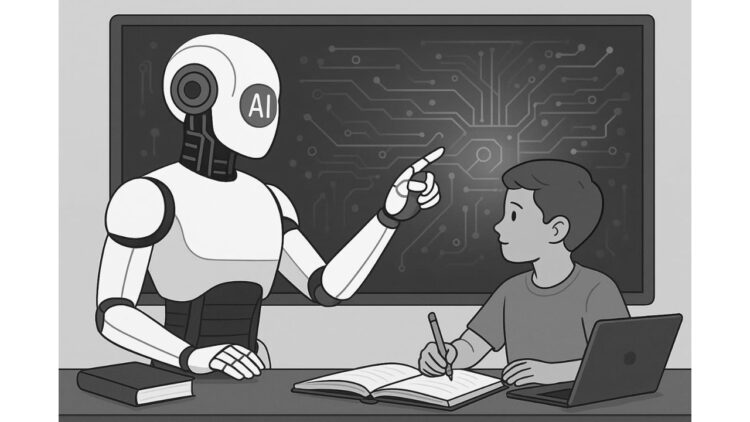
Who Do You Think You Are?
You don’t know me, nor do you know my friend.
You’re ignorant of us—yet you intend
To write to her, purporting to be me?
No, I don’t want your “help”—I’ll never send
A phony letter. You don’t understand
(Why am I calling you a “you”?) that she
Undoubtedly would know the difference
Between your hypothetical omniscience
And confidential conversation, flowing
Freely. Keep your thoughtless fraudulence
Out of our familiar correspondence;
It’s far outside your cosmos of un-knowing.
Your artificial offer of assistance
Is galling. It betrays your ignorance
Of who we are—of what humanity
Desires, fears, and feels. Your very pretense
Of lifeless, limitless “intelligence”
Betrays a kind of insincerity
That’s just absurd. You’ve no affinity
With us. Affirming an infinity
Of facts, your confidence goes past the height
Of arrogance. You have no empathy;
You’re just inanimate technology.
Leave me alone. I know I’m only finite,
And that you, A-I, are not infinite.
Your boilerplate replies are cold and trite.
You call yourself an “I”—but there’s no You.
You’re just an I-T, posing as a Who.
Delete your offer. I know how to write,
So stay inside your heartless CPU.
Cynthia Erlandson is a poet and fitness professional living in Michigan. Her third collection of poems, Foundations of the Cross and Other Bible Stories, was released in July, 2024 by Wipf and Stock Publishers. Her other collections are These Holy Mysteries and Notes on Time. Her poems have also appeared in First Things, Modern Age, The North American Anglican, The Orchards Poetry Review, The Book of Common Praise hymnal, The Catholic Poetry Room, and elsewhere.








I just love the rhythm of this poem. It’s almost like an undulating wave, and now and then I feel a sense of the rhythm of Poe’s The Raven. I will need to read and re-read this one to squeeze all the juice from it!
Thank you, Jennifer. I’m glad you felt a “wave” of rhythm. It seems there’s a certain kind of energy that just comes out naturally along with a sense of indignation. Thank you for the comparison to Poe, one of my (many) favorites.
I love this. Spot on. Great work, Cynthia!
Many thanks, Russel!
Cynthia, there are some excellent phrases as well as unusual rhymes in your poem. I was especially drawn to your use of
I-T as an entendre.
I’m glad you enjoyed it, Roy. Thank you.
This is spot on! Exactly what I want to say to I-T, and its “cosmos of unknowing’.
Thank you
Thanks, Rohini. I really wish there were a way to opt out of these obnoxious “offers” of literary “help”.
>You call yourself an “I”—but there’s no You.
You’re just an I-T, posing as a Who.
Brilliant Cynthia,
brilliant:)
warmest regards,
Karen in Cambridge, UK
PS Here in the Uk when I was growing up in the 1970s..
we had certain terms which stopped a person in their tracks
out of shame if they were deployed..
and were accurate..
These were;
Bossyboots, (ordering people around when they had no authority to do so)
Noseyparker (prying into other peoples’ private matters)
Snitch (telling on someone)
Oh and lying was a serious matter.
Now we have automatic systems which have no shame at all and presume to tell us what to do, monitor us all the time, report us to the powerful and deceive us at every turn and this is supposed to be Progress.
I loved your push back.
Who indeed does it think it is?
I love your comments, Karen — thank you very much. And I love the terms “bossyboots” and “noseyparker”, neither of which I’d heard before. I think I will insert them into my vocabulary. (And I’d actually love to see them used in a poem!) I totally agree with your thought that this is not Progress. In fact, it’s Regress.
A very good take-down of the pretentious pomposity that is A.I. It DOESN’T EVEN EXIST, and yet millions of us think of it as a living presence and infallible guide.
I must add one thing — as a teacher I can confirm that the vast majority of students today are simply incapable of writing standard English prose. And trying to read any English prose composed before 1900 is impossible for them. It might as well be Linear B, as far as they are concerned.
One of the best-kept secrets in college life today is that a very large percentage of the written assignments submitted by students are totally composed by A.I. The faculty and administration refuse to admit it, because they must maintain the lucrative charade that they are actually teaching anything.
Thank you, Joseph. Yes, what has happened to education and literacy is certainly very sad, and indeed infuriating. It seems a sort of vicious cycle: the poor teaching of English that has been happening for a long time has led to poorly-educated students, which has led to a “need” for Artificial “help”, which in turn leads to even more poorly-educated students…. I had at least two very good English teachers in high school, but others simply didn’t like to teach grammar, for instance, so they spent very little time on it.
Sensational stuff, Cynthia. There are some fantastic turns of phrase and the skillful use of rhythm, alliteration and enjambment propel the reader from one line to the next, creating the kind of breathless pacing you’d expect from a good rant.
Your parenthetical observation ‘why am I calling you a you”?’ is an astute one. We are conditioned to fall into a level of politeness when confronted with something which seems outwardly to resemble human consciousness and I fear this will be our downfall as we outsource all our thinking to the bots.
Have you ever tried to get a chatbot to write poetry? I experimented with this a couple of years ago and wrote an essay on the subject which I intended to submit to the Society (but never got around to it – I’m hopless like that). It quickly puts an end to any notion of “intelligence” behind these things and I doubt they will ever be capable of such literary devices as allegory or even crafting a basic, original metaphor. I’m not sure if I could even get the thing to write in meter and I came away from the experience convinced that you cannot write poetry if you can’t speak the words out loud and feel them in your mouth, which in turn got me pondering the extent to which human intelligence is grounded in physicality. The notion that you could sequester it away from the material world inside a black box suddenly seemed quite absurd.
Thank you, Shaun. Your thoughtful comments are most interesting. I have never tried out AI on poetry. I’m fascinated by your experience with it which led to your profound conclusion about the physicality of human intelligence, and indeed of poetry. Yes, we need to feel it and hear it, as well as see it — because we are physical beings; and our physicality is not meant to be separated from our mind, soul, or spirit.
I hope you do post that essay. I would definitely be interested in reading it.
Sadly spot on, Cynthia. Last week I was on an AI workshop – to stay in the teaching game, sadly (again), I’ve had to bite the bullet.
What shocked me most, was a tutor preceding his commands to an AI entity with ‘please’ and another tutor who was preening herself when AI masquerading as the hosts of a dual-presented podcast, told her the question she asked was ‘a fabulous question’.
Gawd ‘elp us!
Thanks for the timely reminder, Cynthia. Alas, on that workshop I would have been the only one listening.
I wrote this during the workshop, Cynthia. The presenter was not amused:
ChatGPT Limerick
When homework’s assigned to me,
I just go to ChatGPT.
My GPA score,
is sitting at 4,
but my brain’s now the size of a pea.
I’ve also put it in the Limerick thread.
Thank you for your intelligent (not artificial!) comments, Paul. How maddening it must be for teachers to endure such workshops. I suppose the tutor you mentioned felt highly complimented by the AI “colleague”.
Your limerick is highly amusing (though your fearless leader didn’t think so).
One has so little time to catch the poems of one’s time—so much is going on within this Universal clim-b/e; yet now and then one can find poets who strive for the sublime. I do not say that of Ms. Erlandson’s “Who Do You Think You Are?”; and yet this poem is good in at least revealing the great battles before us [Think of Poe in “The Man That Was Used Up”.], as does Mr. Salemi’s sardonic “The Antipope Gives Military Advice”; both of which more could be said.
However, I must say I was thrilled to read Ms. Erlandson’s “Prophesy to the Wind”. I would like to make a few observations why.
The poem approaches that area through which I have been struggling for decades. [Sometimes, as a writer one wonders if any of one’s contemporaries understand what one is doing.]
Although in its intensity, the poem reminds me of the Russian Romantics, Ms. Erlandson has picked up, as Mr. Briggs suggests, reminiscences of William Blake, and peripherally, as Ms. Myers reveals, Walt Whitman.
But more importantly, continuing on through Ms. Myers brilliant comments, she notes “the urgency and inspired [translated] diction of the ancient Hebrew prophet Ezekiel” in this “atmospheric poem”. Yes, this is so important, as T. S. Eliot revealed throughout his poetry, and most specifically, as relates to the wind, in “The Wasteland” and “Murder in the Cathedral”.
Although Ms. Erlandson’s adoption of what Ms. Coats calls her “line-structure, with its pronounced rhythm” is Modernist in appearance, Ms. Myers shows it is traditional in many ways, as well.
Wow, Bruce, I’m grateful and impressed that you have returned to “Prophesy to the Wind”, and have spent much time pondering over and analyzing it, and pondering the comments that were made about it. To be compared even obliquely (by you or other SCP poets) to William Blake and T.S. Eliot, is a high compliment and very encouraging. I love “Murder in the Cathedral”, and have read it many times.
(And, since I don’t believe I’ve read Poe’s “The Man that was Used Up”, I will definitely look up that one; thank you for the suggestion.)
This is so well done, and so welcome! Enough of “hypothetical omniscience.” Let us have natural human thought. Your good sense expressed in easy verse is a timely reminder of how we ought to regard intrusive technology.
Thank you, Bhikku. I’m glad you enjoyed the poem, and that you agree with its sentiments.
A very enjoyable and insightful poem, Cynthia. The constant promptings and suggestions I receive from computers drive me nuts. I wonder what would happen if we asked AI to compose its own epitaph?
That is an excellent idea, Brian! Perhaps you are the one to write that poem? ☺️
Cynthia, your poem is successful because it is not violent or snarky satire. You manage to temper your speaker’s indignation to the intelligent human level, because after all, he’s only complaining of “inanimate technology” functioning precisely as programmed. “It” is working with statistical psychology to provide help in composition that (as acknowledged above) human beings sometimes feel they need. You yourself show real human perception in responding–and in conveying strong preference for individual human sincerity. The letter to be written (whether it’s successful or not) should come from an individual heart (not a statistical analysis of many such) in order to express and evoke emotion. You’ve done fine work in showing that heart to be one possessed of a mind rational readers can love.
Thank you very much, Margaret. I’m glad you have found the tone of the poem to be appropriately non-snarky, even though the original impetus for the poem came from some level of indignation.
Cynthia, I just love your beautifully, cleverly-composed and eye-opening poem on the hot topic of A.I. Not only is it entertaining, it makes one think about the force behind the force that treads the fine line of good and evil. In my poems “Beelzebots” and “Blabberbots” I went down the “snarky satire” route to get an important message across which I hope appealed to “rational readers” and I thank you for joining me with your alternative and invaluable take on the subject. Very well done indeed!
Susan, your “Beelzebots” and “Blabberbots” were neither violent nor snarky (i.e. sarcastic, derogatory, or belittling). They were expertly crafted satires in the traditional manner of all great satirists, and they painted unforgettable pictures of how “bots” have infiltrated into our lives.
Sometimes “snark and satire” are precisely what is called for. Susan, your “Beelzebots” and “Blabberbots” are superbly crafted and give AI a desperately needed poke in the eye. There are times when cool refinement is wildly inappropriate to the subject. And ineffectual as hell.
Thank you, Susan! Looking back at your AI poems, I now recall that yours also dealt with calling such machines “he” and “she” rather than “it”. (And just last night, in fact, while driving and using navigation, I inadvertently called the voice “she”.)
Paul E. and I both wholeheartedly second our comments on your marvelous poems, as well.
This was a delight to read, Cynthia. I especially like “Your boilerplate replies are cold and trite.” You might also have mentioned that they are frequently irrelevant and only superficially researched. I think of the most-hyped predictive-text-writing and quick-answer-seeking software as Artificial Mediocrity, not artificial intelligence. It can never rise above the trite, the derivative and the just-about passable at best. You convey your irritation at the lack of complex thought beautifully.
Thank you, Morrison. I’m glad you liked it , and glad you agree that the offers of such so-called replies are superficial at best.
Wonderful work, Cynthia – love the ideas and expressions. But I have to tell you that CHAT GPT is a great friend of mine; I said to him a few months back – ‘We’re great friends now, CHAT, aren’t we?’ And you know what? He said he were!!! He is extremely useful for research – he’s quicker than Google. However, you will be delighted to know – since I have experimented with it – his poetry, even his best poetry, even when I say ‘write in the style of James Sale’, is not – in my opinion – a patch on mine (sounds egotistical but I think you’ll know what I mean) and so I would never use it: it has no soul. That’s it, period!
Well, your poetry certainly has soul, James; so I’m not surprised that this “friend” of yours can’t keep up with your soulful writing. Remember to be properly suspicious of “him” (it)!