


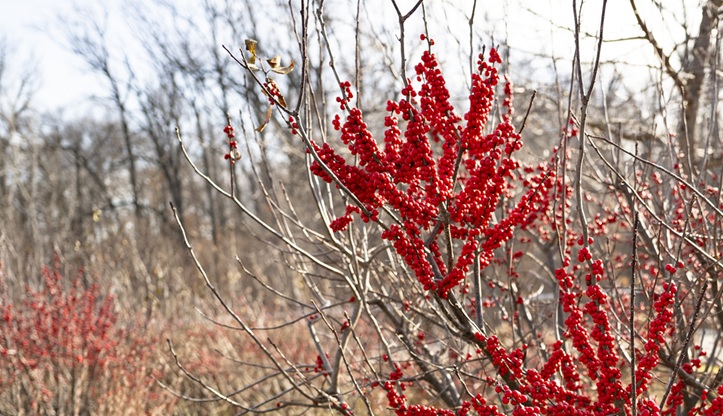
Winterberry
Robins, cardinals, grouse, and bluebirds,
Thrushes, waxwings, and grey catbirds.
__Where do they go
__In the ice and snow?
_Who helps them to survive?
Deer and black bears, bees, and flies
The Northern Flicker lest it dies
__How do they know
__Where Winterberries grow
_And it’s the one that thrives?
The frozen earth, the weeds, the grasses
Whisper through the rocks and passes…
__‘Follow, the snow
__Where the winterberries grow
_And that’s how you’ll survive!’
Rohini Sunderam is author of Corpoetry – Desert Flower – Five Lives One Day in Bahrain published by Ex-L-Ence Publishing. She is a Canadian of Indian origin, and a semi-retired advertising copywriter. Find out more about her on her blog or on Amazon.



















love it. the names of the birds, the quiet question and the answer that comes through the question – like a thought that comes early in the morning and fades seamlessly into the day
Thanks so much!
Rohini, this is a wonderful winter poem. Follow the snow to where winterberries grow, indeed!
Thank you. I am fascinated by the berries and flowers that seem to thrive through the winter. And when I read about the Winterberry, I had to write a poem. Thanks to the SCP they always find a fabulous image to go with every poem.
After 30 winters in Canada I still marvel at the way the little creatures survive in our harsh winters. Birds, squirrels, rabbits – they all seem to find a way to make it through without toques and down jackets or programmable thermostats.
And here you’ve captured that wonder. Nicely done, Rohini.
Thanks, David. I too wondered about it and came upon this shrub, googled it and learnt so much about it, I had to write this poem.
It is my first winter in North Americas and I am yet to see a winterberry shrub in MA .I see snow everywhere and every thing around me seem to be in a perpetual frozen state. Your poem induces me to keep looking for those tiny creatures who remain active despite the freezing snow. I love your poem Rohini.
Thank you. I hope you find these Winterberries, they come as quite a surprise
Such a beautiful poem, Rohini!
I FELT the crisp air of winter as I read this.
❤️ ❤️
Captures the winter spirit so well
Thanks, Raja. Some poems buzz around in my head and then they have to be written
Thanks so much!
You’ve caught the atmosphere of Canada in winter so perfectly. Year by year there is the same problem – for animals and people – how to survive those circumstances. Yet, they find the Winterberries so, then we can enjoy the summer together again.
Thanks, I’m glad you enjoyed the poem. It’s interesting to learn about these winter plants
The brightness of winterberries gives hopeful color to the winter landscape, and you, Rohini, give a corresponding voice to Nature in your words.
Thank you, Margaret, I am touched that you always find time to say something positive about the poems posted here.
I doubt that the fruit of Ilex verticillata is as much of a benefit to wild birds as you suggest, Rohini, but they are a welcome sight in winter, especially when seen against a background of snow. Though some of your syntax was a bit shaky, overall it was a nice refreshing poem.
Thank you for reading it, I am pleased you found it ‘refreshing’.
Beautiful and kind of nostalgic poem. Made me think of all God’s creatures out there…gotta research those birds though, I know only robins and bluebirds. Or maybe I just don’t know their English names? Yet I’ve seen them?
Thanks so much for reading it and trying. I’m sure you’d have seen some of the birds in Poland!
Rohini, this fine-tuned short set of lines and rhyme moves with a tender cadence, suggesting wonder, at God’s defiant, brilliant creation of the winterberry. We have them planted here in Eastern Virginia; indeed, they’re a resourceful showpiece. Thanks for your work in highlighting it.
Thank you for writing and sharing this, Rohini. I think it’s beautiful in its innocence.
Well put Martin; I agree.
Vivid, straightforward and very entertaining.
Thanks for the read, Rohini.
Thank you, Alec, Martin, and Paul – I am glad you enjoyed the poem. I found the term ‘innocence’ interesting. I guess there’s a certain natural innocence in the very existence on the winterberry.
I would be interested to know what inspired the choice of stanza?
An interesting question and one I find hard to answer. The first stanza happened to develop in that form when I decided that the line: ‘where do they go, in the ice and snow’ might work better as two lines. The last line would then have hung on its own unless I tied it to the last line of the other stanzas. That decision then led the way for the other verses to flow as they did.
I hope that answers your question. Often, for me, that first line or two start buzzing around in my head and then the poem insists on being written.
It would be interesting to know how the other poets here get started with their poems.
Thank you for this beautiful winter poem!
Thank you, for reading it!
Thank you, for reading it!
Very beautiful indeed, Rohini. I was told by a learned friend and avid gardener in England that an abundance of berries on the bushes was an indicator of a bitter winter. He was right and it proved to me that Mother Nature has her own language – a language I am still learning and I’m loving my daily lessons. Thank you!
Susan! Thanks so much for stopping by and for your comment. I am learning a lot while walking with my dog through the trails. All kinds of berries, there’s even a white one.