


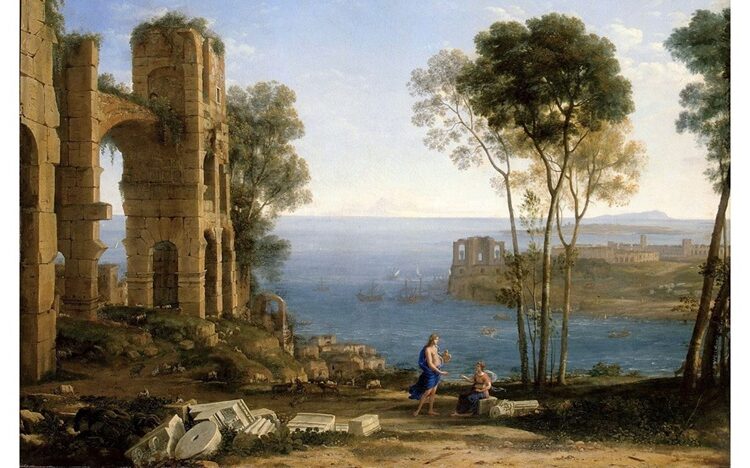
On the Ruins of the Ancient City Cumae
by Jacopo Sannazaro (1458–1530),
translated from Latin by Margaret Coats
Here the far-famed walls of ancient Cumae rose,
_Prime glory of the clear Tyrrhenian Sea.
Here awestruck questioners came rushing evermore
_To hear your oracle, O great Apollo.
Here energetic sailors found the shielding harbor
_Where Daedalus had rested from his flight.
Who could have thought, as long as brilliant fate beamed on,
_Wild forests here would shelter savage beasts?
Silent the secrets of the fate-announcing Sibyl,
_Where now a shepherd pens his sleepy sheep.
Sage fathers congregated in these lordly courts,
_Now home to serpents and fierce birds of prey.
Grand halls displaying wax ancestral portraiture
_Sag in a heap, collapsed through their own weight.
The noble entryways adorned with sacred trophies
_Lie underfoot; grass grows on gods destroyed.
Such beauty! The skill of many hands had shaped these tombs,
_But ruin subjugates fine art’s devotion.
Among the lonely houses scattered here and there,
_A stranger stalks and spears a bristly boar.
Did not the god himself breathe song to guide Greek ships,
_Led by a dove, as settlers toward this shore?
Why should we wonder how brief moments of our lives
_Depart? A violent death suppresses cities.
O, may my prophecies deceive myself, the poet,
_And future times think what I say is false.
You, Rome, will be no more embraced by seven hills,
_Nor Venice rise mid-waves to rival Rome.
To you, my foster mother, a plowman will proclaim,
_“Naples is nothing but soil.” Can I think so?
The Fates betray us men. Their dreadful force decrees
_Whatever you see today will pass away.
Latin Original
Ad ruinas Cumarum urbis vetustissimae
Hic ubi Cumaeae surgebant inclita famae
moenia, Tyrrheni gloria prima maris,
longinquis quo saepe hospes properabat ab oris
visurus tripodas, Delie magne, tuos,
et vagus antiquos intrabat navita portus
quarens Daedaleae conscia signa fugae
(credere quis quondam potuit, dum fata manebant)
nunc silva agrestes occulit alta feras.
Atque ubi fatidicae latuere arcana Sibyllae
nunc claudit saturas vespere pastor oves;
quaeque prius sanctos cogebat curia patres
serpentum facta est alituumque domus;
plenaque tot passim generosis atria ceris
ipsa sua tandem subruta mole iacent;
calcanturque olim sacris onerata tropaeis
limina, distractos et tegit herba deos.
Tot decora artificumque manus, tot nota sepulcra,
totque pios cineres, una ruina premit;
et iam intra solasque domos disiectaque passim
culmina saetigeros advena figit apros.
Nec tamen Graiis cecinit deus ipse carinis,
praevia nec lato missa columba mari.
Et querimur, cito si nostrae data tempora vita
diffugiunt? Urbes mors violenta rapit.
Atque (utinam mea me fallant oracula vatem,
vanus et a longa posteritate ferar!)
nec tu semper eris, quae septem amplecteris arces,
nec tu quae mediis aemula surgis aquis,
et te (quis putet hoc?) altrix mea, durus arator
vertet, et ‘Urbs’ dicet ‘haec quoque clara fuit.’
Fata trahunt homines. Fatis urgentibus, urbes
et quodcumque vides auferet ipsa dies.
Translator’s Note
This is the ninth poem in Sannazaro’s second book of elegies. The form is elegiac couplets, with a line of dactylic hexameter followed by one of dactylic pentameter. I have translated into iambic hexameter and pentameter. Division into eight-line “stanzas” is not in the original, but the poem has convenient pauses at those places, where I pause for the convenience of readers.
The name of Apollo in the first stanza, and the names of the three cities in the final stanza, do not appear in the Latin. The identities are clear, but presented allusively by Sannazaro, who was born in Naples not far from the site of ancient Cumae. He studied at the university there, and after a career elsewhere in Italy and in France, spent the last 25 years of his life in his native city.
The Cumaean Sibyl
by Margaret Coats
Within a cavern chamber I repose
Upon a throne of figured brocatello
In blushing purple, scarlet, saffron yellow,
Reflecting what my courtyard garden grows.
My prophecy a golden age foreshows,
A king eternal whose mute force feels mellow.
“Too sweet and juicy,” global builders bellow,
“This world needs earth and culture burst by hoes.”
Will peas and beans bloom better, vulcanized?
The straggling ivy tendrils die unspied?
Acanthus climb a tottering inferno?
Their sovereign may well stand unrecognized,
Misrepresented, falsified, denied,
While self-absorbed souls drown in Lake Averno.
Poet’s Note: Ancient Cumae was a Greek colony in the region of the present-day city of Naples. Lake Averno, considered an entrance to the underworld, is nearby. In Vergil’s Aeneid, the Cumaean sibyl guides Aeneas to the underworld and warns him of dangers. An enigmatic figure who speaks in riddles, she was revered in Roman culture, and remains a symbol of prophecy and destiny.
Ivy and acanthus are associated with pursuit of knowledge, and with immortality achieved through performance of difficult tasks.
Margaret Coats lives in California. She holds a Ph.D. in English and American Literature and Language from Harvard University. She has retired from a career of teaching literature, languages, and writing that included considerable work in homeschooling for her own family and others.

















“The Cumaean Sybyl” is such a great poem with amazing use of words like “brocatello,” “foreshows,” and “burst by hoes.” I have always admired your erudite capabilities and intellect infused with great sensitivity and emotions. The notes were essential to my ability to relate to the context.
Thanks, Roy, I’m very happy you like the sonnet. These poems on ancient Cumae need explanatory notes, and some good rhyme for your sake, but Sannazaro’s elegy just would not rhyme in translation any more than it does in the original!
Margaret C.
Congratulations on your lifetime of work with ancient classics of literature and languages. You have a formidable ability and familiarity with such esoteric knowledge. Thank you for your intellectual gift to readers.
From Margaret B.
Thank you, Margaret B., for your kind appreciation. The Sannazaro poem is just one example showing how very long poets continued to compose in ancient classical languages and literary forms. I’m glad the Society is willing to bring such things to light.
Margaret, “The Cumaean Sibyl” is a beautiful Petrarchan sonnet, a superb piece of work. It’s a privilege just to read it!
Thank you so very much, Paul! Since the Cumaean Sibyl is the most important of sibyls in literary history, I’ve given her the venerable Petrarchan form of sonnet. This “Sibylline Sonnet” can be compared to three other posts by that name on this site, with different forms of sonnet for each sibyl.
Oh Margaret! Thank you so much for lifting us out of these dark days into the masterful idyllic poetry of long ago Italy. In a way, you have raised obscure, long-buried words from the dead, brought them to life, and given them voice, complete with peas and beans, ivy and acanthus twisting and blooming themselves into fiery infernos!
And well-timed too since one month from today, I embark solo on a journey that will take me to Rome to Venice to Ravenna to Bari to Matera to Naples (Pompeii Herculaneum Vesuvius) and one final day in Rome when I hope to revisit Saint Peter’s and afterwards stroll past the Parthenon on my way back to my hotel, the rail station, and, at the end, a long flight home. Along the way, I dare to hope that I will experience some of the same thoughts and feelings you have so masterfully expressed in your verse.
James, your upcoming trip will surely be filled with inspiration! Hope much of it is idyllic, as well, despite any disturbing distractions of modern cities. Glad this poem of Sannazaro’s could serve as an uplift. I have long wanted to give the Society something from the vast library of neglected Renaissance Latin poetry; this piece seems to have been meant for you. My Cumaean Sibyl is contemporary, and a bit cranky, as her prediction of a golden age with an eternal king (cf. Vergil’s Fourth Eclogue, where the poet is sometimes thought to be her media mouthpiece) seems not to have been acknowledged by our global age. May you enjoy her natural garden’s peas and beans, with ivy and acanthus, as you travel.
It is always fascinating to me to see how a particular theme acquires a certain immortality and may be seen traveling through the ages. Here, Margaret, we have the subject of ancient ruins and an evocation both of their one-time glory as well as a melancholy observation as to what that glory has become. Your translation dates to the Renaissance but ties in nicely with poems by Shelley, Keats, Browning and Wordsworth. Truly, a recurring and timeless poetic theme. The line “But ruin subjugates fine art’s devotion” especially resonated with me. Well done!
Thank you, Brian. The theme is universal, as you say, but particularly attractive, I think, to the Renaissance and to the Romantic era–for different reasons. This elegy is relatively brief, but Sannazaro creates a compact masterpiece of wide-ranging lament over the classical past, with a strongly personal memento mori for the present. You are touched by his lines on the decay of artistic beauty, which he emphasizes by “tot . . . tot . . . tot,” “so much . . . so many” encompassed in one ruin of the city. Like other artists of his period, he aimed to re-create the inspiring losses, with considerable hope that “posterity” would appreciate their achievements. The Romantics, I would say, turned instead toward describing and memorializing the psychological effects of contemplating ruin. Both approaches evoke emotion.
“On the Ruins…” is just a lovely poem, Margaret. Latin have I none (except some scraps peeled off from English reading), but I certainly appreciate your graceful rendering of the author’s poignant lament. Impermanence is a major Buddhist theme. There’s no getting around the fact, but let us find some wisdom and beauty in the contemplation thereof. “Grand halls…. Sag in a heap….” What a fine image.
“The Cumaean Sybyl” is a wonderful compilation of rhymes: brocatello (!) and all the other -ellows fitting together nicely as, let us say, a bouquet? And “foreshows” is a pleasant coinage. (At least I’ve never heard it before.) Congratulations on another successful poem-fashioning!
Thank you for your kind attention to both poems, Bhikku Nyanasobhano. The contemplation of ancient ruins (past glory and melancholy present) has become a universal theme, as Brian Yapko remarks above. And you refer to the major Buddhist theme of impermanence. Let me add to what I said to Brian, concerning Sannazaro’s final lines. There he looks to both present and future. Not only does he lament the present state of ancient Cumae, but takes up the role of poet as prophet, to predict that Rome, Venice, and his own home of Naples will someday vanish, as Cumae has, in effect. This is an original contribution to the lyric theme. And he is speaking of cities still well-known to us 500 years after his poem was written. We could say, as he says he hopes, that his predictions have proved false. Except that Venice is definitely in the process of sinking! It will need all the help of modern engineering not to crumble into the Adriatic. And its inhabitants cannot enjoy contemporary conveniences, because of the difficulties in making old houses into the kind of homes now desired by almost everyone. Technological progress and human demand for its comforts make yet another aspect of impermanence.
Thank you Margaret for these two amazing poems. There is so much here to absorb and ponder.
How wonderful that you can interpret for us such beautiful and ancient words.
Thank you very much, Isabella. These kinds of poem don’t always appeal to readers, but I do them to satisfy myself, and I’m always very glad to have appreciation from someone willing to ponder!
Twice I’ve returned to ‘On the Ruins of the Ancient City Cumae’. The first two attempts I was in the wrong mood, but this time… I found this poem a more sober version of Ozymandias, looking at the brevity of man’s accomplishments, all of which are in the hands of the Fates, and the aftermath of a populace reverting to subsistence. Some wonderful turns of phrase pepper this poem and having visited Jerash (abandoned when an earthquake destroyed the city’s irrigation and water system) and Musrawatt (sic), a ruined city in the midst of a desert, this poem is even more profound to me.
As for The Cumaean Sibyl, well, it seems to cover themes that are eternal.
Thanks for the reads.
Thank you for your attention, Paul. I too consider the Sannazaro poem one that requires a settling of mood to appreciate. Ozymandias may be the best known work on the theme, but as you’ve pointed out, there are many instances of such long-term ruin in human experience.
The Sibyl presents other eternal themes, and I brought her in because of her living in the same location. Interesting that to Sannazaro, who undoubtedly knew of the prophecy of Christ attributed to her, she is merely one item lost among Cumae’s ruins of antiquity.
A new translation by Margaret. Will it be from French or Italian? Neither – from Latin! It is rare to come across a translation of Latin Renaissance poetry. Some of it has been translated through Harvard’s “I Tatti” series, though I could not say whether the translations are metrical.
The hexameters are handled particularly well, in the sense that they sound natural rather than artificially and unduly long, even when embellished with feminine endings.
The combination of the form (an elegiac-esque succession of hexameter and pentameter, the closest possible English equivalent to the original) and the individually well-executed metrical lines provide more than enough rhythmic structure to negate the need for rhymes, which, in any case, were not present in ‘classical’ Latin poetry, even if they are found in later works in that language. Rhyme becomes less charming and more trivial in a language whose declensions are so strictly regular.
Thanks, Daniel, I’m glad the hexameters sound natural. That’s certainly the principal aim after achieving the right accentual length of lines, in order to correspond somewhat to the original Latin meter. Rhyme proved impossible. But you may be interested that Joseph Connolly, an American priest scholar writing in 1957 on hymns of the Roman liturgy, said: “Rhyme is not foreign to Latin poetry, as early fragments show. There are examples of its use in the writings of all the great Latin poets of classical times.” This was astounding when I first read the statement, but having more experience now of the wide range of Latin poetry, I think he must mean occasional rather than regular rhyme. That is, rhyme as an embellishment at times, but no stanzas with parallel rhyme schemes until the medieval sequences. Instead, songs with rhyme such as: xaxa xxbb cxcc dxxd, where x lines are unrhymed. You are correct that rhyming declension endings is too easy to look artistic!
Margaret,
Regarding On the Ruins of the Ancient City Cumae, I am surprised at how smoothly the translation flows. I found this poem easy to follow and liked the “timing” as I read it. It’s beautiful.
Thanks, Laura. The Italian poet beautifies the “now and then” of Cumae, reflecting on visible ruins. As he moves forward to the future of cities he’s visited, we can imagine these too, for many of us have seen them just as Sannazaro did so long ago. I’m glad his gloom at their possible passing has yet to happen!
Margaret,
Your second poem here was a bit more challenging for me. I relied on your comments to return to it and re-read it. I liked it, but its flow challenged me.
That’s a good thing!
Glad you like a challenge, Laura! The character is a strange one, and I made her speak with a prophecy applicable to ancient and modern times. Appreciate the attention you gave me in returning to re-read.
This is a lovely elegy, a measured yet melancholy reflection on the evanescence of human grandeur. Your translation does justice to the original, and has the added virtue of providing clarifying glosses without using footnotes (e.g. specifying “Venice,” which is only alluded to in the original). Your alteration of Alexandrines and pentameter is an English-friendly adaptation of the original verse, and goes a long way to preserve its flow. You also preserve the blank verse of the original, which was apparent to me only on re-reading, so well did the language flow. As in the original, the form lies in the meter.
Your poem to the Sibyl herself is striking: visually stimulating and multi-layered. You also in a brief space convey the Sibyl’s character, the wry old prophetess. In the sestet I sense an allusion to the Sibyl’s foretelling of Christ, a prophecy, which she introduces with a mocking question that reveals her sharp tongue.
Thank you, Adam. I especially appreciate your compliment on the ease of language flow in the Sannazaro translation. Although the elegy is complete in a mere 32 lines, this may have been the most difficult poem I’ve rendered into English for our contemporary readers. As you noticed, it also required work to convey the author’s allusive style (which would have been one of its beauties to learned readers in his own time) into meaning that most modern readers can appreciate without an array of footnotes. The universal appeal of the theme lies partly in his carefully detailed description, and more particularly in the feeling response to it, that he conveys so well through the metrical form.