


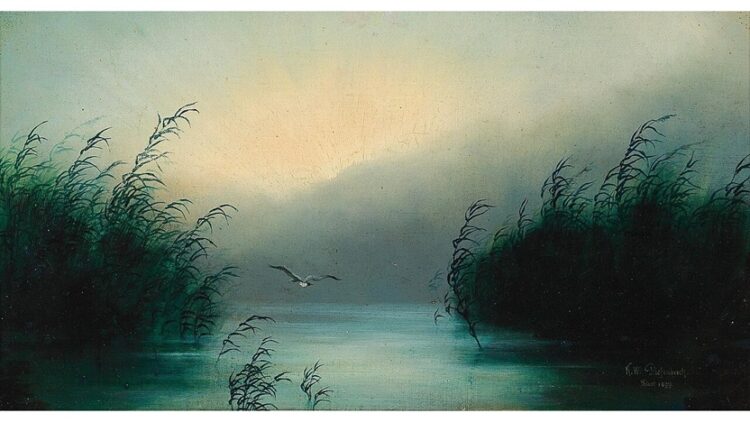
Allegrezza
In the harbor, the masts tilt left and right
like metronomes conducting waltzes made of wind
and wave, while on the shingle, gulls pluck whelks
from briny nooks, their gullets pulsing hard
to gulp the rubbery flesh. The shroud-light dims,
diminuendo made of mist descends,
and all the world’s small music fades away.
The sudden silence fills with my labored breath
and the hiss of gravel crushed beneath my boots,
a kind of white noise blunting subtler strains
around me. Ahead, the trail is thronged with crows.
As I approach, they surge away, their wings
and starless croaks resounding through the hills.
I’m shamed that even they are made of song
while I walk mute through symphonies of light
and green and life. The sun peels back the fog.
From somewhere in the grass, a wren sings out,
his warble dazzling, a burst of boundless joy.
Alice
Ungainly summer light, balanced on the crowns
of spendthrift oaks, tips from branch to branch
until it falls on bough and leaf then pools
among arthritic roots, guttering in the shade
and kindling all the dust and pollen bronze.
Against the tree, a girl of seven leans
and reads her book, itself about a girl,
one who spies a rabbit with a pocket watch.
She follows him down a nearly endless hole
to find a realm where all the doors reveal
kaleidoscopic gardens, menageries
of talking beasts, and all the perfect madness
she never dreamed she’d need. The reader blinks,
a sleepy flutter, then finds herself again
among the pillars of the real, the boles.
Rob Griffith’s latest book is The Devil in the Milk (Kelsay Books, 2017), and his previous book, The Moon from Every Window (David Robert Books, 2011), was nominated for the 2013 Poets’ Prize. His first book, A Matinee in Plato’s Cave, was the winner of the 2009 Best Book of Indiana Award. His work has appeared in PN Review, Poetry, The North American Review, Poems & Plays, The Oxford American, and many others. He is the publisher of Measure Press and teaches creative writing at the Savannah College of Art and Design.














I have thoroughly enjoyed both poems, with “Allegrezza” (great title) transforming the seascape into music, and “Alice” transforming reading into an act of enchantment. Together, they create an exquisite interaction between the natural world and the imaginative one. I love every line of each, but I especially like the alliterative musicality and the beautiful image of the closing couplet of the first because it speaks to my heart. I will never forget the day I was dazzled by the warble of a wren — I couldn’t believe that the mellifluous and lilting trill from a branch above me came from a small, dull-hued bird. It was a beautiful lesson in humility. This world would be a bleak place without the song of nature and the wonder of books. Rob, thank you!
These are both lovely vignettes, in elegant language, of two small scenes. The first is descriptive of place, while the second is also allusive to a well-known story and character, and they have a dreamlike resonance.
One question — the last word of the first poem is “joy,” so I assume that the poem’s title is meant to indicate the same. But in Italian the correct spelling of the word for joy is allegrezza, with two z’s.
That was an editor’s error. Fixed. -Evan
The astonishing “hiss of gravel” gave me a start – and a stop. I had to pause to take in the wording. It’s spot on.
Both poems are lovely.
I found both poems beautiful too. So many outstanding phrases in the first . Gullets pulsing hard/ to gulp the rubbery flesh – grabbed me first and then – all the world’s small music – several more until the final – the wren’s boundless burst of joy. A really lovely poem, as is “Alice”
The graphic is beautiful too, Evan. It seems a “symphony(ies) of light
and green and life”.
I admire the concert of “Allegrezza,” Rob. Musical terms, breath marks, silences, the metronome marking rhythm–and noise from others than the observed natural performers. Good to have the “speaker” there as de facto audience, especially as the sun lifts the curtain for an unexpected encore. “Alice” presents picture-in-picture-in-picture to your reader looking at the reader in the poem. Masterful technique in both.
Allegrezza – a symphony of sight and sound which reminds me how alert to the world around us we need to be to write poetry that transcends and creates a picture beyond the norm. What a great poem, Rob.
Alice reminds me its time I had another tour through Carroll’s brace of classics. That final, back to reality two and a bit lines is a great ending and the first time I’ve seen the word ‘bole’ in a poem, I believe.
Thanks for the reads.
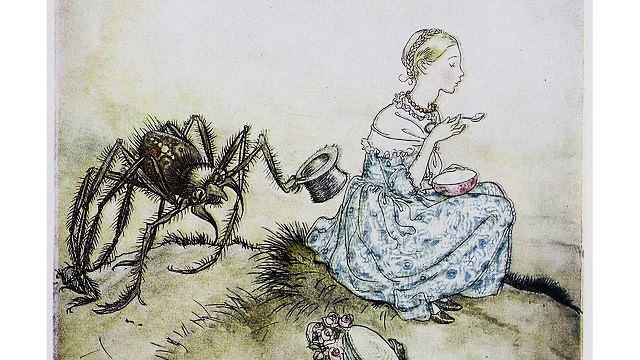
Imagination blending with the real world, an astute rendering of the mind of a seven year old. It’s the age when the drudgery of learning to read starts to recedes. Perfect choice of age to carry that theme. They call it the age of reason but I think it’s an age that experiences a growth spurt of imagination. Childhood innocence facing the “bole” of life’s mundane realities: tree trunks needed for timber. Thank you Rob.