


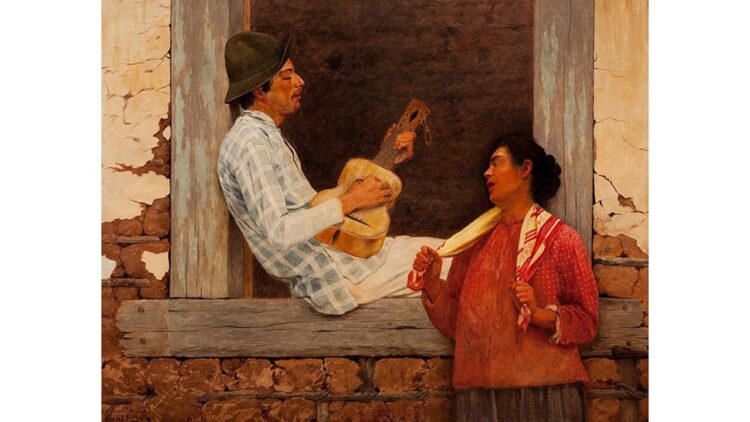
By the Waters of Babylon
All faces are foreign here, all streets unknown,
and even the sun seems like an alien star,
darker and redder than a homesick eye.
One hundred miles, ten thousand miles, how far
is far away? Laptop and telephone
pretend to bridge all distances, but lie:
the land beneath our feet is not our own.
And so we sit, each cradling a guitar,
beside this river, trying not to cry.
Will Villa-Lobos, Dowland, Bach, or Sor
sound the same here if we can make our hands
remember the cunning with which we once played
the anxious strings? But silence reprimands
the comfort we hoped music would restore
us sitting among the willows here. To pray
is vanity, for how can we implore
God for mercy, if by his command
our songs are stilled, and we are cast away
to this strange land. Perhaps our God prefers
the unfamiliar idioms of this place
to ours. All this is bad enough, and yet,
we have a further fear time will erase
the memory of home which still endures—
that it may, like a nova of regret,
fade out before our heart’s astronomers.
May God forbid such ultimate disgrace:
forgetting all we live to not forget.
He Makes His Way
A Thursday’s child, he may have far to go,
though he’s faced such resistance on his way
that making headway has been just as slow
as if he had been born on Saturday.
So saturated with ability
it fills his tracks with every step he takes,
his rising was an easy prophecy
like that a circus fortune teller makes.
Still, working every day till day is night
to clear the thorns and thistles from his field,
he cannot make what’s going wrong go right
or earn a living that the ground won’t yield.
Perhaps someday he will arrive. For now
his eyes burn with sweat dripping from his brow.
Duane Caylor is a physician in Dubuque, IA. His poetry has appeared in a number of journals, including First Things, Measure, Slant, and Blue Unicorn.



















I really like the rich, sustained allusion to Psalm 137 in the first one. Wonderful poem!
Thank you for your kind words. The idea of “home” as a place for which we have a natural, native affection seems an offense to those who long for a rootless, soulless, anonymous society of monistic materialism, but believing that there is such a thing as human nature, I was hopeful that the theme of the poem (like the first two strophes of Psalm 137) might resonate with others. I am glad it did with you.
“By the Waters of Babylon” speaks so richly, as Bill says above, of the psalmist’s expression of the sorrow in having involuntarily left home, and all that it means, behind. How, indeed, can one sing a song of home in a strange land? “Silence reprimands the comfort we hoped music would restore.” So true — a song that brings joy in one’s loved homeland, must evoke sorrow when one is cast away. You’ve created an especially beautiful metaphor with your phrases “a nova of regret” and “our heart’s astronomers”, harking back to the opening of your poem which speaks of unimaginable and heartbreaking distances from home.
Thank you. I am grateful, as I always am, for your positive comments. I don’t wish to seem mercenary –and please feel under no duress from this request–but I have a book, My Father’s Oaks, coming out from Wipf and Stock later this year, and given your previous comments on my poems, I was wondering if you would consent to review the book with an eye toward providing a brief rear cover commentary. My email is [email protected], and to keep your contact information private, you can respond there. And please accept my apologies if this is a somewhat gauche way of going about this. I am no spring (or even summer) chicken, but I am a novice at this book thing. Thank you again for your repeated kind comments.
The title of your first poem reminded me of the song, “Rivers of Babylon,” recorded by Boney M, a rock group out of Europe. Putting it into a more modern context was interesting and your imagery was evocative.
Thank you. You have always been complimentary, and I am grateful for your taking the time to read and comment upon what I write. Way back in the dark ages, when most of what I wrote was free verse, I (wrongly) imagined that I could be some sort of contemporary successor to the metaphysicals and the imagists; at least, I appreciated their rich metaphors, both explicit and implied. I now make no pretension of being either student or adept of any particular school (although I’ve only written metered verse for 40 years now).
There is a wonderful sense of “conversational quiet” in the first poem. The speaker talks meditatively, as if he were simply thinking to himself, the rhyme scheme is easygoing, and the enjambments are perfectly natural and unobtrusive. It’s the kind of sane, clear, thoughtful poem of interior musing that i would love to see published in “Poetry,” but never will be anymore.
The sonnet that follows it is also very nicely done, and also has the aura of thoughtful meditation.
Hi. Thank you for commenting on my poems, both now and previously. It’s a high compliment to mention a poem as worthy of Poetry. I like to think of talking to myself as a form of meditation (in an informal sense) and my poetry as writing to myself. I took the liberty of listing you with Wipf and Stock as someone who might be willing to review my volume of poetry to be published later this year with a view to a cover blurb. But, as I said to Cynthia Erlandson above, please feel no obligation.
I must say, Duane, that every once in a while a poem chills me to the marrow, and this one does it in much the same way as Yeats’ “Sailing to Byzantium” did when I first read it. In both of your poems, nothing stands between what you say and the way you say it, which is how it should always be in a great poem.
Hello. Your words are more than kind, and I am greatly appreciative. It’s humbling to have my writing mentioned with Yeats’ “Byzantium” (or anything else written by Yeats). May I be so bold as to ask if you might be willing to look at my forthcoming book and consider providing a rear cover review? No duress, though. But if so, let me know at [email protected] and I will forward your email to Wipf and Stock. In any case, though, thank you very much for your very complimentary comments. Have a great day! You have made mine.
“By the Waters of Babylon” makes them your own, Duane. The title and several references tie it to Psalm 137, but very loosely. At once a classical and personal poem, it involves the reader in his own reflections on such a situation as this one you describe in your artistically individual manner.
I’m intrigued to see you deal with a “Thursday’s child” in the same way of taking a well-known (but in this case much simpler) poem and fleshing him out. Well done! Maybe I’ll try Friday’s child someday.
Thank you. I take inspiration where I can find it. Writing is a sometimes laborious compulsion for me (I sometimes like writing, but I always like having written). Friday ‘s child would certainly be a delightful subject.