


Epitaph for a Lost Civilisation
“Mine honour is my life; both grow in one:
Take honour from me, and my life is done.”
—Richard II, Act I, Scene 1, 188-9
O what is left, our armies lying defeated,
Surveying now the ruins of our world,
When not from foe, but honour we retreated,
Our past disgraced and flag of shame unfurled.
That thing that long ago our forebears gave us;
That quality transcending time and space,
We just forgot, and nothing now can save us
As all that happens next we must embrace.
We tolerated the intolerant,
Inviting him and millions of his kind:
As masters once on every continent,
A debt we felt to huddled humankind.
We bid him come from demographic need
As well as out of kindness and compassion,
For many of our kind declined to breed
With feminism now the raging fashion.
Instead, we longed for wealth and all excess;
Enjoyed a dizzying world that ever changed;
With instant fame our measure of success
From roots and all we were became estranged.
We drifted in a sea of vacancy;
Believed the things we wanted to believe;
Assumed that only we had agency:
A shallow people wont to self-deceive.
And so we let him come and multiply,
And bring his children, too, and all his wives,
While always found a way to justify
The way this now affected all our lives.
We noticed how his preachers hated us
Despite the kindly welcome they’d received;
And some would wonder what awaited us
With many seeming constantly aggrieved.
We didn’t change our course though needing to;
Ignored our fears or hoped they’d go away:
A lack of prudence then proceeding to
Become another debt we’d have to pay.
We blurred the line dividing foes and friends;
Pretended every culture was the same.
Forgetting where appeasement always ends,
We failed our friends to our eternal shame.
We put our trust in international law
And lawyers disposed to cause our country harm.
And as his numbers burgeoned ever more,
We closed our ears when allies voiced alarm.
Subverting those ideas of right and wrong
And reason which had guided us before,
We failed to keep our national purpose strong
While keeping open still our nation’s door.
Despite the storm clouds gathering all around us
We carried on our efforts to appease;
And with such chains our wily foe now bound us
As never could be cured of this disease.
We’d closed our ears to all the pulpit hate,
And now abased ourselves before the foe.
Abandoning what made our nation great,
We brought upon ourselves a world of woe.
Yet worse, we turned our menfolk into women
And taught them it was wrong to stand and fight;
Made virile masculinity forbidden
And bloodless creatures words would put to flight.
And so we cast away nobility:
That regal standard raised to guide our lives;
That uncorrupted godlike quality
Which makes us fight for good and shield our wives.
A race of craven cowards our kind became
That rather offered him its girls than fight;
Upon ourselves heaped more eternal shame,
Unworthy any more of freedom’s light.
And, finally, we sacrificed our Jews,
And in their backs we plunged our coward’s blade.
We daily scapegoated them on the news,
Inciting him to murder while they prayed.
No form of perfidy we didn’t try;
No basic moral precept but betrayed;
The very pattern of how nations die,
Our fall from grace we publicly displayed.
And so the outlook now is grim and stark—
How bright by contrast yesterday appears!
A dhimmi future: dismal, dim and dark,
Enough to justify our bleakest fears.
We’ve thrown away a thousand years of culture;
Our future now as Englishmen is gone.
This evil feeds upon us like a vulture.
This carcass all that’s left of Avalon.
If only we had fought our battles harder,
And disciplined ourselves in self-belief,
Our world might not have ended in disaster,
But rather we’d be sighing with relief.
Poet’s Note: The poem is from the author’s unpublished work, The Bus Poems: A Tale of the Devil. An earlier version of the poem appeared in New English Review.
Paul Martin Freeman is a retired art dealer living in London. His book of whimsical verse, A Chocolate Box Menagerie, is published by New English Review Press.

















This is a deeply bitter and unpleasant poem, because it states the truth plainly and without apologetic hesitation. The battle in Great Britain is, for all practical purposes, over. The left-liberal scumbags have won.
The fact that this poem doesn’t have a snowball’s chance in hell of ever being published in the U.K. proves that freedom of speech and thought is dead there. If by some chance it were published, Paul would be arrested and charged with thought-crime. The entire legal system in Britain is now specifically designed to make white persons second-class citizens. Enoch Powell was prophetic on this subject.
Does it really matter who replaces Starmer? Will anything at all change?
The poem is dedicated to Professor Joseph S. Salemi. The dedication seems to have been lost somewhere.
Paul, thank you for the dedication. I am very glad to be associated with this work, and I hope that others will add their comments to the discussion thread.
Thank you, Joe. A small token of my esteem and respect.
For those unfamiliar with the situation in the UK, here are some references:
(1) Starmer and international law:
https://www.bbc.co.uk/news/articles/c3354d5j8jzo
(2) Human rights lawyers present threat to British troops:
https://www.telegraph.co.uk/news/2016/09/19/human-rights-lawyers-now-present-a-real-threat-to-british-troops/
(3) JD Vance’s warning about the retreat of free speech in Britain and Europe:
https://securityconference.org/assets/user_upload/MSC_Speeches_2025_Vol2_Ansicht.pdf
(4) “wily” foe:
https://www.telegraph.co.uk/news/2025/07/08/britain-appeasement-islamists-an-insult-to-the-victims-of-77/
(5) Katie Lam’s speech to Parliament about the rape gangs:
https://www.facebook.com/jonathangullis/videos/labour-cancels-rape-gang-inquiries/683073964198243/
(6) BBC anti-semitism:
https://www.commentary.org/articles/stephen-pollard/bbc-antisemitism-hamas-israel/
(7) Heaton Park Synagogue attack:
https://en.wikipedia.org/wiki/Manchester_synagogue_attack
An extremely well written piece, Paul, and about as depressing as any I’ve ever read. Still another reminder that ‘Cultural’ change of this nature, and to this magnitude, typically tends to eventually backfire, as it definitely has in the UK and several other risk-taking European nations. An excellent and very important piece all the way around.
Thank you, Mark. It is a depressing tale indeed, all the more so as what we are seeing was entirely predictable, and indeed was predicted by voices we refused to listen to.
Paul, yours is a powerful poem of plundered prestige and purity reduced to ashes of that which once was a nation of pride and purpose. We all know what happened to Rome that was sacked by internal enemy from external sources. The Bible issues a warning that foreigners in the land compose a direct threat who carry out the judgment of God. Deuteronomy 28:43-53: is a warning that if a nation turns away from God, foreigners living among them will rise above them, and hostile foreign nations will be sent to conquer and besiege them as a form of judgment. Ezekiel 28:7: Foreigners are sometimes described as tools God uses to bring downfall or destruction to arrogant and wicked kingdoms. The UK has now become a reclamation project.
Thank you, Roy, in particular for the biblical references. Who can say the Bible has nothing to teach us these days?
Dear Paul, until almost the end of the poem I thought you were talking about the United States.
Your words are bleak, yes, but there is an energy in the poem that makes me think the narrator is going to rise up and take his country back. Perhaps this is wishful thinking on my part.
Dear Mary, thank you for reading this poem and commenting. It’s one of a series on the subject. Elsewhere I’ve been more optimistic:
https://www.classicalpoets.org/the-new-satanic-mills-a-poem-by-paul-martin-freeman/?_gl=1*8m06lt*_ga*MjExMjAzMTEwMi4xNzYzNzY1OTU1*_ga_EY9ZJL5W74*czE3NzkyNjQzOTYkbzI1JGcxJHQxNzc5MjY1NDU4JGo1OSRsMCRoMA..&_ga=2.184249382.1663555668.1779114283-2112031102.1763765955
A very powerful poem, Paul, which is laid out with flawless — if painful — logic. The UK has dug itself into an ideological pit from which is appears there is no escape and which its foes, smelling blood (and decaf soy lattes), are taking full advantage of. At present, the progressive citizens of the UK remain mired in an ideology which logic dictates must result in their cultural suicide. This is the paradox: England cannot be true to the values it has espoused as “progressive” and yet survive. Paradoxically, if English culture does indeed find full expression of its liberal values by allowing itself to be swamped by the Third World as the liberals seem to wish, England will cease to exist AND this cherished progressivism will never survive. Sharia law will kill it dead. And so, like HAL, the unhinged computer in 2001, A Space Odyssey, the liberals in the UK — as well as those in the US — are utterly paralyzed by conflicting programming in which curating the optics of how they are perceived outweighs their very existence.
I do believe there is a viable solution which could restore the UK but it would require that a substantial block of people overcome the programming which says that their own survival does not matter so long as they remain welcoming and nonjudgmental. Alas, it may require 40 years in the desert until this generation has been consumed before England finds its cojones, rises up like the men they were at Trafalgar and Agincourt, stops whining and cowering, and starts to fight for its own survival.
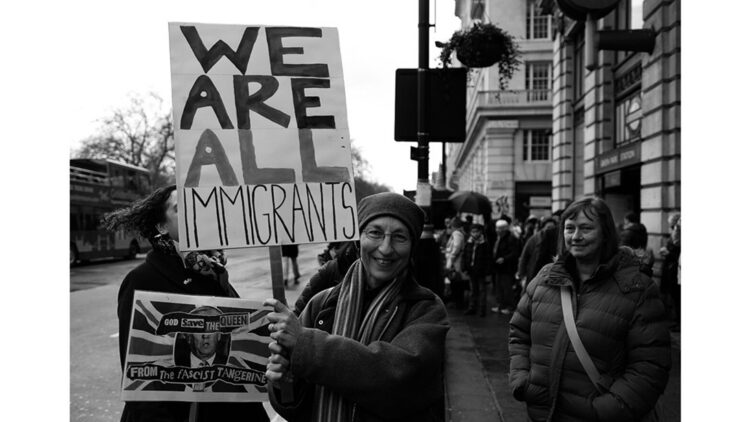
Look at the stupid, clueless people in the photo that Evan has chosen to illustrate this poem. THEY are the problem. Those smiling bitches are celebrating the end of their national identity, and their looming descent into the state of Dhimmitude. I have seen similar photographs from Germany, where crowds of brain-dead Krauts gather in public to welcome the arrival of immigrant cultural poison.
James Burnham was right to title his book “Suicide of the West.”
Thank you, Brian. Yes, some experts are already predicting civil war in the UK as something only months away.
Like Mary, I was imagining the poem (until near the end) to be about the U.S. I’m afraid that if things don’t change, it may soon be almost as accurate if read that way. As an American Anglican, though, I both mourn for, and pray for, both countries. I surely hope that the recent elections in England will have good effects.
Hello Cynthia. We shall see:
“all is willed within the womb of time”
That thing that long ago our forebears gave us;
That quality transcending time and space,
We just forgot, and nothing now can save us
As all that happens next we must embrace.
Brilliant.
warmest regards,
Karen
Thank you, Karen, and warmest regards to you, too.
Paul
Even though we had a war to be free from Britain rule, I never would have imagined, nor wished, to see that nation fall into such decline. Your poem highlights the dangers of what is currently known as “suicidal empathy”.
If Britain falls, everybody’s screwed, for no one will be around to save our asses when the rising horde mows down our life-sustaining native grasses. King (so-called) Charles is missing in action and deserves a few months in embarrassing traction to fortify his spine, which now seems non-existent. If nothing else, this poem is a warning to all Americans who want to remain American.
Kip, many decades ago I had a conversation in Europe with Otto von Hapsburg, at that time an important representative in the pan-European parliament. He was the man who, if the Austro-Hungarian Empire still existed, would have been The Holy Roman Emperor. He would have had the right to wear the crown of Charlemagne, and that of St. Stephen of Hungary, and be the absolute ruler of most of central Europe.
Our conversation touched upon monarchy, and the comparatively few monarchs who were still heads of government, with significant political power, as opposed to the past. He told me something that I never forgot.
Otto von Hapsburg said that the reason so many kings were overthrown was not revolution or ideological upheaval. It was the fact that after 1700 they had ceased to go into battle as the heads of their armies. A monarch’s most important duty, he said, was to lead his soldiers in combat and if necessary die with them. When monarchs stopped doing that, a deep sense of disorientation unconsciously developed in the public mind, and monarchs lost their prestige and divine aura. They were seen as useless. Think of the kings who died in battle: King Harold in 1066, Richard III in 1485, King James of Scotland in 1513 — they died doing their duty.
We can’t expect anything like that from modern monarchs, who are just pampered wimps serving as figureheads.
Joe, this is an amazing comment. I have long been fascinated by the Hapsburgs and I would give a lot to have been able to meet their last real scion. I am incredibly jealous that you got to do so. I remember watching Otto von Hapsburg’s funeral on TV televised from Vienna and being dazzled by the Imperial trappings of the ceremonies. There are few places on Earth which revere a lost monarchy like Austria.
As for the insights offered by Archduke von Hapbsurg, they are stellar and something I have never considered. I wish this conversation you had with him could be turned into a poem for posterity. (Any interest?) It deserves to be remembered. Especially since it is so accurate (although Nicholas II leading Russia in WWI may undermine the argument. But perhaps not. Russia was probably too far gone to allow for that level of national loyalty to the Czar.)
Irrespective, learning that you once met Otto von Hapsburg has actually made my day.
It was so many years ago. He was still a vigorous man in his fifties, fluent in English and several other languages. The conversation (at a reception in Germany) was brief, and there is little else I remember about it, so me writing a poem on it is unlikely. I do recall thinking what a shame it was that the Austro-Hungarian Empire no longer existed, and that this highly cultured and politically savvy man was not the ruler of Central Europe.
As a Brit, I have to admit finding some of these comments by American cousins rather strange. Whatever happened to the Declaration of Independence, Democracy, etc?
We over here got the impression that you didn’t like our old colonial ways. That’s why you got rid of us. Yet now it seems some of you dream of an Empire even more sclerotic than the British monarchy.
As for it being a shame some Austrian chap isn’t the ruler of Central Europe. Now, I’m no historian, but I recall there was such a fellow in the 1930s and 1940’s who wanted to do just that. But you got rid of him too!
What’s going on?
Paul, it’s rather simple: I’m of the view that if the Kaiser had remained leader of Germany there would have been no Hitler. And if the Tzar had remained leader of Russia, we would have been spared Lenin and Stalin.
I think these statements are undeniable. But surely the point is that both had to go on account of their various failings and what followed was in part a consequence of these. They helped shape the world that others found for which they can’t be excused nor should this be forgotten when lamenting what came after. History is a process: we can’t just chop it up into bits we like or dislike.
We started the War of Independence because you Brits were violating the basic rights of free-born Englishmen, not because we wanted a “democracy.” You were taxing us without representation in Parliament, you were imposing absurd laws on us, you were preventing our natural westward expansion by not allowing us to go through the Cumberland Gap and settle new lands, you were encouraging the Indians to attack our outlying towns and outposts, and you were over-regulating our trade. What did you expect?
Democracy? That meant something a lot different in 1776 than it does today. It meant local control over our lives, and freedom from bureaucratic arrogance. It didn’t mean the Woke bullshit and the encouragement of various culture-destroying poisons that it generally means now. The United States is a republic, not a democracy.
Adolf Hitler was a political aberration that came about as a result of a totally useless and unnecessary conflict that we call the Great War, or World War I. Do you think anyone of his low character and skeletal education could ever have become the Reich Chancellor of a major European state prior to 1914? Comparing him to Otto von Hapsburg is not just insulting, but historically absurd. The Hapsburg dynasty had ruled an aggregate empire of many races and peoples — a multicultural state in the true sense of a much-misused word. That empire (with twenty different languages printed on its currency!) was the keystone of Christendom, and a crucial factor in maintaining a working balance of power among the various European states. When the Austro-Hungarian Empire was broken up, at the insistence of that idealistic buffoon Woodrow Wilson, Europe was left wide open for the domination of a resurgent and revanchist Nazi Germany that went berserk.
By the way, Hitler HATED the Hapsburg dynasty and an independent Austria-Hungary, and he ordered that Otto von Hapsburg be shot on sight if the Gestapo caught him after the Anschluss.
Well-stated, Joe. When the 13 Colonies united, their focus was on redress for the wrongs perpetrated upon the Colonies by an overreaching and too-distant Crown. It was not some utopian sociology experiment. It was practical people searching for practical solutions regarding local governance.
As for the Hapsburgs, I think much of the success of the Dynasty is reflected in the amazing loyalty and affection with which Austrians still keep that monarchy alive. It is impossible to visit Vienna and not see memorials to the Hapsburgs everywhere, from their former palaces (Schoenbrun and the Hofburg) to their lore surrounding the Empress Sissi, the the bakeries which still show imprints of royal approval and the crypts which receive fresh flowers from nostalgic Austrian patriots every single day over 100 years after the end of their rule.
As for the real world benefits of a monarchial system, Europe is only part of the story. I’ll take the Cambodian royal house over the Khmer Rouge anyday. Not to mention the Shah of Iran over the execrable Ayatollahs. And I’ve never disassociated the overthrow of the Bourbons from French Reign of Terror. And I have no doubt whatsoever that if China had not overthrown its last emperor, Pu Yi, that the monstrosity that is Communist China would never have been born.
When a monarchy is overthrown history reveals that the resulting power vacuum draws in the worst of humanity.
Just not, you would say, in the case of George Washington and the Signers.
There are always exceptions.. I think the key is to look at historical tendencies and trends. If history teaches us anything at all, it’s that there are no absolutes. Yes, we appreciate George Washington, et al. The American Experiment has been a good one. Until now.
Btw, my comment about Kaiser and Hitler is actually a paraphrase of views held by the great Winston Churchill:
“This war would never have come unless, under American and modernising pressure, we had driven the Habsburgs out of Austria and the Hohenzollerns out of Germany. By making these vacuums we gave the opening for the Hitlerite monster to crawl out of its sewer on to the vacant thrones.”
8 April 1945.
“If the Allies at the peace table at Versailles had allowed a Hohenzollern, a Wittelsbach and a Habsburg to return to their thrones, there would have been no Hitler. A democratic basis of society might have been preserved by a crowned Weimar in contact with the victorious Allies.”
26 April 1946.
The monarchy in Great Britain was not “overthrown” by our War of Independence. We simply told King George and his purblind ministers to LEAVE US ALONE, so that we could live our lives and manage our business without interference from overseas bureaucrats and meddlers.
This is why it is a mistake to speak of the American “revolution.” A revolution is a outbreak of ideology and fanaticism, bent on changing the world and intruding into private lives. Our war in 1776 was motivated by our desire to live our lives in peace, to do what we wanted, and to settle new territories in the west, without a far-off Parliament second-guessing every decision we made.
Yes, but that “unnecessary conflict” occurred within the context of the monarchial system it helped destroy and was one reason why many felt it had to go. Also, Hitler could not have achieved political power, taking Germany to war again, without tapping into both current discontent resulting from WW1 and something deep within the German psyche. To that extent, surely, he cannot be dismissed as a mere aberration.
If you want a real-world reason why Hitler came to power, look to the palpably idiotic Treaty of Versailles of 1919, which the American economist John Maynard Keynes described as a prescription and recipe for another world war. Without it, a beaten Germany with a fledgling democracy might have had a chance to recover and take root. With it, Germany was doomed to fall prey to violent resentment and psychotic ultra-nationalism.
There was no way at all, prior to the conclusion of World War I, that a nonentity like Adolf Hitler could have become the leader of a major European state. It would have been unthinkable. No social and political establishment, from the the Shetland isles to the tip of the Italian boot to the Carpathian mountains, would have tolerated such a cipher! Only in a democracy could such a man gain massive power.
As for the idea that “the monarchical system” brought about World War I, it doesn’t hold water. By 1900 most monarchs were well on the way to being figureheads, and actual government was in the hands of Prime Ministers, their cabinets, elected bodies of representatives, and the press. The real force that caused World War I was democracy itself, and the sheer maddened war-fever that swept Europe like a plague after the murder of the Archduke and the Austrian ultimatum to Serbia. In that atmosphere, any politician who dared to talk of peace would have been crucified. As for the kings, queens, and emperors, what the hell could they say? They had to go along.
Paul Martin, your poem actually demonstrates the remaining life of a culture by its thoroughly rational verse presenting an entirely valid argument. It takes thought to recognize one’s place in history, and more still to set it out so well in words. Thanks for supplying your supporting material, too; I’m happy to see it though I know some of it from continuing regular visits to England. Higher costs will keep me away this year, but I was interested to see the small groups of builders that can revive culture and transform it, especially by breeding and belief. It won’t be the same as what is being lost, but can be significant. One intriguing figure, twice convicted and imprisoned under the Race Relations Act, now lives in the US and was a college professor to one of my children. Just the story of his admittedly racist and sometimes violent resistance makes it seem improbable that he has become a man of letters, but I’m reading his very impressive literary biographies, of which there are many. And his poetry anthology. You may remember the “Free Joe Pearce” campaign that was so embarrassing to liberal powers that be, because it stirred up vivid sympathy in the form of graffiti.
Hello Margaret. Thank you for your usual thoughtful comment.
The story of our nation’s decline could be told in many ways, but I used the quote from Richard II as it seems to me the loss of honour is the hallmark of our weakened and degraded age. No more clearly do we see this than in the response of the fathers, uncles and brother of the raped children while the authorities looked the other way. I cannot recall a single act of retribution against the perpetrators taken by these men.
We may call this the behaviour of civilised people, but no society whose menfolk are unwilling to stand up for their girls in the time-honoured fashion can survive.
Agreed. Loss of honour in the very traditional sense by young women, evoking no response or revenge from their traditional but no longer honourable guardians. The breakdown of the family may be a partial cause, with no menfolk close enough to the victim to feel responsibility. As well, you remark that “civilised” men consider retribution the duty of police and prosecutors (“the authorities”). Very occasionally, men in the American South or West take action in such a case, only to be considered criminals themselves.
As for Joe Pearce whom I mentioned above, he began, at the age of 15, to engage in street conflict with opposing gangs. Since he and his cohorts favored involuntary deportation from Britain of all immigrants, and even of children of immigrants born and raised in the UK, their action was socio-political, rather than motivated by personal or family reasons. Interestingly, he did not get into much legal trouble for street fighting, but for publishing a magazine with words which were said to harm race relations.