


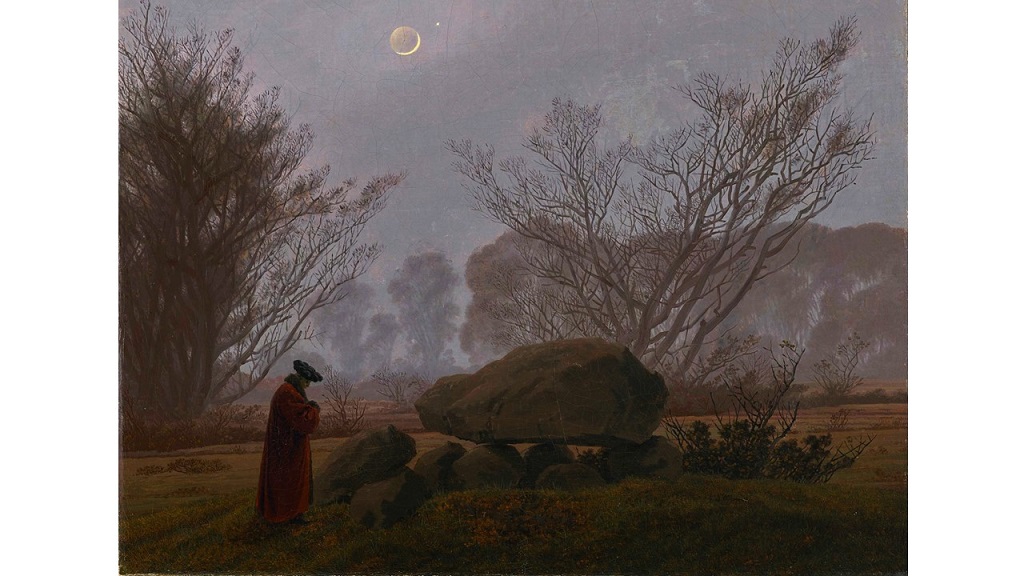
Solitude
Bright Venus, crescent moon, faint pearl-gray sky
obscurely light the scene. A giant dolmen
prostrate, astride huge boulders: megalith
collapsed, rock flotsam strewn across the fen.
Thin corkscrew trees extrude brown elfin leaves.
The time is evenfall, the hour when
quietude reigns: no sounds of creatures stirring,
of reprimanding squirrel or warbling wren.
A solitary figure stands in profile—
red robe, black hat—staid academician.
His head is bowed, his gloved hands clasped together.
Daily he visits this secluded glen,
a seeker with a Goethean intellect,
expanding his steady narrow scholar’s ken.
But runic stones, nor twilight’s silver gloom,
nor silence of this isolated place,
nor Friedrich’s skilled perspective—brooding don
aligned with tombal ruins—can ever trace
that consummate bleak terror we endure,
when our own destined deaths we squarely face.
Egg Gathering
A door half-open, gauzy gloom beyond.
Outside, a bare yard hemmed by wire-net fence.
Inside, contented clucks of laying hens,
a fetid warmth, as of a fungal pond,
the close air dense with gassy, birdy smells,
loose feathers stuck to mounds of dried-out dung.
A basket on a metal hook is hung,
in which are nestled brittle downy shells.
God’s potence: an immaculate ovoid.
Twice-daily, muslin-aproned, hair uncombed,
Clare skirts the field, recalls her great-aunt’s cow
hitched to a shaft, before brute tractors roamed.
A sacral virgin steadfast in her vow,
she gathers fecund eggs: pale, unalloyed.
The Suburbanite
As I was walking one June morning,
_around my neighborhood,
the houses in their tidy rows
_looked just as good homes should.
I skirted the stagnant man-made pond.
_A robin trilled its call
from somewhere on an oak tree branch:
_“For our nestlings we give all.
We spear small wriggling damp earthworms
_our babies can ingest,
and dive-bomb cats and jays and hawks
_that come too near our nest.”
But now the mowers started up
_their engines’ crashing blast.
“Oh, be not fooled by this lush green—
_your habitat can’t last.
We strangle all the wilding world
_with poison, scythe and blade.
Trimmed grass presents a flawless green,
_boxwoods cast subtle shade.
Wild creatures are not welcome here:
_no birds, nor bugs, nor bees.
So get thee gone! You make a mess.
_Our humans we must please.
They are our sober middling class
_whose taxes are sky-high—
doggedly working on their lawns,
_disorder they decry.”
Returning then, I shut my door.
_The A/C cooled the air.
Its hum blocked out the robin’s shrieks;
_I settled in a chair.
Mary Jane Myers resides in Springfield, Illinois. She is a retired JD/CPA tax specialist. Her debut short story collection Curious Affairs was published by Paul Dry Books in 2018.















Mary Jane, this trio of atmospheric lyrics presents a hauntingly lovely and poetically lonely concerto.
The first poem, though entitled “Solitude,” gradually populates the scene. Venus beams in the first line. “Thin corkscrew trees” and “elfin leaves” animate the evening. You insist on its soundlessness–but do so by reminding readers of the missing noisemakers, squirrel and wren. Your rhyme scheme is subtle: xaxaxaxa xxxaxa xbxbxb. Rhyme indeed, but just so soft enough to be noticeable. In the second stanza, you introduce the human figure from the painting about which you write. He adds intellectual interest, being a scholar engaged in regular contemplation. This is more than the painter can tell with his art. And in the third stanza, you call for the painter Friedrich to play his part, defining what he and his meditative figure intend to approach as “consummate bleak terror.” This takes the poet as concerto conductor to say–and to question the possibility of consciously achieving it.
The sonnet “Egg Gathering” celebrates another lone figure, the virginal Clare achieving her twice-daily mission in a henhouse yard with all the sensual qualities thereof. She carries in her mind the memory of her great aunt’s time. I notice you don’t say “grandmother,” maybe in order to imply Clare’s faithful family succession without marriage and childbearing. She is nonetheless “steadfast in her vow” and, as the final word proclaims, “unalloyed” as the immaculate ovoids she gathers. This poem is a masterpiece of suggestion and wonder. Wonder, however, that may be known to us.