


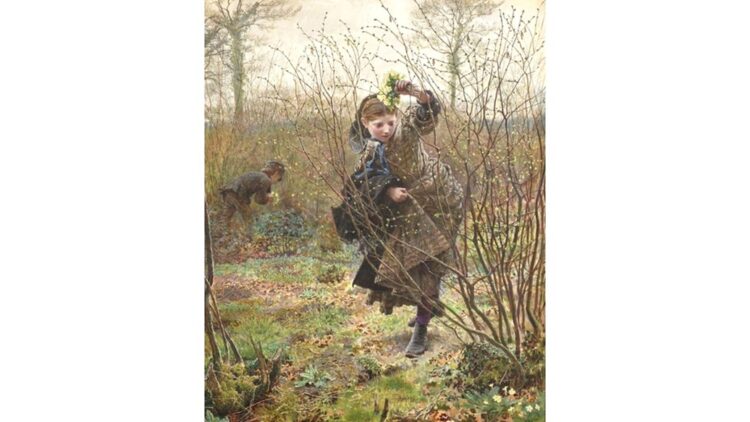
Spring in the Moment
It is a time to learn to walk.
Too many ages have we spent
In plodding with aggrieved intent.
Let’s go with smiles and little talk.
Cooperating bones will bear
A body where the path allows,
And please do note, the willow bows,
As we go out in gracious air.
Spring in the moment shall dismiss
Tense ghosts of business, luck, success.
Why should we scheme, regret, or guess?
The breeze delights, let’s trust in this.
Though we be awkward, who’s to care?
We need not calculate a route
Nor plan a resting place to suit
When here forsythia is fair.
The last year’s turf beneath us shows
Among its withered, shrunken straws
Minute flowers, born of those laws
That likewise raise the classic rose.
We pause and watch as life proceeds
In small, in great, in earth and mind.
Today your ready glance might find
A renaissance in moss and weeds.
Then let us wander as we may,
Onward at so serene a pace
As fits us to the hour and place
Where we can feel the waking day.
A glimpse above of flashing wings,
The scents that from the damp earth rise,
And bright surrounding chirps and cries
Suggest a new-struck spark in things.
And there, topmost, is spring’s great sky,
A dazzling and windy space
Where swelling clouds in series race
To change and vanish from your eye.
High-standing sun on still-bare trees
Warms branch and bud and us as well.
Glad in this moment, we can tell
Springtime again will gently please.
We’re slow, we tire, we sometimes sigh,
But in the season green and sweet
The frogs along the streams repeat
Their chants that ease and pacify.
When strangers, walkers blessed by sun,
Pass us and smile we nod and beam,
Perceiving them as kin who seem
Like us to have no need to run.
Walk where you wish. I’ll take this trail,
Perhaps to climb that flowery hill,
Assisted by the spring’s fresh will,
As floating seeds on breezes sail.
Goodbye, go look, go breathe, and then,
Rejoicing in the fragrant air,
Do let your thoughts be just as fair.
Spring is your youth, it’s here again.
Bhikkhu Nyanasobhano is a native of Kentucky who for many years has been a bhikkhu, a Buddhist monk of the Theravāda tradition.














Enjoyable, refreshing, lilting sing is your fine tribute to spring.
What a rejuvenating reading! The mention of the “new-struck spark” (from stone on stone) manifests that moment of new fire in the “chirps and cries” already sounding in the previous line. Spring brings things together. When the sun “warms branch and bud and us as well,” community develops gently. The fresh air of the final stanza, inspiring fresh looks and fair thoughts, smells fragrantly of the re-creation of youth. Good re-minder, Bhikku Nyanasobhano!
I enjoyed the feel woven throughout this poem of the jadedness of winter being left behind for an innocent rebeginning, come spring.
Thanks for the read, Bhikku Nyanasobhano.
This exemplifies the function of poetry: a surface-level paean to the renewal of life in spring, but with a clear deeper meaning as well: a spiritual renewal, a return to life in the deeper sense. I also sense a very Buddhist conception of the cycling of life, but with a sense of optimism rather than entrapment.
What a gentle, wandering poem — like a slow walk itself. You feel the damp air and hear those frogs by the time you’re done.
Now Adam, I appreciate where you’re heading by saying, “This exemplifies the function of poetry: a surface-level paean to the renewal of life in spring, but with a clear deeper meaning as well: a spiritual renewal, a return to life in the deeper sense.”
What you’re describing is allegory, or something close to it: surface meaning with something richer running underneath. Saying that mode is the function of poetry, is like saying a good fence exemplifies the whole purpose of ranching — it’s just one piece of a much bigger operation.
It’s a fine and honorable thing in a poem, no doubt. But it ain’t the whole rodeo.
You’re leaving out poetry that hits you straight in the chest with pure feeling — no digging required, no hidden levels, just the thing itself landing hard and true.
You’re leaving out poems where the sound and the rhythm do all the work, where the music is the meaning.
You’re leaving out witness poetry — words written about real suffering that isn’t allegorical at all, they’re just honest and unflinching.
And you’re forgetting celebration, praise, the wedding song, the hymn — where the surface is the whole point.
Not to mention pure joy, play and wit, where the only job is to make somebody smile, like Susan’s latest poem.
This poem’s a good one.
There is room for all kinds of poetry under the big tent of the Society of Classical Poets.
We cannot hang the whole definition of poetry on one nail.
I love how mindfulness themes weave in and out, subtly and powerfully.