


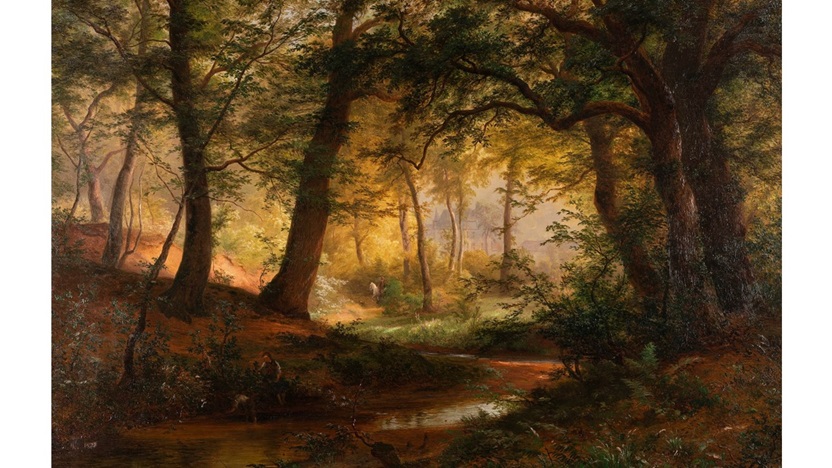
The Heart of the Wood
At the edge of the wood it is green,
With the leaves all aglow in the light,
And the forest appears so serene,
That my eyes could do naught but delight.
In the midst of the wood it is dim,
And the sun is no longer ablaze,
But the stillness conceals something grim,
As the jungle becomes like a maze.
And at nightfall the woods become black,
And the branches become like a snare!
My body prepares for attack,
While my soul becomes close to despair.
But the heart of the wood is a glade,
Up above silver stars fill the night.
Now my soul is no longer afraid,
For the heart of the wood is so bright.
Text and Music by Joseph David Greene. Performance: William Bolin, Bass Joseph Greene, Piano
Joseph Greene is a 23 year-old composer, pianist, and choir director. In 2022, he won second place in the Society of Classical Poets Translation Competition with his translations of two German poems by Wilhelm Müller and Ludwig Rellstab. His orchestral compositions have been performed by the Dakota Valley Symphony and the Redlands Chamber Orchestra. Greene lives in Riverside, California and works as choir director and organist for the Diocese of San Bernardino and Our Lady of the Rosary Cathedral.

















This is a beautiful portrayal not only of the woods but of the heart.
What more can we ask of poetry, Joseph! An emotional and lyrical narrative describing a journey of discovery, in which the carefully patterned words are expressively performed by a singer, while piano music does not merely accompany the song, but itself tells the tale in its own mode. All art is imitation, and yours seems to provide confirmation that musical sound imitates emotion not with words evoking thought, or with color and design in a picture, but directly.
Joseph, thank you for your efforts. The musical production is well done, but for me, the poem alone is a well trodden path of predictable sentiment. I respect the work that has gone into bringing music to the SCP but the poem makes me yearn for originality. The word “jungle” in “The Heart of the Wood” seems an out of place word choice. It appears more confusing than enlightening.
I was going to remain silent on this poem, as I usually do when I can’t find anything special to praise. But without belittling the efforts of Mr. Greene, let me state that there is a big difference between musical lyrics (in which much latitude it allowed) and formal metrical poetry in the traditional sense. The poem (as words on a page rather than as something sung to musical accompaniment) is clunky and pedestrian.
It does seem to me (as it does to several other longstanding contributors to the SCP) that the site has been flooded of late with a number of saccharine. cutesy-poo, and pietistic poems, as if they were written for a church-social picnic or a child’s birthday party, whereas some excellent professional adult-oriented work has been rejected. What’s going on?
Thank you, Susan, for breaking the ice.
Mr. Green, I enjoyed your song lyric and the YouTube performance. That being said, I’m not sure why it’s here on the SCP. Song lyrics are not poems. I’ve written song lyrics of my own back in the day, and I’ve studied musical theater extensively so let me try to summarize some of the key differences offered by the great Stephen Sondheim: A lyric set to music must necessarily exist in time. You can read a poem at your own pace, revisiting lines at will. Lyrics are bound to the rhythm of the music and are gone as soon as they are sung. They are not meant to be read independently. Lyrics must be instantly understood. An audience hears them only only in real time, and so they cannot soar linguistically because if they are too packed with poetic devices or verbage they become incomprehensible. Most importantly, song lyrics lack completeness on their own. A poem is a stand-alone piece of art. A lyric by definition lacks something – it relies entirely on the melody, subtext and performance to mount it.
So all this being said, yours is a perfectly charming song lyric (albeit with that nagging “jungle” misstep) but it is not a classical poem. So that begs the question of why it is here. And that begs the further question of what exactly is now the SCP’s mission. I knew what it was five years ago. I’m not sure that it carries the same set of values that it did when it was the premiere classical poetry site in the English-speaking world. In fact, like others who have been observant concerning developments on this site, I’m confident that it does not.
As for subject matter – through no fault of your own, Mr, Greene, you have stepped into a conflict concerning the present and future of the SCP. I’ve already carefully read other comments in this thread – particularly, Susan Bryant’s and Joseph Salemi’s and I must say I share their concern about the SCP becoming overly reliant on poetry whose best attribute is that it is “nice.” “Inoffensive.” “Sweet.” Subjects that a great section of the population thinks of as “poetic”, which is to say, poems fit for Hallmark Cards and hymns. I have no particular beef with either Hallmark or the Hymnal, but I do think our beloved site has somehow segued into playing it so safe that only a handful of poets seem interested in innovation, expression of the full range of human experience, or sometimes even just an exciting demonstration of skill. I have some idea of how we got here, but will save that for another day. For now, I would just note that playing it safe seems to me the most dangerous thing one could do for it elevates the maudlin over the brilliant and it rewards timidity.
A great many fledgling poets seem interested in creating a “flower” poem or a “Spring” poem or a “Autumn leaves” poem or an “Angel” poem. All very legitimate, but at a certain point it starts to feel like inexperienced bakers are following a recipe to figure out how to write a flower poem. They are then very satisfied when a flower poem emerges which has all of the stereotypes, tropes and cliches we expect of a flower poem. Does that mean the poem is a success? A failure? I suppose it depends on your point of view. But, personally, I now dread revisiting something that has been poeticized incessantly through the years. I’ve already seen it 30 times. This isn’t a cake we’re trying to get right by following instructions. There shouldn’t be a recipe for a flower poem. Or any poem. Skill and energy within a fixed form, yes. But that’s also a different discussion.
We are the heirs of Byron and Shakespeare, of Chaucer and Milton and Coleridge and Yeats and Eliot and Blake. These were poets who took daring risks with their poetry. Every great poet that we study and admire was a risk-taker. That’s why we study and admire them! Restoring that spirit of adventure, or actually being EXCITED by poetry rather than trying to simply reinvent what has already been published countless times would be a grand thing for the SCP. Those are my two cents.
Again, sorry for your piece to be the vehicle for some of these comments, Mr. Greene. You show a great facility for language and I have no doubt that you will write great things. Do consider the idea that, when it comes to art, risk-taking is a virtue. I look forward to your next piece.
No matter how accomplished the production, drivel remains drivel.
Joseph, I enjoyed this poem. The rapid pace of anapestic trimeter keeps the readers involved, and your choice of adjectives brings us full circle: from aglow, to dim, to black, and back to bright.
Goodness gracious, some of these comments are harsh! Yes, the last three lines need salt, but the rest of the poem is good – including “jungle” in the second stanza.
Harsh, Ms. Gardner? You have no idea how savagely harsh true literary critique can be when a target deserves it. One problem at the SCP seems to be an unspoken “Gentlemen’s Agreement” here that nothing posted here should receive anything but effusive praise.
Thank you, Mr. Greene, for the poem and the song. Would I have published this if it were just a poem? Probably. It is an interesting Wordsworthian interplay between the narrator, the forest, and narrator’s emotional experience.
It seems people are wondering about my editorial standards. When I select a piece for publication I’m looking at two dimenions:
(1) The outer form: meter, rhyming, grammar, basic coherency between words and ideas
(2) The inner form: does the poet accomplish what he or she seems to set out to do? is a story successfully told? is a character, place, conflict, emotion, idea fully developed?
As long as these criteria are met, I do not discriminate. It so happens that many people tend to write about nature. I have no problem with that. I’ve spent many hours listening to music scales, hearing new musicians struggle and triumph over the same classical music pieces, seen classical dancers do the same moves countless times over. What comes out in the repetition are the nuances of each artist’s character. In other words, if we ask you and 100 other poets to write a sonnet about Spring, each one will be unique and will show the skill level and the delightful differences in each poet’s character. As long as they are all in the traditional form, I’m happy to watch and enjoy. Out of this, we also see the contours of the art form and its overall beauty.
For finely curated smaller groups of poems I think the two options are competition winners and individual poet’s books. Perhaps one day we will also have a monthly print magazine where potentially only 5 to 10 poems appear alongside essays, art, reviews, interviews, etc. That would be cool.
-Evan Mantyk
SCP Editor
I am very glad that Evan Mantyk does not discriminate. I trust that this means no poem is rejected because of its political, social, sexual, ideological, cultural, religious, or anti-religious presuppositions. Perhaps that should be specifically listed as number 3).
There is a great deal of discrimination that necessarily happens for any editor and that is implied in my above two points, especially the second. When is a story successfully told? When is an idea fully developed? Ten different editors may have ten different opinions. Each editor has their aesthetic whether consciously or subconsciously. I also have my own aesthetic, which may or may not feel as if it is encroaching on poets’ own aesthetics. On the general framework of the above, which has my aesthetic standard embedded in it, I do not discriminate.
Back to Mr. Greene’s poem, one failing of his poem is the over-packed telling of his mini-story. We go from a delightful forest, to a terrifying forest, all the way back to a beautiful heart in the forest in what amounts to about one sonnet’s worth of language. This is like trying to cram two turns, or voltas, into one sonnet. This is holding the poem’s potential back in my opinion. So it’s not a great poem, but a good poem.
-Evan
I appreciate your thoughts on these subjects, Evan. And obviously this is your site. You publish what you deem best — that is your exclusive right. But I think you are making a false comparison when you discuss repetition in performing arts versus repetition in literature. It is inherent to the world of music that different orchestras will all tackle Beethoven’s Fifth and each conductor will do it slightly differently. It is inherent to the world of theater that different casts will tackle King Lear and we expect Laurence Olivier and Patrick Stewart to speak the same lines. The same with ballet and The Nutcracker. But I believe that when we are talking about actual creation of an art object — whether it is a painting, a sculpture, a song, or a poem — such repetition is not desirable. There is only one Mona Lisa and reproducing it repeatedly does not bode well for the future of portrait painting. A composer who can’t seem to break free of the themes offered in The Jupiter Symphony should not be encouraged to simply imitate Mozart over and over again. On the other hand, I suppose it all depends on what the goal is. One goal might be to nurture excellence and novelty in music. A more modest goal might simply be to have a spinet in the parlor to replay old tunes with no expectation of more.
There was a painter/art instructor named Bob Ross some years ago who had a television series where he showed audiences how to create a painting to look just like his. His official merchandise allowed fledgling painters to paint by numbers. Did he do the art world a favor? Again, it depends on your point of view. I suppose many fledgling painters got to create something that hangs on the walls of their grandchildren. But they will never be recognized as artistic achievement. And independence of thought and creativity were not rewarded. What are we hoping to accomplish here at SCP? Are we trying to make people feel good or are we serious about advancing poetry into the 21st Century. Or is it both? “Both” is a laudable goal but I’m reminded of the old Russian proverb: “He who tries to chase two rabbits will catch neither.”
And the absence of the voices of some poets in this comment thread is deeply telling.
Brian, thank you so much for this astute and important observation and for having the courage to share it. I find myself in full agreement. There’s a meaningful difference between revisiting existing works and creating new ones, and how we draw that distinction is crucial to the future of literature. I stand firmly on the side of “advancing poetry into the 21st Century” though I worry that this stance is growing increasingly unpopular.
This is why I spoke honestly about the poem in this comments thread. I have learned much from the feedback of skilled and forthright poets on this site. I mentioned the poem lacked originality and the word “jungle” jarred, not because I set out to be harsh, but because I wanted to give a true depiction of how I saw the poem – a sincere opinion from a fellow poet to be observed, discarded, or deleted as Mr. Greene sees fit.
I agree completely that treatment of this poem has been “harsh”. Surely the subject so heavily discussed above could be argued in another space and not at the expense of a writer who has bared soul and reputation. It would be another matter entirely if this site were a poetry workshop where critical comments are encouraged but it has not been any such thing in the years that I have been frequenting it. It has been rare to find any critical comment and if any advice has been offered it has been in as kind a manner as possible, the operative word being Kind, not “nice”.
No one here has any animus against Mr. Greene, who is merely an unlucky collateral casualty in a festering and unresolved dispute. The issue is not even that of repetitive subject matter as mentioned above, although that is a symptom of the problem. The deep issue is the direction of the website, and whether the SCP will be a mere showcase for inoffensive, child-friendly, pietistic amateur work — much of it deliberately solicited or encouraged by certain members with a religious agenda of their own — or whether the SCP will welcome hard-hitting, edgy, provocative poems, even if they aren’t approved by some religionists. When professionally done poems of this serious type are rejected in favor of the blandest nature poems, or embarrassing emotional effusions worthy of Hallmark cards, then a problem exists.
And let me second Brian Yapko’s comment — the glaring absence of certain voices in this discussion thread is deeply telling. It would seem that certain members are trying to camouflage their agenda with silence.
At the top of the comments there is a link to SCP’s Comment Policy. As a learning site, there are often, appropriately, robust discussions. The poet on this page, Mr. Greene, may have any comment removed for any reason whatsoever. Just contact me and I will take care of it.
Only Mr Greene knows how his piece came to be written. Personally I see no harm in it and I enjoyed hearing it sung. I sympathise with him for having touched off this thread when all he wanted was, I assume, to share something he is pleased with.
More generally, my view is that a poem written to order, or merely because its subject happens to be topical or fashionable or easy, isn’t poetry at all, because it lacks the foundation of the unrepeatable state of mind, and the impulse, which brings a true poem into being. Perhaps we overlook the possibility that, if a subject suggests itself so strongly to the poetic imagination that a poet feels impelled to (re)capture it, the result is both sincere and original, regardless of its perceived quality. Different kinds of poet are sensitive, or susceptible, to different experiences, just as different readers will respond differently to pieces on this website. If a poet feels driven to express ideas and sentiments that have affected him, I can’t see that it matters two hoots if they’ve already been cranked out thousands of times (spring, war, disappointment in love, etc). Looked at this way, the subject chooses the poet, who is innocent of triteness. Blame his muse.
Mr. Briggs, poetry can be personal, or impersonal. The notion that every good poem is produced by a deep sentiment or emotional impulse that has seized and affected the poet is a Romantic misperception. Many excellent poems are simply cranked out, mechanically, by skilled professionals who know what they’re doing.
The issue in this discussion thread isn’t what prompts a poet to write something. The issue is about what sort of poems are accepted and posted, and what sort are rejected. Evan Mantyk has been generally fair about allowing all kinds of voices to appear, and the only source of anger lies in the perception of some of us that certain members are using undue influence to limit the range of poems posted here, to censor some poems because of their subject matter, and to encourage a flood of poems that are sentimental and pietistic and scripturally linked at the expense of others that are not.
That is a fair concern, because if sentimental, pietistic, and scripturally linked poems of an amateur nature are allowed to dominate the SCP, the site will lose any reputation and prestige that it now has as the premier place for formal metrical poetry in the Anglophone world. It will become just another hearts-and-flowers religious website, connected to a sectarian agenda.
To my critics, I offer just a few thoughts. I truly do appreciate those of you who have taken the time to offer thoughtful and constructive feedback.
First, regarding the question of whether the work is simply song lyrics, and the applicability of such work on this site. I actually wrote the text a good deal of time before I wrote the music. Naturally, as a musician, my mind had a musical approach to it, and I considered writing music at some point. That being said, I have many other poems in this vein that I have never written music to and probably never will. I would like to point out that for a long time even great poets wrote lyrical works, which then were taken up by great composers. I won’t claim to be up to their standards, but consider Goethe’s Erlkönig, set by both Schubert and Beethoven, or the many great artsongs of the 19th century. It was from this artsong tradition that I sought to write, not in the commercialized pop forms of alternating verses and choruses. It seems to me that artists used to be a lot more interested in interdisciplinary exploration, collaborating, and building on ideas from other creative fields. It would be a pity if we put the blinders on and cut off a whole world of rich musical and textual harmony that has been lacking in our time. Perhaps if more finely trained poets would write great lyrical poetry, composers like myself would not have to fill the gap with our less cultivated powers.
Secondly, as to the merit of the poem itself. I will readily admit that, technically, there is a lot of room for growth. I was in high school when I wrote it, and it only underwent minor textual revision while the music was written and revised much more extensively during my time in university. Is it a bit sentimental? Yes I suppose so, I was considering (and undergoing) the time of the coronavirus lockdowns and how the same thing appeared so different as I journeyed through it. My perspective changed dramatically as I saw opportunities arise that would never have come about otherwise. Being so young, I suppose it is only natural that it sounds a bit immature, but I think the deeper exploration of perspective (mirrored in the modal treatment of the music) is worthy of consideration.
I did think twice about the word “jungle,” but it has caused far more controversy than I expected! Obviously it is not technically accurate, but since when did we take poetry so literally? The whole point is that the way the group of trees is experienced by the narrator evolves as he goes through it. A jungle and a wood are not experienced in the same way, and that is the point.
I could be wrong, but it seems many of the criticisms are against a romanticism in modern poetry generally. It almost seems as though if Longfellow were to publish some of his work in here, it would be decried as cheap and sentimental too. I do not deny that my work has a long way to go, and I could take more risks in exploring form in the future. I hope that if time permits, I will be able to do so. But there is also a similarity between being chained to past conventions and chained to modern ones, or projections of future ones. I enjoy poetry which has a certain simplicity of form. I think it allows for ideas to be expressed in a beautiful and meaningful medium. By exploring first the basics, perhaps I will be able to explore in a direction that adds new colors without sacrificing those things.
In all, I appreciate those of you who have contributed thoughtfully. I am concerned for all creatives with standards (myself included) that sometimes we can allow our love of aesthetic beauty (or novelty) to mar the beauty of our souls. In this case, I simply ask that my offering be received with constructive feedback which can concretely promote my poetic craft. And if anyone would like to collaborate with a composer, I am happy to discuss it.
I took this piece as metaphorical, as a life journey through space and time, so I’m a bit surprised at the poem’s reception.
‘Jungle’ did jar, and as a suggestion, Joseph G., perhaps something like ‘Like a predator’s ravenous gaze’ would suffice, which still conjures up the imagery of fearfulness of the unknown.
Thanks for the read.