


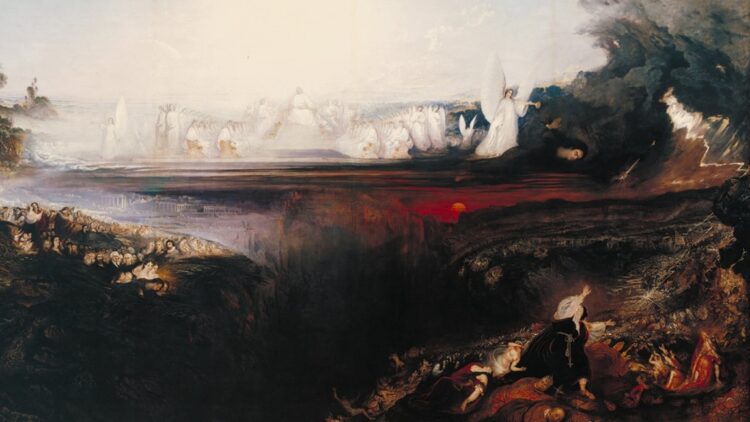
The Number 217: A Glimpse of Armageddon
“And palmeres for to seken straunge strondes”
—Chaucer, Canterbury Tales
It happened on the number 217
While on his way one day to Turnpike Lane
That Palmer had a glimpse of Armageddon
And never rode a London bus again.
While sitting on the upper deck as usual
He happened to observe the evening sky.
Though later he would write he’d been delusional,
He saw what seemed an Angel passing by.
We reproduce the story he recounted
Exactly as his audience testified.
Though clear that letter cannot be discounted,
The truth we let the reader now decide.
In fact, although in what he wrote emphatic
His listeners had believed he thought it real,
His story so convincing and dramatic
No subsequent denial could conceal.
And sure, that eerie tale was most compelling
And real, indeed, as Palmer sitting there.
So strangely powerful was, it’s said, the telling
That people gasped as though from want of air.
The Spirit, it appeared, was wearing armour
And had a grace no mortal eyes have seen.
And this would animate our Mr. Palmer
When later he described the curious scene.
It shone in all the colours of the rainbow,
In hues of brilliant gold and azure blue,
And flew without a sound—a wondrous dumb show:
An Angel from the heavens through and through.
Its wings appeared of utmost delicacy
And scarcely moved as if remaining still:
An effortlessly subtle efficacy
Directed by the powerful spirit’s will.
Upon its head, the Angel wore a helmet
Emblazoned with a crest of many globes.
A bevor, too, it wore, as soft as velvet,
Extending down concealing silver robes.
Its body armour though defied description.
As Palmer stared, the arabesque designs
Appeared to move and form a strange inscription
Composed of scrolling labyrinthine lines.
And truly most exquisite was this armour
Which seemed diaphanous and filled with light,
And this had mesmerised our Mr. Palmer
As something only truly wondrous might.
But then occurred what so completely shocked him
He lost all confidence in what was real:
A sight so inexplicable it rocked him
And knocked him off his rational even keel.
The Spirit melded with the world around it
While still remaining what it was itself,
Its loving being seemingly unbounded
With all it saw its own extended self.
So when a robin perched upon its arm
And poked about, spontaneous and free,
As though to nourish it and shield from harm
It all at once became a sheltering tree.
And when a thousand starlings darted by,
Delighting in their murmuration trail,
A million instantly adorned the sky,
Exulting as they buffeted the gale.
Then after, when the birds had flown away,
Its Angel form would straightaway return.
And all this Palmer witnessed with dismay
As later to his audience he’d affirm.
Yet Palmer never saw the Spirit’s face
Which from his gaze throughout seemed carefully hidden,
That crested helmet hiding thus its grace
As though to look upon it were forbidden.
But underneath it Palmer sensed its essence:
Ineffable, mysterious and pure;
So quite incredible a noble presence
Of what he’d seen he’d later be unsure.
Now, so enrapt was Palmer in this vision
He failed to note the darkening cloud behind;
But then he saw what seemed an armed division
Of every kind of blackness intertwined.
This thing was starting upwards from the ground
As though from somewhere deep within the earth:
A hidden world with neither sight not sound
Existing since before the Cosmos’ birth.
An ancient world as old as Father Time
Beyond what men and mortal creatures know
Where punishment is fitted to the crime
When Justice Absolute requires we go.
A world of torment, bitterness and hatred;
Of souls in unremitting endless pain;
Of unacknowledged yearning for the sacred
And God, whose light they’ll never see again.
This blackness swarmed about like teeming rodents,
Or locust armies high above a storm,
And these he realised were its opponents
Beginning in their battle lines to form.
For these, indeed, were denizens of Hell:
Demonic forces of the darkest deep,
And wailing phantoms of the damned as well
Aroused from their eternal tortured sleep.
And wickedness of every type was there:
Perverse, unspeakable, grotesque and foul.
And something stirred in Palmer like despair
In answer to their endless mournful howl.
And now this crew had come unleashing evil,
The Fiend in furious malice at their head;
So numberless they seemed in power equal
To anything awaiting them ahead.
The Angel, Palmer saw, was on a mission
To note these dispositions from afar:
Perhaps upon a scouting expedition
From some uncharted universe or star.
But as our man was watching, speculating,
A witness to those strange events that night,
He realised, too, the Spirit had been waiting,
For soon appeared the most exalted sight.
A light was on a journey in the heavens,
Appearing like the dawn from over Kent.
Composed of gleaming Seraphim with weapons,
It now began its measured grand descent.
Majestic in its scale and wondrous aura,
In Harmonies Celestial it moved,
As far from Satan’s legions’ rank disorder
As Heaven is from deepest Hell removed.
And in that radiance Palmer sensed a splendour
That shone from every hidden noble face:
An indescribable commanding grandeur
No brutish force of evil could displace.
A sacred presence from another world,
The light advanced, unnoticed and unheeded;
With glittering battle standards now unfurled,
It made its way in silence unimpeded.
This, too, in eerie motion was encroaching
Unseen upon our Earth and evening sky,
As inch by inch these powers were approaching
To meet, it seemed, above the London Eye.
Poet’s Note: The London Eye is a giant cantilevered observation wheel opposite the Houses of Parliament. The county of Kent borders London on the south-east. The other locations mentioned are on the 217 bus route in West London. The poem is from the author’s unpublished work, The Bus Poems: A Tale of the Devil. An earlier version was published by New English Review.
Paul Martin Freeman is an art dealer living in London. His book of whimsical verse, A Chocolate Box Menagerie, is published by New English Review Press.
















Paul, what a powerful tale you tell in amazing detail and imagery of a cosmic Armageddon that at once enthralls and engrosses the mind. How beautiful the angelic description and how dark the forces of hell preparing to meet in that final battle. The classic rhyme and meter is impeccable upon second review, since I was so absorbed in my first reading of this immaculate story of supernatural proportions.
Thank you, Roy. So glad you liked it enough to read it twice!
I tried to create in the angel a figure of unbounded being, merging at will with the surrounding world. It had to be incredible while still remaining believable. I hope people think I succeeded.
Excellent tale, Paul Martin, of Armageddon, the final battle, recognized as going on right around one. That says a great deal. You make it the sudden perception of the ordinary Palmer on Bus 217. Fine job of gradually focusing on traditional details regarding angels and devils and lost souls; these seem to appear and disappear, just as do our recognitions of holiness and depravity in our midst. I wonder if you chose the name Palmer to refer to its root meaning as one who achieves the palm, that is, wins the personal battle. In the Middle Ages, weren’t those who completed the pilgrimage to Jerusalem entitled to a symbolic palm? Maybe these very perceptions are leading your central character that way. I very much like the symbolic use of the London Eye to conclude. Yes, indeed, London can see what happens within it, but the moral vision is often clouded and sometimes entirely excluded by the Eye’s other function as sensationally thrilling entertainment. Nothing wrong with that, at least for those undisturbed by what it does to the cityscape. My son loved it!
Thank you, Margaret. I’m glad two generations of your family liked it!
Please see my reply to Roy above for what I was hoping to achieve in my depiction of the angel. Yes, as the quote from Chaucer shows, I was thinking of the central character as an Everyman-type pilgrim.
Paul, Your description of the unnamed angel is stunning as is your added twist as to its integral morphing with natural Creation. And you do well to end the story where you do—at the moment before the battle that never comes. For in Revelation 16 with the forces of evil gathered on the symbolic plains of Armageddon (the actual Megiddo is in northern Israel), the angel of the Lord—speaking the Word of God—simply says, “It is done,” and it is done.
C.S. Lewis compares the so-called “end times” to the end game of a chess match where mate is inescapable but the losing side refuses to concede and keeps playing until the inevitable end—an end that comes much as T.S. Eliot (in a somewhat different context and before he became a Christian) describes as, “this is the way the world ends, not with a bang but a whimper.”
Most good poems (like your reference to Chaucer) tell a story. Your poem tells a good story. And it tells it well.
Thank you for your appreciative comments, James. I couldn’t hope for more.