• Submit Poetry
  • Support SCP
  • About Us
  • Members
  • Join
Wednesday, July 1, 2026
Society of Classical Poets
  • Poems
    • Beauty
    • Culture
    • Satire
    • Humor
    • Children’s
    • Art
    • Ekphrastic
    • Epic
    • Epigrams and Proverbs
    • Human Rights in China
    • Music
    • Performing Arts
    • Riddles
    • Science
    • Song Lyrics
    • The Environment
    • The Raven
    • Found Poems
    • High School Poets
    • Terrorism
    • Covid-19
  • Poetry Forms
    • Sonnet
    • Haiku
    • Limerick
    • Villanelle
    • Rondeau
    • Pantoum
    • Sestina
    • Triolet
    • Acrostic
    • Alexandroid
    • Alliterative
    • Blank Verse
    • Chant Royal
    • Clerihew
    • Rhupunt
    • Rondeau Redoublé
    • Rondel
    • Rubaiyat
    • Sapphic Verse
    • Shape Poems
    • Terza Rima
  • Great Poets
    • Geoffrey Chaucer
    • Emily Dickinson
    • Homer
    • Henry Wadsworth Longfellow
    • Dante Alighieri
    • John Keats
    • John Milton
    • Edgar Allan Poe
    • William Shakespeare
    • William Wordsworth
    • William Blake
    • Robert Frost
  • Love Poems
  • Contests
  • SCP Academy
    • Educational
    • Teaching Classical Poetry—A Guide for Educators
    • Poetry Forms
    • The SCP Journal
    • Books
No Result
View All Result
Society of Classical Poets
  • Poems
    • Beauty
    • Culture
    • Satire
    • Humor
    • Children’s
    • Art
    • Ekphrastic
    • Epic
    • Epigrams and Proverbs
    • Human Rights in China
    • Music
    • Performing Arts
    • Riddles
    • Science
    • Song Lyrics
    • The Environment
    • The Raven
    • Found Poems
    • High School Poets
    • Terrorism
    • Covid-19
  • Poetry Forms
    • Sonnet
    • Haiku
    • Limerick
    • Villanelle
    • Rondeau
    • Pantoum
    • Sestina
    • Triolet
    • Acrostic
    • Alexandroid
    • Alliterative
    • Blank Verse
    • Chant Royal
    • Clerihew
    • Rhupunt
    • Rondeau Redoublé
    • Rondel
    • Rubaiyat
    • Sapphic Verse
    • Shape Poems
    • Terza Rima
  • Great Poets
    • Geoffrey Chaucer
    • Emily Dickinson
    • Homer
    • Henry Wadsworth Longfellow
    • Dante Alighieri
    • John Keats
    • John Milton
    • Edgar Allan Poe
    • William Shakespeare
    • William Wordsworth
    • William Blake
    • Robert Frost
  • Love Poems
  • Contests
  • SCP Academy
    • Educational
    • Teaching Classical Poetry—A Guide for Educators
    • Poetry Forms
    • The SCP Journal
    • Books
No Result
View All Result
Society of Classical Poets
No Result
View All Result
Home Poetry

‘Barabbas’: An Easter Poem by Susan Jarvis Bryant

April 5, 2026
in Poetry, Culture, Sonnet
A A
33
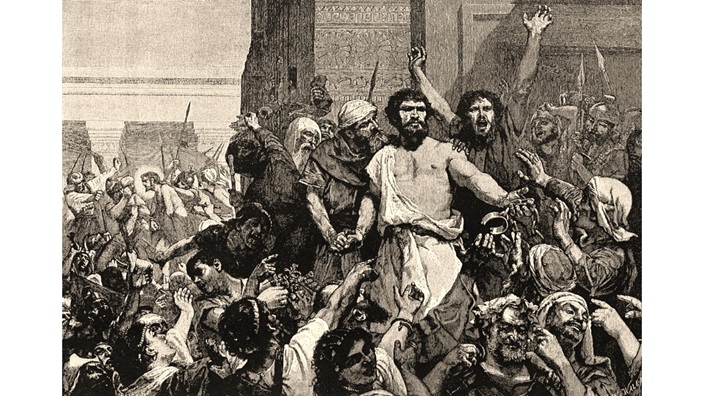
illustration of Barabbas being released (public domain)

illustration of Barabbas being released (public domain)


Barabbas

They named their chosen one and set him free.
They picked a thug who reeked of others’ blood.
He bore the stain their wayward hearts could see—
Familiar ground might serve some greater good.
They knew the cutthroat path the rebel took,
The street where shadows veiled each evil deed,
The alley of the quarry and the crook—
They knew his sort and so the pack agreed
That darkness was the devil better known.
The starkest light would bare each buried lie.
The Truth had witnessed every seed they’d sown.
They knew the One they had to crucify…

He waits with grace (while seasons ebb and bloom)
Beyond the barriers of time and tomb.


Susan Jarvis Bryant is a poet originally from the U.K., now living on the Gulf Coast of Texas.
Tags: EasterSusan Jarvis Bryant
ShareTweetPin
The Society of Classical Poets does not endorse any views expressed in individual poems or commentary.
Read Our Comments Policy Here

RandomPoems

‘The Golden Mean’ and Other Poetry by Bruce Dale Wise
Beauty

‘The Golden Mean’ and Other Poetry by Bruce Dale Wise

October 22, 2015

The Golden Mean By Aedile Cwerbus Right living's hard, the ever-urgent prow pursuing storms or pressing up against life's dangers,...

poetry/benson brown/readings
Classical Poets Live

CPL: Why Are Trendy Poets Weirdos? Eccentricity vs. Creativity (Part 3 of 3)

September 13, 2023

. Classical Poets Live with Andrew Benson Brown Episode 6 Part 3 of 3: Why Are Trendy Poets Weirdos? Eccentricity vs....

Next Post
‘Murder at the Stocker Mansion’: A Poetic Noir Whodunit by Brian Yapko

'Murder at the Stocker Mansion': A Poetic Noir Whodunit by Brian Yapko

‘A Very Early Taste of Poetry’: An Essay by Joseph S. Salemi

'A Very Early Taste of Poetry': An Essay by Joseph S. Salemi

‘An Excerpt’: A Poem by Bruce Dale Wise

'An Excerpt': A Poem by Bruce Dale Wise

Comments 33

  1. Cynthia L Erlandson says:
    3 months ago

    “Beyond the barriers of time and tomb.” Absolutely beautiful, and profoundly true, Susan. And what an original perspective on Easter, to focus on Barabbas. “Darkness was the devil better known” is a great twist on a a well-known saying.

    Reply
    • Susan Jarvis Bryant says:
      3 months ago

      Cynthia, I am so glad you enjoyed this poem. I believe there are many lessons to be had from the Barabbas story – lessons today’s society could learn an awful lot from. Thank you very much for your kind words and your keen eye.

      Reply
  2. Brian Yapko says:
    3 months ago

    This is a marvelously sharp poem for Easter, Susan, in which you express disgust concerning the hypocrisy and narcissism of the mob. Instead of saving the life of the One who could lead them to redemption and renewal, they chose the one who would never expose their rottenness. People very often prefer lower companions who do not challenge them or uplift them in any way. Lower companions who simply cosign their BS and let them get away with being less than they could and should be. To heck with enlightenment or virtue.

    I’m glad you chose Barabbas as a vehicle for this important observation. Our minds are much in tune for I did my own Barabbas poem a couple of years ago on a similar subject. Yours, however, is considerably more interesting. As for Barabbas, you’ll find few better characters to serve as a metaphor for choosing corruption over growth and goodness.

    A very happy Easter to you and Mike!

    Reply
    • Susan Jarvis Bryant says:
      3 months ago

      Brian, I just love your contemporary translation of my poem. Your vivid “consign-their-BS” line says it all! Barabbas as the companion who never challenges you is a spot-on modern reading that the poem fully supports. Everyone needs validation and affirmation in today’s society of personal and fluid truth – the more of it, the merrier the recipient, and the source of the validation and affirmation matters not. When that source is a surgeon with a scalpel ready to neuter minors, then society should wake up to the fact that they might not be treading a virtuous pathway to joy and enlightenment… I live in hope. Brian, thank you, as ever, for your fine eye and constant support.

      Reply
  3. Mark Stellinga says:
    3 months ago

    ‘He waits with grace (while seasons ebb and bloom)
    Beyond the barriers of time and tomb.’ encapsulates, for me, the very essence of what makes ‘Faith’ possible, Susan, and, in itself, is a beautiful and extremely stimulating poem. One of the finest I’ve ever encountered. Happy Easter to you both –

    Reply
    • Susan Jarvis Bryant says:
      3 months ago

      Mark, I thank you wholeheartedly for your appreciative and beautiful comment. It’s comments like these that make sharing my poems a worthwhile and joyous experience. I hope you had a lovely Easter!

      Reply
  4. Glendenning Cram says:
    3 months ago

    Note that the name Barabbas means “Son of the Father”!

    Reply
    • Susan Jarvis Bryant says:
      3 months ago

      Glendenning, thank you for this most interesting comment. It highlights the poem’s deepest irony. Early manuscripts of Matthew give Barabbas the first name of “Jesus” which makes Pilate’s question to the crowd chillingly precise – which Jesus do they want? Which son of the Father do they want? The earthly or the eternal? How could I not write about the timeless musings on the human capacity to opt for the lie when the truth demands too much of us? Glendenning, thank you for reading and commenting.

      Reply
  5. Roy Eugene Peterson says:
    3 months ago

    Susan, this is a stellar poem in your constellation of great poems. “Beyond the barriers of time and tomb” — how marvelous the message looms. A heartfelt Amen! for your Easter Sunday missive. I know that Resurrection Sunday is a great day for you and Mike. Blessings to both of you for you both continue to bless us.

    Reply
    • Susan Jarvis Bryant says:
      3 months ago

      Roy, thank you very much for your kind words of appreciation and encouragement. I hope you had a wonderful Resurrection Sunday!

      Reply
  6. Norma Pain says:
    3 months ago

    Thank you for this very timely and beautiful poem Susan. Happy Easter to you and Mike.

    Reply
    • Susan Jarvis Bryant says:
      3 months ago

      Norma, it’s so lovely to hear from you. I’m thrilled you enjoyed the poem and hope you had a wonderful Easter Sunday! Thank you very much indeed!

      Reply
  7. Margaret Brinton says:
    3 months ago

    A compelling poem to reveal all Truth, Susan.

    Reply
    • Susan Jarvis Bryant says:
      3 months ago

      Margaret, I’m glad you enjoyed the poem. Thank you very much for your kind words. The Truth matters.

      Reply
  8. Yael says:
    3 months ago

    Great poem Susan, as always. When I got to the last two lines I was immediately reminded of the beautiful hymn Once To Every Man and Nation, which expresses similar sentiments as your poem.
    https://www.youtube.com/watch?v=nsDFeXwQd1Q
    Wishing you and Mike a blessed spiritual feast.

    Reply
    • Susan Jarvis Bryant says:
      3 months ago

      Yael, it’s great to hear from you and I just love the hymn! Thank you! I hope you had a blessed spiritual feast yesterday… I have a strong feeling it was a heavenly banquet to behold.

      Reply
  9. Joseph S Salemi says:
    3 months ago

    Notice the prominence of the pronoun “They” in this sonnet. It refers of course to the crowd that called for the death of Jesus, but in a much deeper sense it means WE.

    Reply
    • Susan Jarvis Bryant says:
      3 months ago

      Joe, your analysis of the pronoun “They” reveals the very core of this poem, which is indeed, “We” – your comment says so much in its brevity and I thank you very much indeed for reading it so closely. I’m glad the very heart of the poem shines through.

      Reply
  10. James Sale says:
    3 months ago

    Great Shakespearean sonnet where the final couplet delivers its tremendous punch – love it. Well done, fabulous writing.

    Reply
    • Susan Jarvis Bryant says:
      3 months ago

      James, when you say, “fabulous writing” – I grin from ear to ear! Thank you for the joy you have brought to my day!

      Reply
  11. M.D. Skeen says:
    3 months ago

    A tightly-structured, powerful sonnet. Reminds me of some of the religious work of Manuel Carpio.

    Reply
    • Susan Jarvis Bryant says:
      3 months ago

      M.D., I thank you wholeheartedly for your appreciative and encouraging words. They led me to your beautiful and thoroughly entertaining translation of “La Llorona” – which is now sending me on a search of some of Manuel Carpio’s religious works. This is why I love the comments section!

      Reply
  12. Mike Bryant says:
    3 months ago

    Susan, I was with you almost every moment as you wrote this. This one truly was a labor of love. You sweated every word. You actually wrote at least five separate publishable sonnets in getting to this one.
    When Norma said the poem is “timely,” I thought—no, it’s timeless. But maybe they’re the same thing.
    It made me think of the religious leaders who, through the enchantment of their temple and rituals, stirred up the crowd. Those priests and elders had Jesus put to death for heresy-his very presence exposed their darkness.
    Your beautiful poem exposes that same darkness.
    Damn fine work, Susan.

    Reply
    • Susan Jarvis Bryant says:
      3 months ago

      Thank you, Biggest Fan! This really was a labor of love… I don’t usually suffer for my art, but this one trod a fine line between pleasure and pain. You make an excellent point on the manipulations behind the mob mentality. They often come in enchanting and convincing incantations from those who adopt know-it-all status. There is only one source of Truth, and it isn’t from the twisted tongues of those who abuse their earthly power.

      Reply
  13. Wayne H Frazier says:
    3 months ago

    To paraphrase Leonard Ravenhill ; Christ stepped out of time and back into eternity!

    Reply
    • Mike Bryant says:
      3 months ago

      Leonard Ravenhill had a lot of things right. Thanks Wayne

      Reply
    • Susan Jarvis Bryant says:
      3 months ago

      Wayne, thank you! A miracle indeed! This is a beautiful way of making the incomprehensible a lot more understandable. I love it!

      Reply
  14. Adam Sedia says:
    3 months ago

    This is a striking and intriguing work – a meditation in suspended action, without action or dialogue (which we all know already) that explores the inner workings of the mob’s collective mind. “They” repeated emphasizes this: these are not the thoughts of any one person, but of the faceless mob (and much of them also of Barabbas – a skillful stroke). The closing couplet refocuses us where we should be. The mob is deeply rooted in the present and the tangible, while its Victim is “beyond time and tomb.” Marvelous.

    Reply
    • Susan Jarvis Bryant says:
      3 months ago

      Adam, I always appreciate your attention to the finer details of a poem, but they are especially important to me on this poem. It was one of those poems that begged (loudly) to be written. The response has thrilled and astounded me. Thank you very much indeed!

      Reply
  15. Morrison Handley-Schachler says:
    3 months ago

    This is a very fine and eloquent poem, Susan. And yet I feel that, of characters in all the passion narrative, it is with Barabbas, the freed and pardoned wrongdoer, that we should identify ourselves.

    Reply
    • Susan Jarvis Bryant says:
      3 months ago

      Morrison, your observation humbles me . Your point of view is profoundly right. My poem looks at the crowd’s psychology. Your reading looks at Barabbas’s condition. I believe they say the same thing from different angles. You highlight the deeper and far more personal truth. Barabbas did not choose his pardon. He didn’t earn it, and probably didn’t understand it. He simply walked free while another man took his place. In that sense he is probably the truest mirror of all – he mirrors the human condition in all its sinfulness, released by a grace WE did nothing to deserve. I wrote a very short poem on Dismas last Easter:

      He knew, past present pain, a kingdom shone—
      The hallowed lips of Truth had told him so.
      The gift of paradise sprung from a tongue
      That taught him all a harrowed heart need know.

      Your comment has made me think how similar the lesson of Dismas is. Your words have left me even more grateful for the divine gift offered to ALL. Morrison, thank you for completing my poem.

      Reply
  16. BDW says:
    3 months ago

    Pilate offered the Jewish populace, surrounding him in a parabola, the release of Jesus or Barabbas. They opted for the latter. The rabble preferred the rebel, the bandit, the seditious prisoner over Christ. When offered a choice [How could they stand it?], they wanted the Lamb to be sacrificed. So, though the Father’s Son was crucified, the Son of the Father escaped. His spirit was set free the moment the former died; although the mob did not want to hear it. The latter, then, was thus condemned to roam across the earth, until he reached his home.

    Barabbas flourished around the 1st century. Pontius Pilate was the Governor of Judaea from 26 BC to 36 BC. I agree with Mr. Sedia, when he notes that Ms. Bryant’s sonnet conveys “a meditation in suspended action”, where she neatly alludes this to our present time…Easter; where, for instance, it is striking how many in the mob feel such hatred for the targets of vituperation, Christians, Jews, and individuals, like Brian Thompson and Charlie Kirk.

    Reply
    • Susan Jarvis Bryant says:
      3 months ago

      BDW, thank you for this intriguing reading. Your image of Pilate and the parabola of the crowd is striking with its geometry as destiny angle. And your observation that Barabbas was, in a sense, condemned to his freedom (sentenced to wander the earth carrying a grace he never sought) has pulled me in. Your point about the targets of modern vituperation cuts close to the bone. The mob loves a scapegoat, and as the names of the scapegoats change, the hatred remains depressingly constant. Christians and Jews have weathered centuries of it, and still the crowd cries for Barabbas. I appreciate your thoughtful and wide-ranging response. Yet another dimension has been added to my humble poem – a poem I thought I’d finished. I’m starting to feel there’s a lot more to say.

      Reply

Leave a Reply Cancel reply

Your email address will not be published. Required fields are marked *

  1. Joseph S. Salemi on ‘The Council of Infinite Opinions’: A Poem by David LeeJune 30, 2026

    You won't get any argument from me, Mike. Tell it to whatever jackass becomes the next British PM.

  2. Mike Bryant on ‘The Council of Infinite Opinions’: A Poem by David LeeJune 30, 2026

    First, I love the poem, it has given rise to some important questions. Second, Doctor Salemi, I find it strange…

  3. Joseph S. Salemi on ‘The Council of Infinite Opinions’: A Poem by David LeeJune 30, 2026

    And I am reminded of all the left-liberal dweebs who are refusing to admit that Europe is being invaded and…

  4. Russel Winick on ‘Not Small At All’ and Other Short Poems by Russel WinickJune 30, 2026

    Thanks for a great comment, Paul. If you write that short story, I’d surely want to read it. And SCP…

  5. Paul Freeman on ‘The Roommate’: A Poem by Jeffrey EssmannJune 30, 2026

    I get a feeling of a roommate who is unable to take control of her life, hence the horoscope. As…

Subscribe to Daily Poems

Enter your email address to subscribe to this blog and receive notifications of new posts by email.

Join 1,592 other subscribers

Recent Poems

  • ‘Archaic Torso of Apollo’ by Rainer Maria Rilke, Translated by Mary Jane Myers
  • ‘The Council of Infinite Opinions’: A Poem by David Lee
  • Odyssey Audiobook Serialization Begins: First Fully Dramatized Version
  • ‘Not Small At All’ and Other Short Poems by Russel Winick
  • ‘The Roommate’: A Poem by Jeffrey Essmann
  • ‘Pouting Polly’: A Poem by Robert Nachtegall
  • Two Satirical Sonnets by Joseph S. Salemi
  • ‘Then and Now’: A Sonnet by James Sale
  • ‘The Ministry of Twee’: A Poem by Susan Jarvis Bryant
  • ‘Breath of Night’: A Poem by Paulette Calasibetta
  • A Song Inspired by Edward Rowland Sill’s ‘Among the Redwoods’, by Gunny Markefka
  • ‘Kaddish for My Father’: A Poem by Brian Yapko
  • ‘Canceled’ and Other Limericks by Joseph Mason
  • ‘The Diamond’: A Marriage Proposal Poem by Adam Sedia
  • ‘The Dancer’ and Other Rondeaux by David Murphy
  • ‘Chastity’: A Sonnet Sequence by Justin Dasher
  • Horace Odes I.11 and III.30, Translated by Mary Jane Myers
  • ‘The Bird with the Ugly Voice’: A Poem by Scharlie Meeuws
  • ‘The Dryads’: A Poem by Patricia Rogers Crozier
  • ‘Stories of Saint Anthony’: Poems by Margaret Coats
  • ‘An Englishman to World Cups Past’: A Poem by Paul A. Freeman
  • ‘Faux Pas’ and Other Poetry by C.B. Anderson
  • ‘Trip to Italy: A Poetry Travel Journal’ by James A. Tweedie
  • ‘Spring Song’: A Poem by Rohini Sunderam
  • ‘The Eagle’: A Poem by Bruce Dale Wise
  • ‘Good Night’ and Other Poetry by Kevin Ahern
  • ‘Mothiavelli’ and Other Poetry by Susan Jarvis Bryant
  • ‘Poetic Justices: The Poetry of United States Supreme Court Justices’: An Essay by Adam Sedia
  • ‘Blur’ and Other Poems by Anna J. Arredondo
  • ‘The Cottage on the Ridge’ and Other Poetry by Martin Rizley

Categories

  • Acrostic
  • Alexandroid
  • Alliterative
  • Art
  • Best Poems
  • Blank Verse
  • Chant Royal
  • Classical Poets Live
  • Clerihew
  • Covid-19
  • Deconstructing Communism
  • Educational
  • Epic
  • Epigrams and Proverbs
  • Essays
    • Interviews with Poets
    • Poetry Reviews
  • Featured
  • From the Society
  • Great Poets
    • Dante Alighieri
    • Edgar Allan Poe
    • Emily Dickinson
    • Geoffrey Chaucer
    • Henry Wadsworth Longfellow
    • Homer
    • John Keats
    • John Milton
    • Robert Frost
    • William Blake
    • William Shakespeare
    • William Wordsworth
  • Human Rights in China
  • Limerick
  • Love Poems
  • Music
  • Pantoum
  • Performing Arts
  • Poetry
    • Beauty
    • Children's Poems
    • Culture
    • Ekphrastic
    • Found Poems
    • High School Poets
    • Humor
    • Riddles
  • Poetry Challenge
  • Poetry Contests
  • Poetry Forms
    • Curtal Sonnet
    • Haiku
  • Poetry Readings
  • Rhupunt
  • Rondeau
  • Rondeau Redoublé
  • Rondel
  • Rubaiyat
  • Sapphic Verse
  • Satire
  • Science
  • Sestina
  • Shape Poems
  • Short Stories
  • Song Lyrics
  • Sonnet
  • Symposium
  • Terrorism
  • Terza Rima
  • The Environment
  • Translation
  • Triolet
  • Video
  • Villanelle

Quick Links

  • About Us
  • Submit Poetry
  • Become a Member
  • Members List
  • Support the Society
  • Advertisement Placement
  • Comments Policy
  • Terms of Use

Welcome Back!

Login to your account below

Forgotten Password?

Retrieve your password

Please enter your username or email address to reset your password.

Log In
No Result
View All Result
  • Poems
    • Beauty
    • Culture
    • Satire
    • Humor
    • Children’s
    • Art
    • Ekphrastic
    • Epic
    • Epigrams and Proverbs
    • Human Rights in China
    • Music
    • Performing Arts
    • Riddles
    • Science
    • Song Lyrics
    • The Environment
    • The Raven
    • Found Poems
    • High School Poets
    • Terrorism
    • Covid-19
  • Poetry Forms
    • Sonnet
    • Haiku
    • Limerick
    • Villanelle
    • Rondeau
    • Pantoum
    • Sestina
    • Triolet
    • Acrostic
    • Alexandroid
    • Alliterative
    • Blank Verse
    • Chant Royal
    • Clerihew
    • Rhupunt
    • Rondeau Redoublé
    • Rondel
    • Rubaiyat
    • Sapphic Verse
    • Shape Poems
    • Terza Rima
  • Great Poets
    • Geoffrey Chaucer
    • Emily Dickinson
    • Homer
    • Henry Wadsworth Longfellow
    • Dante Alighieri
    • John Keats
    • John Milton
    • Edgar Allan Poe
    • William Shakespeare
    • William Wordsworth
    • William Blake
    • Robert Frost
  • Love Poems
  • Contests
  • SCP Academy
    • Educational
    • Teaching Classical Poetry—A Guide for Educators
    • Poetry Forms
    • The SCP Journal
    • Books

© 2025 SCP. WebDesign by CODEC Prime.