


Twelve Labors More
Part II. The Music of the Spheres
Read Part I here.
I.
My life continued quiet till one morning
When—“knock, knock, knock”—upon my porch I found
Great Socrates, Achilles, and Falstaff.
I craned my neck: no cop cars were around.
“Come on, you ready?” Socrates inquired.
I tried to shut the door but his staff flew
Into the crack and kept the door from closing.
I whined, “They’ll see me if I go with you.”
“We’ll be invisible, just as before,”
He told me though I think by “we” he meant
The three of them, not me, as people looked
At me alone while on our way we went
On foot two miles to the local school.
“What are we doing here?” I had to ask.
It was a Sunday and the place was dead.
The bearded sage replied, “Another task.
Don’t worry I’ll turn off those cameras.”
He waved his staff and hopefully that worked
As we approached the front door, which was locked.
Our fearless leader clearly became irked,
But Falstaff soon enough had picked the lock.
We went into the Science Lab where hung
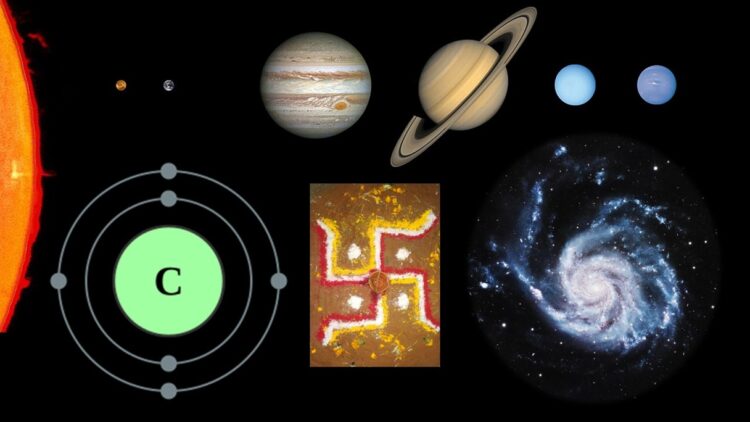
Two posters you might see in any school:
The Solar System’s orbits, rung by rung,
The Periodic Table next to it.
The wise old man examined them as if
Some priceless art, then said, “Come follow me”
And jumped into the poster like a cliff.
I looked at Falstaff, then Achilles, but
They merely looked at me. Achilles said,
“I think he just meant you. He told us both
To keep close watch as you two go ahead.”
I didn’t understand how I could follow,
And deep down I was just afraid to bump
My head into the wall. But then I thought
About old tales that tell how Taoists jump
Into a cup-sized gourd of wine. And so
I shrugged and thought, “Why not? What’s there to fear?”
And jump I did into the pitch black poster
Careening down so faraway and yet so near
Till when I heard a voice: “I’m glad you’re here.”
II.
Achilles poked his spear into the wall
Which, sure enough, was hard like solid brick.
He said, “I’ll watch the door; you watch the window.”
Falstaff replied, “Good sir! I shall be quick
To take my post and execute my duties.
Be sure of that, as sure as day shall dawn
And dogs will bark, and hungry cats mee-ow
For licks of cream, a scrap of fish or prawn…”
And all the while, amidst his walk and talk,
Falstaff, not near the window as of yet,
Was opening the drawers that he passed
And poking round to see what he might get.
Then from a mess of schooltime items came,
A bag of Snickers bars whose image caught
The probing eye of Falstaff who remarked,
“What bauble has this worthy smithy wrought?”
And soon enough he worked his eager fingers
Through the bag while gazing out the window
Above an empty playground on a day
Of clouds that threatened weeping like a willow
(Which helped transform the wall into his pillow).
III.
And there we were upon an asteroid
Of sorts that moved wherever Socrates
Had willed it to—in this case past the Moon
And toward the sparkling, far-off Pleiades.
Our path of travel took off straight but strange
Because the farther that we flew from earth
The tinier the size we shrank down to.
Yet, though we had a microscopic girth,
We also kept accelerating, so
Before too long we had a sweeping view
Of the whole solar system’s span and we
By now were small as atoms as we flew.
This size affected everything we saw,
Which now was not like any poster seen
Before; for all the particles of dust
Around the planets had a glowing sheen.
The Earth was more like Jupiter (which now
Itself was ten times bigger yet); the two
Were just as luminescent as the sun
Which had grown dim enough to not eschew.
And while I call these “planets” here in words,
In truth they looked as if they were on rings
Formed up of tiny particles grown large
And stranger still, as noted then, “It sings.”
The spinning planets played on astral strings.
Not unlike white noise, or the seashore’s waves,
Or buzzing that you hear when all is silent.
But unlike shadows on the walls of caves,
Perception now was clear, and powerful—
Each drop of sound within the sea could save
With holy hymns amassing to exult
The Being Supreme beyond all earthly graves.
Then as the planet moved away, sound faded
But not before another quickly hummed—
Another mass of spinning, super-sound,
So beautiful, it tingled then it numbed.
And onward, revolutions, vast rotations
Kept singing out, cascading over me
In blissful “music of the spheres” as writ
In long forgotten books and poetry—
Back then some still could hear their harmony.
IV.
“Hey, Falstaff!” Achilles called out, sharp as steel.
The snoring knight smeared with a Snickers drool
Choked up and jerked in a grotesque display.
“Sir, Lord Achilles, hail!” so said the fool.
They’d been on guard at least four hours now.
Achilles had blocked the doors with cabinets
And shelves and checked the windows for a foe,
But nothing stirred upon these battlements.
Yet that was all about to change. Achilles gave
Up any thought of foes who might show up
And turned his spear upon the chubby knight:
“You, Swine, get up, for no more will you sup
Until that belly feels the burn of action.”
He moved his own blockade and marched Sir John
To that drear playground they had seen outside.
Achilles said, “It’s time for fun—get on!”
Yet neither of them noticed as they left
(The lab room door wide open) that the roof
Sagged awfully swollen down as if something
Would push right through—a Santa’s reindeer hoof?
Such are the fruits of guards grown too aloof.
V.
As Socrates and I flew further out
The solar system further fell in view
But Mercury and Mars were now unseen
Just Venus and our Earth, which are imbued
With atmospheres that loomed now so much larger.
And for the outer planets, they were four,
All large before and larger since we shrunk.
And Pluto, small before, was seen no more.
“How many are there now?” I asked myself.
“Where have I seen that pattern once appear?”
I counted six, two small and inner ones
Both by each other gathered rather near
And then a big dark gap, then Jupiter
Then Saturn, Uranus, and last Neptune.
Or was it all of little consequence
Like gazing at the blank face of the moon…
Which, strange enough, is sun-sized in Earth’s sky,
And, strange enough, I saw these planets like
Mere atoms while we flew: “What if they were
That small,” I thought, “then what’s the pose they strike?”
That’s when I noticed that our Sun was like
An atom’s nucleus, the planets like
Electrons and this pattern of them like
“A carbon atom!” I said, feeling like
My brain waves lit up in a lightning spike.
VI.
Falstaff ran up playground stairs, then sat
Quite clumsily so he could take the slide;
Then at the bottom he turned round and scaled
The slope—a feat from which he nearly died.
He crossed a bridge, then down another slide,
Then jogged backed to the stairs where he would start
Again, Achilles smirking on the side
While Falstaff nearly burst his throbbing heart.
Achilles’ laughing stopped when he looked up
And saw tall stacks of paper growing higher
Upon the roof above the Science Lab.
He moved at once to find out what transpired.
First climbing up with agile leaps and holds,
He crept around the paper stacks and found
A horde of creatures, like a mass of ants,
All stepping on each other from the ground
Up to the roof where they delivered papers.
He flipped a cover page and read: “Constraints
On Paleohydrological Events
On Mars Based on…” (I see your eyelid faints).
Each paper had a planet’s name, a moon’s,
An asteroid’s, the sun’s, and focused on
Some minutiae of data once collected,
Now revised, but always it was done
Within empirical parameters
A lettered scientist could verify
So that it shrank the scope of knowledge down
To curious spores that work to putrefy
The will and rot the marrow in life’s bones,
Reducing Truth to lower forms that can’t
Prove that a God exists, a moral’s worth,
Or that we are much more than soulless ants.
But as for ants, these dense deliverers
Achilles saw up close were three-feet tall,
With limbs too short and heads and eyes too big
And voices murmuring, dull and small:
We’re publishing,
We’re flourishing,
We’re nourishing,
We’re worshipping,
We’re publishing,
We’re flourishing,
We’re nourishing,
We’re worshipping,
We’re publishing,
We’re flourishing,
We’re nourishing,
We’re worshipping,
Incessantly they droned, all out of sync
But all the same. Achilles only knew
That this was stacking up a lot of weight.
And very soon the stacks would break right through
Destroying what he had been tasked to guard.
He picked a creature up and threw it off
The side. Its panicked voice repeated at
A higher pitch and speed while cast aloft:
We’re publishing!
We’re flourishing!
We’re nour—
Achilles took his shield off of his back
And charged ahead, bulldozing creatures back
And off the roof, like fluffy snow that’s plowed
Away with ease and flees from swift attack
To leave within its wake a pristine track.
VII.
“We live inside a carbon atom then?”
I asked in wonder at the panorama
While many questions flooded through my brain
Like hurricanes through quiet Alabama.
Perhaps the dead and empty space between
The planets and the stars was not so dead,
Like space between atomic particles
In molecules, in flesh, in every head?
Then all the inklings that we have of life
On higher orders and arrangements made
That seem too much for chance are part of something
Beyond what merely mice and men have laid?
Wise Socrates looked grave and then replied
“Well I just thought it looked amazing! Right?”
And broke out laughing, which seemed oddly timed.
“But seriously,” he said, “I do not quite
See what you see. What is this ‘carbon’ thing?
We haven’t reached the spot yet where we’re going.”
We left the solar system and beheld
The Milky Way, but time and space were slowing
So that its spiral shape looked like four arms—
A giant wheel, the ancient swastika
Used by the Buddhists, Vedas, Greeks,
And Hopi tribe of North America.
“Observe the perfect order” Socrates said.
“The Law Wheel spins with constant energy.”
“And somehow human beings have seen it too,”
I said. “Yes, but,” he said, “What will we see
If we keep going past our galax—”
VIII.
A lightning bolt crashed down upon Achilles
Demobilizing him (though still awake).
Then Zeus’s voice resounded from the clouds
And thundered loud enough to make things shake:
“My apologies, Swift-Footed Achilles,
I cannot let you interfere; although
It’s truly no big deal to me, but I
Was told by them that I could not say no.
I signed a contract with the colleges
And universities so I can stay
In certain courses of the liberal arts;
My stories still may see the light of day.
They said I’m obsolete and tried replacing
Me with Atmospheric Sciences
And Meteorology, but all they do
Is drown the world in research references
And forecast weather sometimes accurately.
But can they hit a mortal with a bolt
Of lightning miles down? Can they
Command a weapon that’s a billion-volt?
Alas, but they’re in charge now; this is what
They want and no amount of tears will bring
The past back.” And with that one single drop
Of rain plopped. Then another. Showering
Commenced and soaked the papers, multiplying
The weight. Falstaff finally arrived,
Which did not help. The roof was buckling.
“What’s wrong, Achilles? All your strength deprived.
The Fates a fitting punishment contri—ahhhh…”
IX.
Now all this cut-off rhyming meant disaster.
The roof caved in, the Science Lab destroyed,
My journey led by Socrates imploded.
I woke up on my couch a bit annoyed.
The secrets of the universe were just
About to be revealed when thunder near
My window woke me—which was odd in mid-
November. Odd as well was just how clear
The dream had been. It wasn’t till the next day that
I saw a video with footage showing
A man break in the local high school where
He only stole some candy before going.
The news piece though was overshadowed by
Another one: the roof above the school
Had fallen in amidst the wild storm,
Which made the Science Lab into a pool.
One student interviewed said, “Kind of cool.”
Evan Mantyk teaches literature and history in New York and is Editor of the Society of Classical Poets. His most recent books of poetry are Heroes of the East and West, and a translation of Sir Gawain and the Green Knight.
















As someone who has himself gone on journeys throughout the stars and galactic bodies, I have to like these flights of fancy, and the oddball throng of travellers – heck, you couldn’t make up Falstaff in THAT company – oh, but you have! Like too the satire: “But all they do / Is drown the world in research references” – as an alternative to the rule of Zeus! Nice, Evan, nice!
Thank you, James. I think I was tired of poor writing in movies and wanted to create something that I thought would be entertaining and perhaps thought-provoking. But whether other people found it so or just weird is another question. I’m glad you liked it!
I am absolutely amazed at the profuse imagination displayed by these verses with a depth of meaning of cosmic proportions that swirl in the mind like the elements and planets ascribed to superior powers. Combining the escapades of Achilles, Falstaff, and Socrates assisting the narrator boggles the mind as the conflict between science and the supernal suffuses this dream world of meaningful cognizance like the “curious spores that work to putrefy The will and rot the marrow in life’s bones, Reducing Truth to lower forms that can’t Prove that a God exists, a moral’s worth, Or that we are much more than soulless ants.” Brilliant work above and beyond mere mortal thinking that inspires and electrifies.
Thank you, Roy. You found one of the more meaningful moments. You summarize the conflict astutely.
Very interesting and funny, even to an unschooled mind.
I’m glad you liked it, Johanna. Thank you for reading.
LTC Peterson has put his finger precisely on it: “the conflict between science and the supernal.” This is one wild and crazy dream-vision that not only carries us out of the world, but also completely transforms our perceptions of size and place into things exaggerately huge, and infinitesimally small. But through it all the satire is clear. The best of this satire is the picture of the gigantic ants, that are “publishing, flourishing, nurturing, worshipping” — what a perfect description of the pointless production of meaningless paper going on in our universities, so gargantuan that it will cause the collapse of an entire educational system! And not even the great Achilles can stop them.
Maybe I’m being too simple, but I cannot help thinking that, if allegory is at work here, then Achilles represents human physical force and impetus, while Falstaff represents selfish pleasure-seeking. Those two states of mind could well represent the entire modern world.
Yes, Joe, allegory is at work here and you precisely hit upon the fundamental forces behind these two characters. I actually based them on the Monkey King (the physical force and impetus, as you put it) and Pigsy (selfish pleasure-seeking) in the classic Chinese novel Journey to the West, which are indeed as you describe in episode after episode and adventure after adventure. When studying the Chinese character the Monkey King I was reminded of Achilles when I noticed that both of them have a weapon so powerful that no one else can reputedly lift it. There are some other heroes in history and culture who are like this as well.
Let’s see now–what’s real, what’s not? I’m just recovering from your fantastic poetic tour. Having missed Part I, I went back, got up to speed, and then was ready to join your eminent literary companions on a trip not entirely reassuring but funny and thrilling nonetheless. And in passing let me note how strange is the current skeleton-cult–not jolly at all, and rather menacing. But I suppose a morbid culture must have its own fitting gods and nightmares. Meanwhile our heroes carry on their space journey and, just as in dreams–or as in Alice in Wonderland–the absurd seems perfectly natural. Momentum matters, I would say, and your narrator does a fine job of sweeping us along among the planets to gawk at many wonders. Thanks for the exhilarating ride.
Thank you for reading, Bhikkhu Nyanasobhano. The skeleton-cult is indeed not jolly and grows odder and odder by the year. The entire strangeness of Halloween was especially highlighted to me by my wife who is originally from New Zealand and grew up when Halloween celebrations were virtually non-existent there. The more I thought about it, the menacing and disturbing nature of the celebration became more and more apparent.
An absolutely fascinating romp through time and space with a unique tone — metaphysical, classical, Shakespearian and yet infused as well with the casualness of teen-speak. That you pull this off, Evan, is quite a feat. I greatly enjoy poetic “visions” and have ever since I first read Kubla Khan. And I have long been struck by the similarity of atomic structure and the solar system. It’s impossible for me to believe that any of this is random. There is a deep, deep order in the Universe.
I found this poem a fun, entertaining and interesting read Evan. Like many dreams it took me on a rather odd journey. I enjoyed the creativity very much.
Evan in Wonderland.
Nicely done.
Wow — it seems to me that this encompasses …. well …. just about everything! History, science, education, “certain courses of the liberal arts….” It’s both profound, and a rollicking good time! That this poem was composed, is enough to prove that “we are more than soulless ants”.
“Beyond what merely mice and men have laid” might be my favorite line. (And panorama/Alabama is probably my favorite rhyme).
There is indeed order in the universe, and a destination ahead. However, with our many models of things from atoms to solar systems, there is more empty space interspersed than things (paraphrased from Sir Arthur Eddington, The Nature of the Physical World). You covered this profoundly philosophical point among the current labors, Evan.