


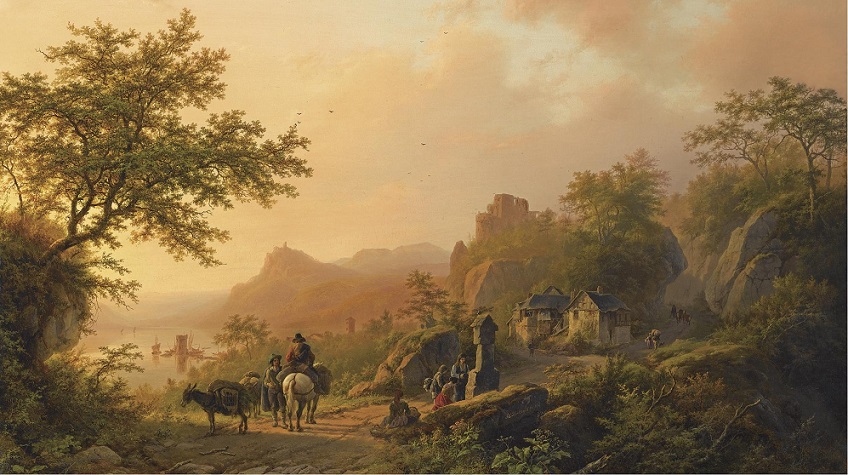
.
August.
The rose-of-sharon blossoms float like stars
Within my reach: I’m lying on the grass
Observing sunset fade and twilight pass
Between their leaves. Cicadas sing their airs,
A gentle dirge: the summer’s passing, too,
With ticks and tocks of crickets counting hours
That still remember June’s long days. Sunflowers—
Aged and withered—still can look down through
Late vernal foliage. This year’s youth has gone
The way of tulips, peonies, and iris
That yielded to the judgment of Osiris
Before July. Now fireflies’ tranquil drone
Accompanies warmth’s final rays, and hums
Fall’s bass line as the last few ripening berries
Attempt to blush before the cold that comes
To bury them with all that winter buries.
.
.
.
.
Summer Evening Sounds
The cicadas are mowing the air
While a gardener buzzes his lawn
And the crickets continue the prayer
They began at dawn.
.
The engine of rush-hour hums
With its stereos’ gut-bruising noises;
Their thunder of synthesized drums
Effaces our voices.
.
Bright-vested roadworkers’ drills
Make a din as they dig in the street,
While the red-breasted robins’ sweet
Notes fill the intervals.
.
Other songbirds have gone away
To meditate for the night
But the jarring rasp of a jay
Scratches the twilight.
.
Air conditioners’ constant drone
Persists after dark; day’s warm breeze
Has gone to sleep with the sun
Behind the trees.
From Notes on Time
.
.
.
.
.
Cynthia Erlandson is a 2023 Top Four winner in the Maria W. Faust Sonnet Competition. Her poems have appeared in The Society of Classical Poets, First Things, Modern Age, The North American Anglican, The Book of Common Praise Hymnal, and The Catholic Poetry Room. Her collections are These Holy Mysteries and Notes on Time.

















Both of these late summer poems are charming, Cynthia. I love the atypical rhyme scheme of “Summer Evening Sounds”, but I give the edge to “August.” There is a melancholy edge to “August” — that “gentle dirge” — but also a timelessness so suited to the subject. The change of seasons is made part of an infinity in time and space. Rose-of-Sharon invokes the Song of Solomon, quite different but of equal antiquity to your mention of Osiris, and all under a carefully wrought sky full of stars. There are so many “sound” words which accompany an anthropomorphizing of nature, including those berries which “attempt to blush.” You’ve managed to universalize and give grandeur to the end of summer but without ever losing an elusive tone of lightness and airiness. Well done!
Thank you so much, Brian! I’ve always felt the change of summer to fall as a very poignant time — sad in its own way (although I love autumn!), and somehow profound. I’m glad you sensed a lightness to it, too.
Cynthia,
What can I say…your poem reminds me of Timothy Steele’s.
You are able to catch the beauty of nature and blend it in with the hustle and bustle of life so seamlessly, it is pure joy to see, feel, and breathe in your poems.
Congratulations.
Paddy
Thank you, Paddy! I’m glad the poems had those effects on you. Are you referring to a particular poem by Timothy Steele? I do like his poetry very much, as well.
Cynthia,
‘August,’ by Timothy Steele. It’s featured in his collection ‘Toward The Winter Solstice.’
Best regards,
Paddy
Enjoyed both poems also, Cynthia. Loved your swapping of sounds between the Cicadas and the mower in the “Evening Summer Sounds” and then further down, the similar vestment of road-workers and Robins.
Thank you for noticing those things, jd. It was fun finding those ideas and figuring out how to execute them.
Loved the vivid imagery. My fave is the cicadas mowing the air.
Thanks for the read, Cynthia.
Thanks, Paul! Your comment made me smile.
These are two pleasant and melodious poems to begin August. They are replete with visual images and auditory tones of the season that enchant and enhance the experience. They are beautifully composed and creative in their depiction.
Thank you, Roy! I’m especially glad that you found them melodious. The overlap of seasons is certainly enchanting to me.
Beautiful, Cynthia!
Somehow I particularly loved “the ticks and tocks of crickets”.
Bravo!
I’m very happy that you like them, Jeffrey! Thank you! I’ve been wondering for years why I think the music of crickets is so beautiful. The poem may be as close as I ever come to explaining that.
These are both very enjoyable seasonal poems and the painting is great too. I especially enjoyed the first stanza of the second poem, it’s really well done, thank you.
I’m so glad that you liked them! Thank you, Yael.
Thanks for the imaginative poems, Cynthia, when I read them I was transported to my backyard.
Thank you, Nathan; I’m glad it was able to transport you!
Cynthia, these poems are exquisite… breathtakingly beautiful! I love their imagery and their musicality. I also admire the unobtrusive subtlety and the smoothness and richness of vocabulary in ‘August’. Both poems are an absolute pleasure to read. Thank you!
Wow, thank you so much, Susan! I’m glad they delighted you, and I’m so grateful for your praise! I love the subject of time and the seasons.
Beautifully written odes to summer. Each poem captures the temporality of the season. Thank you for sharing.
You’re very welcome; thank you, Susan!
What is impressive about “August” is the speed of the poem. From lying on the grass with low-hanging roses-of-sharon above, to warmth’s final rays and then winter burying most things in a mere matter of lines! I began to worry that you might not have had a chance to get up from the grass. This is a new perspective on August to me. Even when I lived in the blizzardy North, August was always just plain hot. However, your refashioning it into a transition period is beautifully done, Cynthia.
Thank you, Margaret! I’m fascinated with transitions; one of the sections of my book “Notes on Time” is called “Transition Times.”
Throughout both of these lovely poems I felt ensconced by that gorgeous sense of late summer as it more frequently used to be, and which consequently lifts my spirits. Many thanks.
You’re so welcome, David. Thank you for your kind comment.
These are both wonderfully inventive and alive, Cynthia.
I’d love to hear you read them. I’m sure summer’s racket could be stilled long enough to permit such a thing.
I would love to, Julian; thank you!
“August” is such a cornucopia of detail and image. I find sonnets to be a curiously elastic form: they hold more than you think they could sometimes. And other times they feel almost weightless. You gain so much with just two more lines, your poem becomes both full and spacious.
An Egyptian name to rhyme with the Greek one is nice. It’s as if the flowers of summer bring the Nile to us. And I also love the “ticks and tocks” of the crickets, the gentle warning they carry. And the berries-buries rhyme to end it. (I say those two words pretty much the same myself.)
I for sure experience August as transition. This year, big winds one night at the end of July carried us across an invisible line.
Thank you so much for your comments, Monika!