


Ballad of the Sequoia
_Six hundred years ago,
My seed was planted in the ground,
_A life so full of promise,
And the green grass all around,
_Since then, I’ve weathered storms;
I’ve seen my brothers come and go,
_But here I am still rooted,
In this valley here below.
_Five hundred years ago,
I was a sapling, young and strong,
_An eagle soared above me,
And I heard his mighty song,
_I said one day I’d meet him,
In the heavens, clear and blue,
_Not knowing of the fire,
I was soon to be put through.
_Four hundred years ago,
The raging sun stretched out his hand,
_The grass around me withered,
And I too was rough and tanned,
_The reaper came through smoking,
And with flames upon his breath,
_I felt his scourge upon me,
And I wrestled then with death.
_Two hundred years ago,
A mountain cracked its highest peak,
_A host of jagged boulders,
Tumbled in a doleful streak,
_They sang the reaper’s melody,
Like tombstones in the dark,
_And all did gather round me,
As they chipped away my bark.
_One hundred years ago,
I had grown weary, I was weak,
_The seasons were so heavy,
That my spirit then was meek,
_The reaper came a callin’,
With a touch as cold as ice,
_I sent him on his business,
But I soon would pay the price.
_For here I die at last,
A great sequoia, tall and grand,
_The reapers come to take me,
With a logger’s axe in hand,
_I’ve loved in spring and summer,
And I’ve said goodbye in fall,
_I froze to death in winter,
Now I’ve heard the reaper’s call.
Lauren V. Leon is a pianist, amateur poet, writer, and artist. She resides in Riverside, California, and works as a Catholic parish musician, choir director, and private piano instructor.
















Sequoias are amazing; It’s a bucket-lister for me to see one. They remind me of a scripture in Isaiah when it say that the days of my people will be like the days of a tree. A tree doesn’t die of old age—something has to act upon it. Great concept to write an anthropomorphic poem from their perspective.
Thank you Michael, I thought of the concept while vacationing with my family in Kings Canyon. There are a ton of Sequoias there that are both living and felled. I heard at the nature center that Sequoias shoot to their full height in six hundred years and then grow wider from there. Thus, the idea was born.
Lauren, A good poem tells a good story, and there are few stories as grand as the epic tale you tell here! Where I live I am surrounded by the rotting stumps of what were once massive old growth cedars. Only a few small preserved groves remain to tell their stories, all too many of which have had sad endings.
There is something striking about an old trees in general, but there is a special melancholy that accompanies dead ones. I greatly appreciate your thoughtful words.
This is a great musical poem with lyrics that tell a great tale about a living legend that finally was felled. In fact, as I was reading it, I began to reflect on an old hillbilly melody and sang the final verses. I have seen the grand sequoia trees and marveled at how much history they have seen–from birth to their final end.
Thank you Roy. I would love to know what old hillbilly melody you used! I must confess that I was in large part inspired by Big Iron when I penned this poem. I wrote my own melody to go with it since I have recently been interested in the poetic tradition of American Folk.
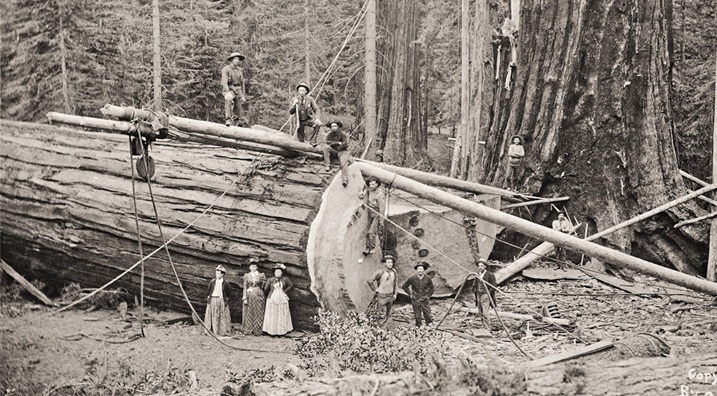
I enjoyed this poem although it is always sad to see these beautiful trees chopped down. The old picture shows how amazingly tall and wide they can get.
Thanks Norma.
I have experienced a deep sense of tranquility being amidst the Sequoia trees and also being amidst the Redwoods. Lovely Poem.
Thank you Margaret.
So beautiful and sad, Lauren. It’s hard to imagine a time when humans lived for hundreds of years, like trees still do. I love your poem; it made me feel deeply, even brought tears. I live near redwoods; trees are such a special gift to us all.
‘sequoia’ is the shortest word in the English language (though not an English word) that uses all five vowels.
Anyhow, what a great ballad, Lauren – and to a tree! You can feel the sequoia’s majesty throughout the poem and you’ve done a great job highlighting the tree’s silent battle with the elements until the Reaper comes calling in the guise of Man. Indeed, we are Nature’s bane.
By the way, the shortest unimported word in English with all the vowels is ‘questionable’.
Thanks for the read. Being usually a desert-dweller, I appreciate poems such as these.
The opening “timelines” of each stanza make the story flow of the ballad easy to follow. “Three hundred years ago” is obviously missing, but there we understand the Sequoia was speechlessly recovering from a battle with death by fire. As others have said, when we pay attention to a seemingly motionless tree, it can seem to exude an emotional narrative–even when it’s a relatively young tree we’ve watched all its life in our yard. The summary of seasons in the final stanza makes the final “reaping” quite plaintive.
Thank you for the kind words Margaret. Alas, I did not think so deeply regarding the missing, “Three hundred years ago.” I had written that stanza and I’m not sure how I missed that when I submitted my poem! Here is the missing stanza:
“Three hundred years ago,
I was still reaching for the sky,
The reaper came to claim me,
But my spirit yet did fly,
He said he’d come to get me,
When at last my life was spent,
I told him I was stronger,
And he’d never see me bent.”