


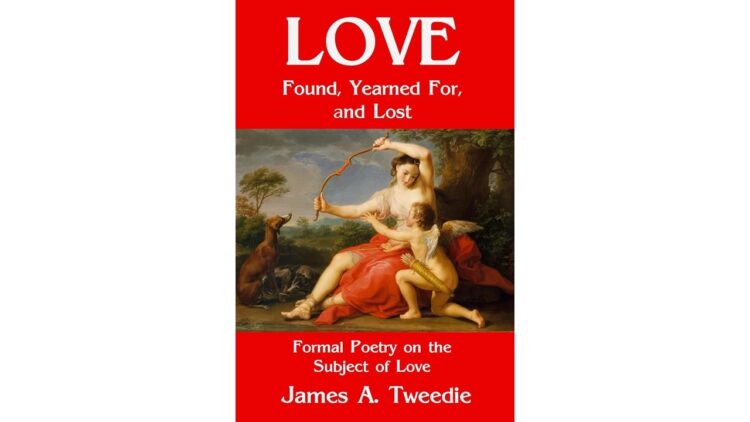
Reviewed Poetry Book: Love Found, Yearned For, and Lost by James A. Tweedie
by Theresa Werba
I have had the pleasure of knowing James Tweedie and his poetry since 2017 when his first poem appeared at the Society of Classical Poets. I have always found an authenticity and truthfulness about life and its many vicissitudes in Tweedie’s poetry that many poetasters with their platitudes and sing-songy rhymes easily avoid. Not James Tweedie!! There is nothing hackneyed or trite or approaching doggerel in anything he writes, when it comes to the subject of love, or anything else. Tweedie brings a depth or reality and relatability to his well-crafted poems, touching upon some of life’s deepest truths with a unique blend of honesty, candidness, tenderness, pathos, and humor.
In Tweedie’s latest collection Love Found, Yearned For, and Lost we have a swath of creativity which enjoins the human, the gritty, the painful, the wonderful, and the transcendent in a refreshing interplay. He reminds me so much of the vulnerability and daring in the sonnets of William Shakespeare, because Tweedie likewise creates poems about the regions of love, in all its many manifestations.
Love Found, Yearned For, and Lost is divided into three sections: a joyful collection of reverie for found love; a section of poetry confessing the vexations and perplexities of unrequited love; and a powerful set of poems about the loss of love to rejection or death.
Tweedie’s new collection is comprised of 61 poems, with over half of them being sonnets. This makes me exceedingly happy, because I have published an entire book of sonnets myself and find much pleasure and beauty in the sonnet and its various sub-forms. I have found several sonnet forms in his work here, all of which he employs to great effect: a hybrid form, which is part Petrarchan and part Shakesperean (ABBA CDDC EFFE GG); the Shakespearean form (ABAB CDCD EFEF GG); the “couplet” sonnet (AABBCCDDEEFFGG); the Petrarchan (which among other variants can be ABBA ABBA CDECDE); and a “fourteener” sonnet, using iambic heptameter with 7 beats instead of the traditional 5 beats (I have also used this form before; it conveys a kind of somber majesty particular to it).
Tweedie also treats us to other forms such as the villanelle, haiku, Sapphic verse, a mirror poem, dactylic hexameter (the form used in ancient Greek and Latin poetry), a few nonce forms of his own creation, and song lyrics. In this way it is much like the old American embroidery samplers which young Colonial girls would create to show their proficiency in a variety of stitches. Here we have a lovely sampler about love in an interesting and satisfying panoply of forms. I also find that the sonnet in particular has suited Tweedie’s subject matter perfectly. Sonnets have been used over the centuries to write about love desired, love obtained, and love lost, to great success; with Tweedie I feel like I am reading both something entirely new and yet a friend echoing from the past, calling me to remembrance.
Several poems stand out to me particularly. “Tango” is a sonnet which uses dance as a metaphor for erotic longing and love. I particularly like the phrase “emotion set in motion”—what can reflect passion and desire expressed in dance better than that?
Unflinching passion; clinching, clutching grasps
Of pulsing flesh erupting in desire
As hands and waists and cheeks engulfed in fire
Converge and merge in unrepentant gasps.
In symbiotic symmetry they stride
And glide as one across the floodlit floor;
A pantomime Te amo, mi amor,
Where love and lust of paramours collide.
Emotion set in motion, intertwined;
With step, a twist of head, and furtive glare
The fervent pair incinerates the air
With agony and ecstasy refined.
Love consummated in a fleeting glance
As Eros and his Aphrodite dance.
This is so excellently executed, and for me, pardon the pun, incredibly “satisfying.” I absolutely love the unrepentant description of eros in its desire, passion, and sexuality.
Another fine example of the intensity and power of passion is a sonnet based on the medieval story of Aucassin and Nicolette, whose love transcends culture and status:
Infatuation, lust, and love, desire—
Above all else, desire!—I wanted you,
Both flesh and soul, the whole of you entire
To urge and surge, to meld and merge into
A unity so deep and so complete
That none, not even God could make undone
Or put asunder. Thunder-drummed the beat,
The cadence of my heart that bid me shun
My faith, my birthright-destiny
And throw it all away for you! So let
Us become one, set free at last to be
No longer Aucassin or Nicolette.
Beyond mere lust or love, one flesh made new;
Forever you in me and me in you.
I absolutely adore the line “To urge and surge, to meld and merge”—just wow! This is literally naked and candid romantic desire, created through assonance and alliteration!
My point is made more pointedly in his poem “Unending,” where Tweedie remarks about “the clash between the sacred and the profane.” Indeed, is there a clash, or need there be? In Tweedie’s work we have a poet who writes about matters of the heart and body honestly, truthfully, without vulgarity or gratuitous sexualization. No Puritan prudishness here! His writing is good because what he writes about is universally real to all of us. It is refreshing that a person can be so candid and expressive about love in its both emotional and physical manifestations. He proves that sexuality is not profane—or needn’t be, unless you make it so.
I also particularly enjoyed “Three Sonnets in an Antiquated Style.” Here Tweedie uses various archaisms such as “doth,” “thy”, “mine (as “my”), “thee,”, “thyself,”, “wouldst,” “desirest,” and “wilt.” I was so enwrapped in this experience I honestly felt like I was reading sonnets by Donne or Spenser or even Shakespeare—they are that faithful to the idiom! (It is a wonderful exercise and I can’t wait to try it myself. I think every sonneteer should attempt this experiment at least once.)
In the second section we have a set of poems about unrequited love. Most interesting to me is “Come Back to Love, My Love” where Tweedie gives homage to the archaic language of the earlier English sonnets, even using Biblical references, which completely captures the very heart and raison d’être of the sonnet form:
Alas! Shall love of thee be all for naught?
Come back to love, my Love, and do not flee
From my pursuit of thee, for thou shalt not
Find love more true than that which stirs in me.
And yet, apart from thee, my love has none
To love, for all the love I had to give
I gave, and laid it on thine own heart’s throne.
And without love, how shall I deign to live?
For thou art life and breath, my Love;
Mine all in all, my morning star, my hope and stay.
So hear my cry, lest I, despairing, fall
Like tears that only thou canst wipe away.
For all my love is thine, and thine alone.
So come, my Love, and join our love as one.
The final section on “Love Lost” brings writing on love to “a-whole-nother level” (as we used to say in New York City). Here Tweedie brings us the gamut of the emotional cost of losing love, either by the other’s choice, or by death. Tweedie poignantly expresses sadness, regret, remorse, embarrassment, faith tinged with nihilism, emptiness, and grief, in such a candid, naked way that one cannot help feeling the emotions he is feeling.
Though I enjoyed the many and varied sonnets, “When Love Is Lost” might be my favorite, particularly because of the line “When star-crossed lovers’ love is double-crossed”—perfection and genius! This sonnet is also brilliant in its use of simple diction to render profound truths about loss of love through the end of a relationship, or death:
To see the summer sun and wish for rain;
To smell the springtime flowers and wish for snow;
To wake at dawn and wish for night again;
To trade today for dreams of long ago.
To grieve the present and embrace the past
Remembering the love that worked its way
Into our hearts and bloomed but did not last;
A fallen blossom doomed to fade away.
And what is there to do when love is lost?
When broken promises betray our trust?
When star-crossed lovers’ love is double-crossed
And life’s tomorrows crumble into dust?
The path we choose shall be the path we keep,
To love again or to forever weep?
James Tweedie is one of the finest American formal poets writing today. The breadth of his work covers both the human and the sublime in ways that few poets have ever managed to achieve. Love Found, Yearned For, and Lost should be commended for expressing the emotional and the erotic—the agony, ecstasy and loss of love—reaching apotheosis in all.
Theresa Werba (formerly known to the SCP community as Theresa Rodriguez) is the author of eight books, including What Was and Is: Formal Poetry and Free Verse, and Sonnets, a collection of sixty-five Shakespearean, Spenserian, and Petrarchan sonnets. Her work appears in numerous journals, websites, and online publications, including the SCP Journal. She has been featured on Classical Poets Live where she discusses musicality and elocution in formal poetry. She is a contributing writer for Classical Singer Magazine. Werba’s background as a Classical singer informs her dramatic poetry readings which are available on Youtube @thesonnetqueen. Her website is www.theresawerba.com.















I am so glad I had the honor and privilege of reading and reviewing James Tweedie’s latest volume of poetry! I encourage the SCP readership to order a copy and enjoy the reading experience as much as I did!!