


The First American Sonnets: David Humphreys
by Margaret Coats
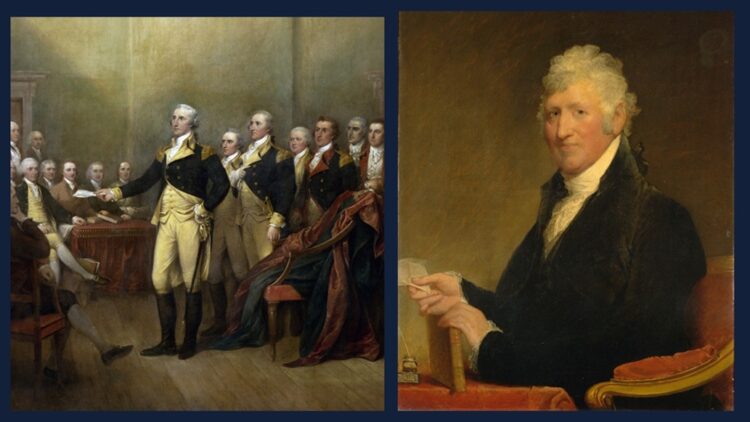
In 1776, the first known sonnet in the United States of America was written by a young patriot ready to join the continental army. Below, see it and several more by David Humphreys (1752–1818), who was born in Connecticut, and graduated from Yale College with honors in 1771.
Humphreys is one of five Connecticut writers called “The Hartford Wits.” He taught school for several years after college, and earned a master’s degree from Yale in 1774, but after declaration of American independence in July 1776, he quickly volunteered for military service. Humphreys proved a capable soldier. In 1780 he became colonel aide-de-camp to General Washington. The two were friends and close associates; the Connecticut Yankee visited Washington’s Virginia home at Mount Vernon several times. Humphreys was also the first presidential speechwriter, adding rhetorical flourish to Washington’s words, and standing beside him during the first inaugural address.
A diplomatic career developed as Humphreys accompanied Benjamin Franklin, John Adams, and Thomas Jefferson to Europe to negotiate commercial treaties for the new nation. He was the first minister to a foreign country appointed under the United States Constitution, serving from 1791 to 1797 as American minister to Portugal, and from 1797 to 1801 as minister to Spain. In later years, Humphreys was active as an entrepreneur. Having imported Merino sheep from Spain, he founded the American woolen industry. He did his best to make his factories, producing woolen cloth and iron tools, superior to what he had seen in Europe, in efficiency and in treatment of workers.
Following are five sonnets taken from the twelve published by Humphreys in Miscellaneous Works (1804), along with much poetry in other forms. Most of these have rhyme scheme abab bcbcc dedee, which is a variation of the standard Spenserian sonnet rhyme scheme, abab bcbc cdcd ee. They employ a closing line lengthened to hexameter, as often in Spenserian sonnets of the period. Notice that Humphreys regularly uses “Columbia” as the poetic name for his nation.
Sonnet I
—addressed to my friends at Yale College, on my leaving them to join the army
Adieu, thou Yale, where youthful poets dwell!
No more I linger by thy classic stream.
Inglorious ease and sportive songs, farewell!
Thou startling clarion, break the sleeper’s dream,
And sing, ye bards, the war-inspiring theme!
Heard ye the din of battle? Clang of arms?
Saw ye the steel ’mid starry banners beam?
Quick throbs my breast at war’s untried alarms,
Unknown pulsation stirred by glory’s charms.
While dear Columbia calls, no danger awes,
Though certain death to threatened chains be joined.
Though fails this flesh devote to freedom’s cause,
Can death subdue th’unconquerable mind,
Or adamantine chains ethereal substance bind?
Sonnet II
On the Revolutionary War in America
When civil war awaked his wrathful fire,
I saw the Britons’ burning stain the sky;
I saw the combat rage with ruthless ire;
Welt’ring in gore the dead and dying lie!
How devastation crimsoned on my eye
When swooned the frightened maid; the matron fled
And wept her missing child with thrilling cry;
Old men on staves, and sick men from their bed
Crept, while the foe the conflagration sped!
So broods, in upper skies, that tempest dire,
Whence fiercer heat the elements shall warm;
What time, in robes of blood and locks of fire,
Th’exterminating angel’s awful form
Blows the grave-rending blast and guides the redd’ning storm.
Sonnet III
—on the prospect of peace, in 1783
From worlds of bliss, above the solar bounds,
Thou, Peace! Descending in these skirts of day,
Bring heavenly balm to heal my country’s wounds,
Joy to my soul, and transport to my lay!
Too long the cannon, ’mid the grim array
Of charging hosts, insufferably roared,
When rose th’Almighty power, with sovereign sway,
To end the battle mutual inroads gored,
Spare squandered blood, and sheath the wearied sword.
Now bids that voice divine th’invaders yield;
From glooms of midnight, morn’s gay prospects rise:
There, see the dawn of heaven’s great day revealed,
Where new auroras dim our dazzled eyes,
Flash o’er Atlantic waves, and fire the western skies.
Sonnet X
—on the murders committed by the Jacobin faction in the French Revolution
When heads by guillotines all ghastly fell,
As mad for gore, o’er Gaul a faction hung,
Then giant Terror tolled his nightly knell;
Wide on the winds the sounds of murder flung!
With agonizing shrieks each prison rung―
Nor yet the tocsin ceased its louder roar,
But every time it undulating swung,
Cold horror froze through every shivering pore,
For victims doomed to view the dawn no more.
Those blood-stained Jacobins in turn shall fall,
Murd’rers of millions under freedom’s name!
But not the blood that deluged frantic Gaul,
In calm Columbia quenches reason’s flame,
Or blots with bloody slur our fair Republic’s fame.
(tocsin: alarm bell)
Sonnet XII
—on receiving the news of the death of General Washington [1799]
Hark, friends! What sobs of sorrow, moans of grief,
On every gale, through every region spread!
Hark, how the western world bewails our chief,
Great Washington, his country’s father, dead.
Our living light, expiring with his breath,
His bright example still illumes our way
Through the dark valley of thy shadow, Death!
To realms on high of life without decay,
Faint, he relied on heavenly help alone,
While conscience cheered th’inevitable hour
When fades the glare of grandeur, pomp of power,
And all the pageantry that gems a throne:
Then from his hallowed track, who shall entice
Columbia’s sons to tread the paths of vice!
Humphreys makes his final sonnet, memorializing Washington, unique among his works, with a rhyme scheme abab cdcd effegg, varying the Shakespearean sonnet model. The poet probably received news of the death while in Spain, serving as American ambassador. He could truly say “how the western world bewails our chief.”
A high sense of American idealism flows through these poems. In the first, the young soldier-to-be calls on college friends, possibly to join him in facing combat ahead that could lead to death or prison, but certainly to take up warlike thoughts and themes in poetry. The second sonnet portrays the sufferings of the entire American people during the Revolution in an apocalyptic vision, suggesting the conflict’s great historic significance. The third sonnet, looking toward peace, sees it not only as won in war, but definitively given by God. Sonnet X, the fourth presented here, displays American horror at the Reign of Terror in France during 1793–1794. Murders by the million are attributed to political factionalism, in calm confidence that American reason could not allow such to blemish our freedom. The sonnet on Washington’s death depicts him as a shining example of virtue mourned by the world, and father of a country whose sons will faithfully preserve his memory and reflect his merit.
Humphreys occupies that unique space in American history amidst the moment that began the Republic, yet when the New World’s literature still held the noblest aspirations of Western civilization.
Margaret Coats lives in California. She holds a Ph.D. in English and American Literature and Language from Harvard University. She has retired from a career of teaching literature, languages, and writing that included considerable work in homeschooling for her own family and others.


















Margaret, I am overwhelmed by Humphrey’s superior word skills, flowing rhymes, something a song writer loves (departure from prescribed meter) by these great Revolutionary War sonnets and subsequent French Revolution and death of Washington sonnets. I behold these fabulously written sonnets for the first time which are introduced by the precise detailing and inherently brilliant essay of one of our living legends.
Thanks for all you’ve said, Roy. David Humphreys, as a cultured individual capable of using good judgment, was the effective kind of change-maker, a builder even more than a fighter. Glad I could briefly assemble details about his life to present his own poetic words and demonstrate his way with language. Like Washington, a figure to be admired as we proceed along the American way.
Thank you, Margaret, for bringing to my knowledge this glimpse of history and this stimulating batch of poetry. How little–if anything at all–do we hear nowadays of unabashed patiotic sentiment, especially delivered in sturdy verse with such images as “calm Columbia…” (would it were so now) and “Great Washington, his country’s father, dead.” This came from a man and an age not yet withered into cynicism and not yet accustomed to “the paths of vice.” His poems call up solemn reflections.
Bhikku Nyanasobhano, you mention several traits obvious in David Humphreys’ poetry, but uncommon in our day and age. He is an unabashed patriot who writes in “sturdy verse.” Neither he nor his age is afflicted with cynicism–and in that last sonnet, he assumes his readers recognize vice, and would feel ashamed and degraded to take part in it. When he concludes the poem on Washington with an exclamation point, we can hear the scorn for anyone who would dare mislead Americans. These attitudes, and the sturdiness of the verse, undoubtedly came from an education built on sound moral values, and on a worthy appreciation of culture. Thanks for your perceptive comments.
Margaret C.
Thank you for this enlightenment and for your persistent research.
From Margaret B.
Thank you, Margaret B. I discovered these by doing research on kinds of sonnet. Even after much rhyme scheme experimentation in the nineteenth century, the form chosen by Humphreys remains mostly his own and, because of its early employment by him, distinctively American.
Margaret, you’ve done a great service by introducing us to this forgotten and neglected poet. I never even heard of him!
The selections showcase that he indeed had great rhetorical skills. One has to wonder if he’s even studied at his alma mater, Yale.
I would hope Yale has a memorial to Humphreys somewhere on campus, and that Connecticut schools in general might pay attention to him and the other “Hartford Wits.” American literature is such a vast field that he gets crowded out. I’ll have to admit I didn’t hear of him in college or graduate school. My 1905 “Chief American Poets” anthology chooses Bryant, Poe, Emerson, Longfellow, Whittier, Holmes, Lowell, Whitman, and Lanier. But now is a good time to remember all the achievements of this remarkable figure from the period of the American Revolution.
Thank you, Margaret, for introducing us to this poet. The patriotic spirit and courage he expresses seem, sadly, to be so much weaker in our country today. Humphries is a great poet to rediscover for our 250th anniversary.
To me, his confidence in Columbia is his strongest trait, and one woefully absent in our country today. Doubtful and divided hearts can’t match his emotional fortitude. Glad you see his patriotic spirit, Cynthia, and thank you for making the comment.
To rediscover him, anyone can look up his Miscellaneous Works (1804) at the Internet Archive. There are other editions, but in this one the sonnets start at page 232, among longer patriotic works.
Dozens of English and American Romantics struggled to create new poetic forms, during that revolutionary era, as in the case Ms. Coats clearly represents in the sonnets of David Humphrey.
David Humphreys
by Usa W. Celebride
Hello, gray ghost, who once upon a time
inhabited Yale college as a youth,
no longer do you linger in that mime,
beside that classic stream in thirst of truth.
In fact, you joined the dogs of harshest war,
the din of battle, clang of arms and steel;
beside the starry banner’s beam of yore,
you leapt with revolutionary zeal,
enlisting to support your nation’s weal.
How could one ever say good-bye to you,
though you are gone, as all must someday go;
because you helped to pull this nation through,
that death itself, uniting with our foe,
has not yet stopped two-hundred-fifty years, great ghost?
Usa W. Celebride is a poet of America.
Bruce, you do him honor in his own terms and form. As I’m sure you noticed, the three-part logic to the sonnet structure seems more important to him than being precise about the rhyme scheme. I do like “classic stream in thirst of truth,” as well as your beginning and ending with “gray ghost.” The charichord suits the poem to a U. Among the many experimenters with sonnets following Humphreys, some others chose to try a three-part poem. This leaves aside the standard 8/6 proportion, which they may have felt too heavy. It also gives alternate spots for the volta, as well as opportunity to turn it into a significant layer, as you seem to do here. Many thanks for producing this remarkable American sonnet!
Very timely, Margaret, and a poet I haven’t heard of before.
I can see why he chose ‘Columbia’, instead of ‘America’, much as I’ll use ‘Albion’ for ‘England’ sometimes. A softer, more romantic sound and a better fit to most poems’ line length.
And thanks for the background information on David Humphreys.
Happy semiquincentennial.
Thanks for your comment, Paul. Since you were just speaking of how words fit a poem’s line length, I’m amused to see that “Happy semiquincentennial” alone fills a pentameter line.
One aspect I enjoyed in writing this American sonnet was the leap from gray ghost to great ghost.
Extremely sorry to misquote, Bruce. You do effect a transformation of the ghost, pulling Humphreys back to life again, to celebrate the nation he had helped pull through at its beginning. Thanks once more for your thought and your art.