• Submit Poetry
  • Support SCP
  • About Us
  • Members
  • Join
Friday, January 9, 2026
Society of Classical Poets
  • Poems
    • Beauty
    • Culture
    • Satire
    • Humor
    • Children’s
    • Art
    • Ekphrastic
    • Epic
    • Epigrams and Proverbs
    • Human Rights in China
    • Music
    • Performing Arts
    • Riddles
    • Science
    • Song Lyrics
    • The Environment
    • The Raven
    • Found Poems
    • High School Poets
    • Terrorism
    • Covid-19
  • Poetry Forms
    • Sonnet
    • Haiku
    • Limerick
    • Villanelle
    • Rondeau
    • Pantoum
    • Sestina
    • Triolet
    • Acrostic
    • Alexandroid
    • Alliterative
    • Blank Verse
    • Chant Royal
    • Clerihew
    • Rhupunt
    • Rondeau Redoublé
    • Rondel
    • Rubaiyat
    • Sapphic Verse
    • Shape Poems
    • Terza Rima
  • Great Poets
    • Geoffrey Chaucer
    • Emily Dickinson
    • Homer
    • Henry Wadsworth Longfellow
    • Dante Alighieri
    • John Keats
    • John Milton
    • Edgar Allan Poe
    • William Shakespeare
    • William Wordsworth
    • William Blake
    • Robert Frost
  • Love Poems
  • Contests
  • SCP Academy
    • Educational
    • Teaching Classical Poetry—A Guide for Educators
    • Poetry Forms
    • The SCP Journal
    • Books
No Result
View All Result
Society of Classical Poets
  • Poems
    • Beauty
    • Culture
    • Satire
    • Humor
    • Children’s
    • Art
    • Ekphrastic
    • Epic
    • Epigrams and Proverbs
    • Human Rights in China
    • Music
    • Performing Arts
    • Riddles
    • Science
    • Song Lyrics
    • The Environment
    • The Raven
    • Found Poems
    • High School Poets
    • Terrorism
    • Covid-19
  • Poetry Forms
    • Sonnet
    • Haiku
    • Limerick
    • Villanelle
    • Rondeau
    • Pantoum
    • Sestina
    • Triolet
    • Acrostic
    • Alexandroid
    • Alliterative
    • Blank Verse
    • Chant Royal
    • Clerihew
    • Rhupunt
    • Rondeau Redoublé
    • Rondel
    • Rubaiyat
    • Sapphic Verse
    • Shape Poems
    • Terza Rima
  • Great Poets
    • Geoffrey Chaucer
    • Emily Dickinson
    • Homer
    • Henry Wadsworth Longfellow
    • Dante Alighieri
    • John Keats
    • John Milton
    • Edgar Allan Poe
    • William Shakespeare
    • William Wordsworth
    • William Blake
    • Robert Frost
  • Love Poems
  • Contests
  • SCP Academy
    • Educational
    • Teaching Classical Poetry—A Guide for Educators
    • Poetry Forms
    • The SCP Journal
    • Books
No Result
View All Result
Society of Classical Poets
No Result
View All Result
Home Poetry Culture

‘The Meteor—A Vision’: A Poem by Adam Sedia

December 4, 2025
in Culture, Poetry
A A
21
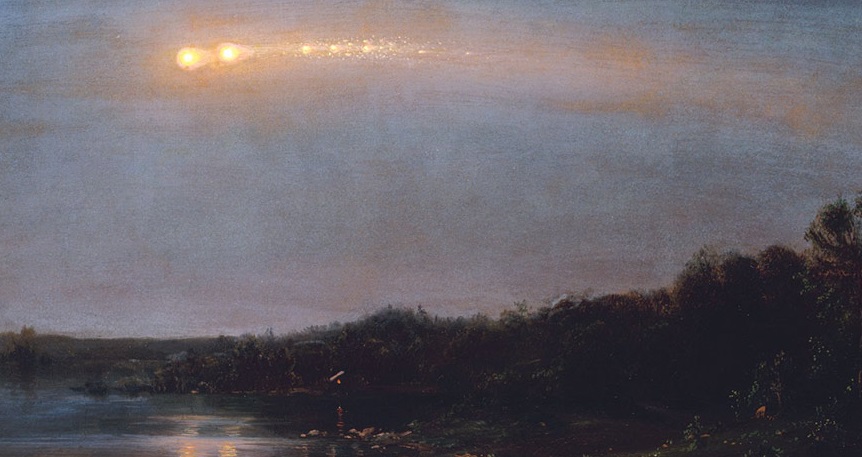
"The Meteor of 1860" by Frederic Edwin Church

"The Meteor of 1860" by Frederic Edwin Church


The Meteor

A Vision

—09.10.25

It cut across the skies,
Grim sign to terrorize
A world whose conscience dies.

Like blinding lightning hurled
From thunderclouds wind-whirled,
It stuns the silenced world,

Rends peoples, realms in twain,
Shakes continents amain,
Drives multitudes insane.

In its horrendous wake,
A rift tears from the quake
Of rage no love can slake.

Its depths show forth, revealed,
What silence long concealed,
Now evermore unsealed:

Infernal magma-fire,
Where countless demons’ ire
Churns in chaotic gyre,

A white-hot, roiling hell,
Whence hatred dared expel
The doom-star to foretell

How they erupt, arise,
Engulfing all that lies
Beneath the restless skies,

Unstoppably expand,
Inundating the land
Where nothing can withstand

The flames that pierce the sky.
The people flee and cry;
The nations fall and die.

How long must earth so rage?
What prayers can now assuage
So crushing a rampage?

Oh! Let this be a dream
Fear-born, whose terrors seem
So real I wake to scream.

But no—I do not wake.
My sight is no mistake.
Earth heaves, the heavens quake,

The realms beneath their sphere,
Both hated and held dear,
Dissolve and disappear—

To rematerialize,
To surge, reborn, and rise
To reach the scorning skies.


Adam Sedia (b. 1984) lives in his native Northwest Indiana and practices law as a civil and appellate litigator. He has published four books of poetry and his poems, essays, and fiction have appeared in various literary journals. He is also a composer, and his musical works may be heard on his YouTube channel.

ShareTweetPin
The Society of Classical Poets does not endorse any views expressed in individual poems or commentary.
Read Our Comments Policy Here
Next Post
‘Four Rooms in Music’s Mansion’: A Poem by Mary Jane Myers

'Four Rooms in Music’s Mansion': A Poem by Mary Jane Myers

‘Fool’s Paradise’ and Other Poetry by Paul Millan

'Fool’s Paradise' and Other Poetry by Paul Millan

‘Yin and Yang’ by Jane Blanchard

'At Dawn of Time': A Poem by Jeff Kemper

Comments 21

  1. Russel Winick says:
    1 month ago

    Adam:

    I shiver reading this. Evan’s great picture sets the tone marvelously, and your syntax, meter, and rhyme carry the story perfectly. It packs a wallop! Wow!

    Reply
    • Adam Sedia says:
      1 month ago

      Thank you! It is wonderful to know that I could inspire a shiver.

      Reply
  2. Roy Eugene Peterson says:
    1 month ago

    Adam, the Bible tells us the world will be destroyed by fire. A meteor strike is one of the ways I have envisioned the end of the world. Your word and rhyme selection is superb in your scary depiction.

    Reply
    • Adam Sedia says:
      1 month ago

      St. Peter speaks of this in one of his two epistles: the world was destroyed once by water, and will be destroyed this time by fire. There are other prophecies that supplement this vision. Look up any of the apparitions of the Blessed Virgin at La Sallette or Akita, right up to the present. I fear we are perilously close to that moment.

      Reply
    • Adam Sedia says:
      1 month ago

      St. Peter speaks of this destruction in one of his epistles: God destroyed the world once by water, and will destroy it again by fire. Many other prophecies supplement this vision. Look at any of the apparitions of the Blessed Virgin at La Sallette or Akita, right up to the present day. I fear we are perilously close to that moment.

      Reply
  3. Joseph S. Salemi says:
    1 month ago

    A very curt epigraph (just a date – 09.10.25) suggests that this poem was prompted by an actual vision the poet had on September 10 of this year, or perhaps the 9th of October.

    If that is true (a massive meteor strike followed by a tearing apart of continents and the eruption of magma from deep in the earth) then the vision is an important psychological message from the unconscious. Of course, it might be true that the poem is pure fictive mimesis, and that this poet is very good at scaring the hell out of us.

    Using trimeter tercets rhyming AAA was an excellent choice for this piece. The shortness, the intensity, the terror, the sense of inescapable destruction — they are all made especially vivid by this structure.

    Reply
    • James Sale says:
      1 month ago

      Totally agree with Joe on this tercet structure – and difficult rhyming pattern – very effective indeed. Well done.

      Reply
    • Adam Sedia says:
      1 month ago

      As you observe further down, it is inspired by true events, though much of it is fictive mimesis. I was quite satisfied with the effect of AAA tercets in trimeter (maybe there is numerological significance there). I think I’ve hit upon a favorite metrical form.

      Reply
  4. Bhikkhu Nyanasobhano says:
    1 month ago

    A thrilling but grim narrative, to be sure, with terse lines beating out, remorselessly, a general destruction. It seizes our attention. The third line, “A world whose conscience dies.” suggests that what follows is as much a moral catastrophe as a physical one. In this it has Biblical overtones. The poet insists, “My sight is no mistake.” And he does not advance any hope that I can see. Rather we get a powerful example of what can be done with powerful, evocative language–three beats to a line, hammering out a frightening vision. Very well made and impressive.

    Reply
    • Adam Sedia says:
      1 month ago

      Thank you! You read correctly: the cataclysm is moral as much as physical.

      Reply
  5. Margaret Coats says:
    1 month ago

    Reading the epigraph as September 10, 2025, that was the date of Charlie Kirk’s assassination

    Reply
    • Joseph S. Salemi says:
      1 month ago

      Yes, I should have noticed that. This makes the context of the poem more public, rather than a private vision.

      Reply
  6. Paul Freeman says:
    1 month ago

    A Biblical prophecy, a metaphor for the present earthly turmoil, an imagined repeat of the astronomical event that put paid to the dinosaurs. You’re poem leaves us with a lot to think about, Adam.

    Reply
    • Joseph S. Salemi says:
      1 month ago

      Yes, that was the massive Chicxulub asteroid impact of 66 million years ago. It is fairly certain now that this event wiped out the dinosaurs, and set the stage for mammalian evolution and dominance.

      Reply
  7. Cynthia L Erlandson says:
    1 month ago

    Adam, this is so profoundly marvelous, that I hardly know what to say about it. I agree with Joseph that the rhyming trimeter tercets make a reader feel the intense, perhaps apocalyptic goings-on. The poem is emphatic, yet mysterious. Its visual imagery is powerful (as in “Infernal magma fire”; “Engulfing all that lies / Beneath the restless skies”; “The nations fall and die.”) But it also connects what can be seen to abstract, philosophical ideas (“A world whose conscience dies”; “Of rage no love can slake”; “The realms beneath their sphere, / Both hated and held dear”. Well — Wow!

    Reply
    • Adam Sedia says:
      1 month ago

      Thank you! I am always flattered to hear your compliments.

      Reply
  8. Margaret Coats says:
    1 month ago

    Dating this vision in the recent past, when the apocalyptic events described were not observed (at least not in the natural sphere) by others, puts the perceptions of your readers in question, Adam. This is a good tactic to make them question the visionary about the truth of his vision. You, and the seer, begin with a meteor, which causes fear, then social division involving rage that literally (as far as the seer sees) raises hell. There is the hatred which is said to be the primary social emotion in hell, and there are flames. Here the seer breaks in with “How long?”, often heard in Biblical psalms where the afflicted describe their seemingly endless afflictions. The seer thinks his vision may be a dream, but discovers it is not.

    A classical (either Hebrew or pagan) setting for this could be a temple where persons sleep for the night in hopes of a divine revelation. In Biblical psalms, they usually (but not always) receive reassuring confidence. But this setting is not available on September 10, 2025. On the day Charlie Kirk was shot and killed, many persons who admired Kirk felt fear, intensified divisiveness, and rage in the moral sphere. As a little time passed, those hostile to Kirk and his supporters began to feel the same. There was also a sense of disbelief. I recall not believing the news when I first heard it, and waking on each day thereafter thinking it could not be true. I would turn on the radio and hear Charlie again.

    Your dramatic plan of dipping into the apocalypse suits the moral feelings of many–despite the clear consolations of an honored funeral and resumption of Kirk’s work by his organization. Those things, of course, bring out the rage of opponents all the more.

    And your wisdom as a poet, Adam, made an excellent choice of a fear-instilling meteor to begin this vision that ends in “scorning skies” rather than “morning skies.” The omen can put supernatural fear into those who are supernaturally oriented–but also reminds naturalistic thinkers of their version of apocalypse.

    This poem must stand among the most creative and most psychologically realistic responses to the unexpected deadly shot fired on September 10, 2025.

    Reply
    • Adam Sedia says:
      1 month ago

      Good catch on the date. This poem was directly inspired by the Kirk assassination, but spoke to something much larger, so I didn’t want to place too much emphasis on the event itself. I remember an author (maybe Emerson) calling John Brown the “meteor” foretelling the Civil War and thought of the bullet that slew Charlie as similarly meteor-like, and took it from there. Thank you for compliments. I truly appreciate them.

      Reply
  9. Brian Yapko says:
    1 month ago

    Adam, I read despair between the lines of this uncharacteristically terse poem. That plus the important tragic date which serves as the epigraph. That plus the ”scorning” skies — a word-choice which startled and then depressed me. Yes, this poem is suggestive of a supernatural vision. This is Cassandra warning Troy of its impending doom. This is Jeremiah warning Jerusalem to prepare for disaster. A dark vision. But, despite your tight control of rhyme and meter, this sounds to me like a howl of pain.

    Reply
    • Adam Sedia says:
      1 month ago

      You read the poem accurately, picking up exactly the effect I intended. Thank you for sharing the effect it had on you. It is extremely satisfying to know that my work can impact a reader — especially a fellow poet — in such a way.

      Reply
  10. Michael Vanyukov says:
    1 month ago

    That’s a masterful depiction of the nature event and the speed with which it occurs, with the whole poem looking like a meteor shower and the punishment of Sodom & Gomorrah, punctuated by its series of rhymes.

    Reply

Leave a Reply Cancel reply

Your email address will not be published. Required fields are marked *

  1. Roy Eugene Peterson on ‘The Measure of a Woman (or a Man)’ and Other Poetry by Paul A. FreemanJanuary 9, 2026

    I concur with the measure of a man or woman is not by ego-fed ascendancy such as money or social…

  2. Russel Winick on ‘The Measure of a Woman (or a Man)’ and Other Poetry by Paul A. FreemanJanuary 9, 2026

    These are both excellent poems Paul. I especially enjoyed “The Measure,” and agree with its message 1,000 percent. Nicely done!

  3. Brian Yapko on Two Sonnets by Nino Martoglio, Translated by Joseph S. SalemiJanuary 9, 2026

    Joe, I very much enjoyed both of these masterful translations of two enchanting sonnets by a poet unfamiliar to me.…

  4. Paul A. Freeman on ‘Encounter with My Dead Father’: A Poem by Scharlie MeeuwsJanuary 9, 2026

    Forgive the pun, but this is a haunting piece of poetry, full of atmosphere and showing craft and care.

  5. Roy Eugene Peterson on ‘Encounter with My Dead Father’: A Poem by Scharlie MeeuwsJanuary 9, 2026

    Sharlie, this a wonderful personal poem and reflection of your precious relationship with your father. I can identify with that,…

Receive Poems in Your Email

Enter your email address to subscribe to this blog and receive notifications of new posts by email.

Join 1,620 other subscribers
Facebook Twitter Youtube

Recent Poems

  • ‘The Measure of a Woman (or a Man)’ and Other Poetry by Paul A. Freeman
  • ‘Encounter with My Dead Father’: A Poem by Scharlie Meeuws
  • Two Sonnets by Nino Martoglio, Translated by Joseph S. Salemi
  • ‘Wall of Ice’ and Other Poetry by James Bontrager
  • ‘King of Poets’: A Poem by Margaret Coats
  • ‘Watercolors’: A Poem by Susan Steele Rives
  • ‘Art and Nature’ and Other Poetry by C.B. Anderson
  • ‘Star of Wonder’: A Poem by James A. Tweedie
  • ‘Yeonmi Park’s Advice to Americans’: A Poem by Warren Bonham
  • ‘Caravaggio’: A Poem by Lisa J. Roberts
  • ‘Refrigerator Bird’ and Other Poetry by Armaan Fatteh-Patil
  • ‘The Oak Trees’: A Poem by Bhikkhu Nyanasobhano
  • ‘A Cardinal on a Snowy Day’: A Poem by Rob Fried
  • Poets Susan Jarvis Bryant and James Sale Respond to Mamdani’s Swearing In as NYC Mayor
  • ‘Single Room Cigarette, 17th Floor Yale Club of Manhattan’: A Poem by Alec Ream
  • ‘Legacy of Light’: A Poem by Martin Briggs
  • ‘The Swarm’ and Other Poetry by Cheryl Corey
  • ‘Lament of a Poet Falsely Accused of Using AI’ and Other Poetry by Paul Buchheit
  • ‘A Gift from the South’: A Poem by Julian Woodruff
  • ‘New Year’s Peeve’: A Poem by Susan Jarvis Bryant
  • ‘Homage to Brigitte Bardot’: A Poem by Joseph S. Salemi
  • ‘Dearth of Emotional Intelligence’ and Other Poems by Russel Winick
  • ‘Fireflies’: A Poem by Mark Stellinga
  • ‘Real Poetry’: A Poem by Eric v.d. Luft
  • ‘Flaws’: A Poem by Joshua Thomas
  • Two Final Poems by Sally Cook
  • ‘Twelve Labors More, Part I’: A Poem by Evan Mantyk
  • ‘A Perfect Match is Found’: A Poem by Roy E. Peterson
  • ‘The Seven Crossings’: A Poem by Ulysses Arlen
  • ‘An Open Book’ and Other Poetry by David McMahon

Categories

  • Acrostic
  • Alexandroid
  • Alliterative
  • Art
  • Best Poems
  • Blank Verse
  • Chant Royal
  • Classical Poets Live
  • Clerihew
  • Covid-19
  • Deconstructing Communism
  • Educational
  • Epic
  • Epigrams and Proverbs
  • Essays
    • Interviews with Poets
    • Poetry Reviews
  • Featured
  • From the Society
  • Great Poets
    • Dante Alighieri
    • Edgar Allan Poe
    • Emily Dickinson
    • Geoffrey Chaucer
    • Henry Wadsworth Longfellow
    • Homer
    • John Keats
    • John Milton
    • Robert Frost
    • William Blake
    • William Shakespeare
    • William Wordsworth
  • Human Rights in China
  • Limerick
  • Love Poems
  • Music
  • Pantoum
  • Performing Arts
  • Poetry
    • Beauty
    • Children's Poems
    • Culture
    • Ekphrastic
    • Found Poems
    • High School Poets
    • Humor
    • Riddles
  • Poetry Challenge
  • Poetry Contests
  • Poetry Forms
    • Haiku
  • Poetry Readings
  • Rhupunt
  • Rondeau
  • Rondeau Redoublé
  • Rondel
  • Rubaiyat
  • Sapphic Verse
  • Satire
  • Science
  • Sestina
  • Shape Poems
  • Short Stories
  • Song Lyrics
  • Sonnet
  • Symposium
  • Terrorism
  • Terza Rima
  • The Environment
  • Translation
  • Triolet
  • Video
  • Villanelle

Quick Links

  • About Us
  • Submit Poetry
  • Become a Member
  • Members List
  • Support the Society
  • Advertisement Placement
  • Comments Policy
  • Terms of Use

Welcome Back!

Login to your account below

Forgotten Password?

Retrieve your password

Please enter your username or email address to reset your password.

Log In
No Result
View All Result
  • Poems
    • Beauty
    • Culture
    • Satire
    • Humor
    • Children’s
    • Art
    • Ekphrastic
    • Epic
    • Epigrams and Proverbs
    • Human Rights in China
    • Music
    • Performing Arts
    • Riddles
    • Science
    • Song Lyrics
    • The Environment
    • The Raven
    • Found Poems
    • High School Poets
    • Terrorism
    • Covid-19
  • Poetry Forms
    • Sonnet
    • Haiku
    • Limerick
    • Villanelle
    • Rondeau
    • Pantoum
    • Sestina
    • Triolet
    • Acrostic
    • Alexandroid
    • Alliterative
    • Blank Verse
    • Chant Royal
    • Clerihew
    • Rhupunt
    • Rondeau Redoublé
    • Rondel
    • Rubaiyat
    • Sapphic Verse
    • Shape Poems
    • Terza Rima
  • Great Poets
    • Geoffrey Chaucer
    • Emily Dickinson
    • Homer
    • Henry Wadsworth Longfellow
    • Dante Alighieri
    • John Keats
    • John Milton
    • Edgar Allan Poe
    • William Shakespeare
    • William Wordsworth
    • William Blake
    • Robert Frost
  • Love Poems
  • Contests
  • SCP Academy
    • Educational
    • Teaching Classical Poetry—A Guide for Educators
    • Poetry Forms
    • The SCP Journal
    • Books

© 2025 SCP. WebDesign by CODEC Prime.

This website uses cookies. By continuing to use this website you are giving consent to cookies being used. Visit our Privacy and Cookie Policy.