


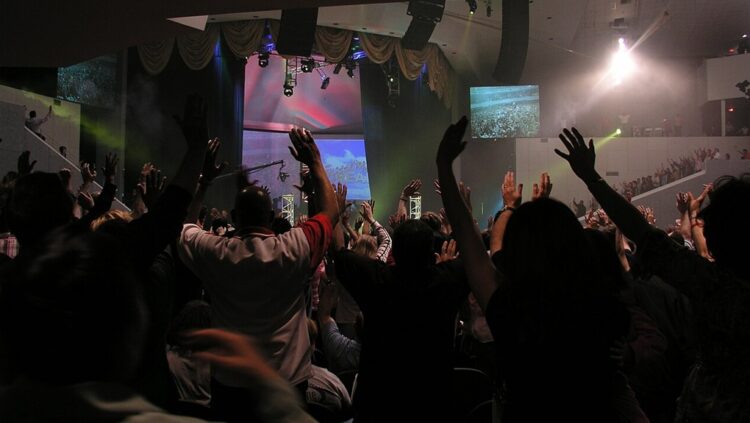
The Holy Rollers on Poetry
We are the Holy Rollers—
We live for solemn prayer.
With censers of pure frankincense
We fumigate the air.
We quote from Sacred Scripture,
Especially Saint Paul:
We love to quote Galatians on
How works don’t work at all.
We gather folks around us,
To help them “see the Light,”
And guide their steps in proper paths
To Piety and Right.
We’ll righteously and loudly
Sing praises to the Lord
In firm trust that our little band
Will grow into a horde.
We listen to long sermons
Droned out by tonsured monks
Who tell us to avoid “the world”
And all its lying skunks.
We pay heed to no tempters,
With worldly traps and baits.
We close our ears with holy wax
And pass collection plates.
We’re firm in our devotions,
Our rosaries and hymns.
We warble out “Amazing Grace”
And “Strengthen, Lord, our Limbs!”
We brook no opposition.
We are the Lord’s Elect—
We have a line to Heaven that
Is open and direct.
And if we write a poem
It has to have the scent
Of piety and penitence
And godly, pure intent.
We don’t like sex or violence;
We don’t like hints of doubt.
We don’t like sharp-tongued satirists
Who wield a whip or knout.
So only send us poems
That place before our eyes
Clear visions of Mount Sinai’s peak,
And manna from the skies.
Poet’s Note
The phrase “Holy Rollers” was used in the nineteenth century to describe certain Evangelical or Pentecostal groups whose modes of worship included speaking in tongues, dancing or gyrating in strange ways, and often falling and rolling on the floor. These practices were often associated with intense revivalist meetings.
In the twentieth century, the phrase was also used in reference to devoutly religious persons, regardless of denomination, who carried on a somewhat intrusive form of missionary activity that pushed preaching, public conversion and testifying, and direct proselytizing in obnoxious ways.
In this poem I have attempted to imagine such persons running a poetry magazine, and setting forth their policy on acceptance of submitted work.
Joseph S. Salemi has published five books of poetry, and his poems, translations and scholarly articles have appeared in over one hundred publications world-wide. He is the editor of the literary magazine TRINACRIA and writes for Expansive Poetry On-line. He teaches in the Department of Humanities at New York University and in the Department of Classical Languages at Hunter College.














This is a really interesting poem. I especially like how it seems to go back and forth between valuation of things religious and a sort of slightly snarky twist on that valuation.
Thank you, Jenna. The poem is comic-satiric, so it deliberately oscillates between playfulness and snarkiness. For me, the greatest compliment I can receive is that my poem is interesting.
Dr. Salemi, at least the “holy rollers” are on my side. I have written a poem about the ones, though, who abhor violence and thus do nothing on earth against the “hordes of violence.” Those are the ones who wring their hands and do not realize they are the instruments of God for actions including going to war and slaying the enemy set against them. I also do not go along with any Pharisee behavior in which some consider themselves the “elect” or “holier than thou.” Paul teaches salvation by grace. That salvation means belief as in John 3:16. James attacks empty faith. “Faith without works is dead.” — James 2:17, KJV/ “Ye see then how that by works a man is justified, and not by faith only.” — James 2:24, KJV. In other words, James is attacking empty faith. Genuine faith produces visible actions. (Good) works don’t create faith, but they demonstrate it. A “faith” that never acts is a dead faith.
LTC Peterson, my poem isn’t so much about religion as it is about aesthetics. I won’t argue the issue of faith versus works as the means to salvation, since I am more concerned with attitudes towards poetry. I consciously included in the poem words and images that would clearly refer sometimes to Protestants, and sometimes to Catholics, so as to be non-denominational in my spoof of activist religiosity in the poetry scene.
Joe… speaking of faith vs. works… I am quite content to let God judge me. I have had enough judgement already from those who consider themselves my betters…
Mike, I feel the exact same way.
The poem is hilarious and apt. When I was very young plumber, I was doing a service call. As I was kneeling near the kitchen sink, the old man that owned the house walked up behind me, placed his hand on my shoulder, and said, “Son, you are in the perfect position to make yourself right with the Lord.”
I explained that I had already worked out my path and I was on a tight schedule going about my business.
He must not have appreciated my comment because this pusher of piety never did pay his bill.
So thanks, Joe, for going about your business… POETRY! Great work.
Many thanks to you, Mike. That story about the old guy by the kitchen sink is exactly what I was driving at. There are some people who cannot keep religion out of anything they do, think, or say.
Joe, as a poet who loves to write satire, this poem is important to me. The poem is an admirably crafted, highly entertaining, funny, and enlightening romp through the world of the “Holy Rollers” through the wry eye of wit. I especially appreciate the grave message beneath the mocking tone. An overly pious mindset would be the death of poetry in its magnificent range and multifaceted takes on life and all it has to offer. A narrow, ideological view stifles excellent poets and their poetry, which is why I’m so glad to see your satirical take on a serious issue on the front page of a poetry site that champions such work. Joe, thank you!
I’m very grateful for your words, Susan. I mentioned in a comment above that the poem was about aesthetics, but it is also about freedom — the freedom not to have a cloud of arrogant pietism hanging over everything we do, or every word we read, or every judgment we make. When that cloud starts looming, the imaginative flame of poetic invention is extinguished.
Ha ha ha!!! Very good – really like: “We love to quote Galatians on / How works don’t work at all.” Nice paradox!
Thanks, James. There is a dramatic monologue by Browning in which he also makes use of the name “Galatians” — it’s “The Soliloquy of the Spanish Cloister.” He actually uses it to rhyme with “damnations.”
Joe, this is a poem not only of great power but of great nerve. The structure is very simple – stanzas of four lines with 1, 2 and 4 being in trimeter and line 3 in tetrameter. This gives the poem a sing-songy “hickory, dickory dock” quality which has a rather devastating mocking effect – it takes what could well have been a dreary serious aesthetic argument and lightens it. That clears up immediately the understanding that this is a satiric poem. But it’s not mere satire. It’s a major assault which concedes almost nothing to those you criticize. Had you intended otherwise it seems probable to me that you would have used pentameter and, indeed, possibly eschewed rhyme in favor of blank verse. I may be stretching my reading a bit, but I also wonder if your choice of form is intended to ironically echo some of the contents of the hymnal.
The substance of the poem is what is critical here. Written in the first person plural (it could be read as a congregation, a prissy mob, or the rather vain royal “we”) this piece absolutely skewers that particular type of writer who injects missionary zeal into everything but whose actions come across as evincing spiritual pride rather than authenticity. We should do this, we should do that. It’s exhausting and slightly ridiculous. At a certain point it comes across as performative – the spiritual equivalent of virtue signaling.
You have, I believe, made a line of demarcation very clear. There is nothing wrong with spiritual or religious poetry. In fact, it is a staple of classical poetry as much as Bach’s masses and cantatas are a staple of classical music. But one must leave room for Mozart’s operas and Beethoven’s symphonies. Your critique is for those who would insist on dominating poetry with rules concerning content and compliance with an ideological litmus test. You are not criticizing actual religious or poetry. You are criticizing the “movement” that aspires to make it dominant. It is a beautiful thing to write a poem which discloses a connection to God. It is much less beautiful to turn that poem into a credo and to suggest it as a substitute for worship. Spiritual pride is always knocking at the door and I sometimes think the only true solution would be to submit such work anonymously so that the focus is sincerely on God rather than on the personality of the artist.
But returning to the idea of a “movement.” Perhaps this historical analogy can help clarify my point: It is one thing to express one’s disdain for alcohol and to choose not to imbibe. It’s an entirely different think to promote Prohibition and force that disdain on the rest of the world.
But you raise other issues with this poem, Joe. It is almost as if you have thrown down the gauntlet to call attention to the future of our own beloved Society of Classic Poets. The site and its peerless editor have certainly shown great courage and willingness to take risks in much of the poetry which has appeared on this site. But there is also, however, what I perceive as a constant tension on the subject of whether poetry here must necessarily comply with being family friendly, soft on subject matter (nature is lovely but rather overexposed) and heavily weighted to being devotional. This is a serious question because classical poetry already has some major strikes against it in the 21st century as being hoary, anachronistic and best relegated to Hallmark cards and the hymnal. Is it possible for classical poetry to also enter into the 21st Century and not be considered old-fashioned or obsolete? Can we compete with a much larger poetic population who love free verse and disdain the discipline of classical poetry? I like to think so and have worked hard to try to make my own work relevant to modern times. I, for one, believe this to be a worthy goal. Are we not the successors of Ovid, Tennyson, Pound and Keats as much as to Milton, Hopkins and Donne?
Your quatrain which says “We don’t like sex or violence;/We don’t like hints of doubt./We don’t like sharp-tongued satirists/Who wield a whip or knout” particularly leaps out at me. William Shakespeare wrote very little – if anything – that was devotional. But he did write quite a bit of sex and violence. We don’t remember Chaucer for his devotions, nor do we think of Shelley or Byron or Browning in those terms. The greatest poetry that has ever existed has not tried to versify the catechism. Rather, it has tried to hold a mirror up to human nature. Or, as Picasso said it: “Art is the lie which makes us realize the truth.” Literature that only feeds one aspect of human nature or pleases only one set of readers who would control what we see and hear – and think – has a very short expiration date. Most of us require more than a diet of bread and wine.
Thank you, Joe, for trying to keep classical poetry not only alive but vital and for pressing us to see the bigger picture. Excellent and brave work.
Brian, deepest thanks for this extensive and gratifying comment. You always pierce as cleanly and as sharply as a laser beam when analyzing not just a poem’s form and content, but also its wider context — and you have done that here in spades. I have the distinct feeling that when you were in the courtroom, your legal opponents trembled with sweat-drenched fear!
Concerning my choice of form, a succinct quatrain of tetrameter and trimeter always works well with a comic-satiric piece. It’s like the fancy footwork that a professional fighter uses in the ring. If you dance lightly, you can punch heavily. And yes — I was thinking of some of John Wesley’s poems and hymns, which also use short meter but in a cloying and tedious manner.
The use of “We” is very deliberate, and a key element in understanding my point. One of the most objectionable elements in certain (NOT all) religiously themed poetry is the unspoken but inescapable sense of community, groupthink, authorized orthodoxy, and calls to loyalty, as if the speaker of the poem were in a pulpit, or ringing your doorbell like a Jehovah’s Witness.
I do not condemn religious and devotional poetry. I have written much of it myself, and many of these poems of mine have appeared here at the SCP. What irks me is RELIGIONIST poetry, which has an evangelical agenda and a hortatory tone — sometimes overt, and sometimes disguised. As you know, I have written an essay titled “Religious Poetry and Religionist Poetry,” where I attempt to distinguish carefully between the two types.
Your mention of the Prohibition period is absolutely on target. Was there ever a time in American history that was more crime-ridden, corrupt, prolific for bootlegging and its associated rackets, and rife with sheer contempt for all law by a large part of the population? Pious ladies in the WCTU and the Anti-Saloon League created serious organized crime in the United States, making it bigger and more profitable than U.S. Steel or General Motors. And for what reason? Pure missionary zeal for some crackpot notion! Stay away from liquor if you must, but why the devil go out of your way to make sure nobody else takes a drink?
That’s the problem I have with much religionist poetry. As Shakespeare says, “Dost thou think, because thou art virtuous, there shall be no more cakes and ale?”
You are right about how fixation on one type of poem, or one thematic preference in poetry, will be fatal in the long run for a website. There has to be range of material, on many subjects. Visitors will not keep coming if every poem in family-friendly, focused on nature or one’s pets, Hallmark-Cardish, or “sweet and heartwarming” in the worst sense of those two words. Where is the stuff that is exciting, provocative, transgressive, ball-busting, edgy?
Evan Mantyk is brave, and he takes risks. He has accepted material that would never stand a chance in other websites, and that is why the SCP is one of the top poetry venues in the Anglophone internet world. Such bravery is becoming very rare in poetry, whether in workshops or public readings or editorial offices or little magazines or websites. In those places poems are now judged by the litmus test of identity, political correctness, adherence to the mainstream norms of feminism, environmentalism, TDS, anti-racism, virtue-signalling, and — unfortunately in some cases — religious orthodoxy.
Let’s not be slavishly obedient to what our elitist masters think, no matter what authority they believe they hold. Let’s be free.
A great right-hook for every timid poet who tends to second-guess themself when penning anything even slightly satirical when it come to ‘Faith’, Joe. If you neglected any aspects of your theological targets, I missed them! Great piece…
Mark, many thanks. I have always said that when a poet composes, it is purely between himself and his “interior audience.” That audience is his stored memory of what he has read, what he has learned, what he has appreciated, and what he values most aesthetically.
Once he and his interior audience agree on a poem, or even just a line, he should NEVER second-guess himself by worrying about what some damned third party thinks.
I really enjoyed this poem Joseph, both the bounce-along ride and it’s spot-on message.
Thank you, Norma. To know that one’s poem is interesting and enjoyable is the chief reward of a poet.
I think Brian Yapko (above) is really on to something. One of my favorite musical groups of the seventies, oddly enough, is the Holy Modal Rounders, an utterly irreverent duo. Here is an example:
https://www.google.com/search?q=holy+modal+rounders+better+things+for+you&sca_esv=666bf1fb673a79dd&sxsrf=ANbL-n4eyQLXdMeiCCwbYdEHTriB–9dpA%3A1777416559985&source=hp&ei=bznxabqROvuqptQP8rekGQ&iflsig=AFdpzrgAAAAAafFHfxZOxJ352Qg3D8MaWugPIUk4mWl-&oq=Holy+modal+rounders+%22better+things&gs_lp=Egdnd3Mtd2l6IiJIb2x5IG1vZGFsIHJvdW5kZXJzICJiZXR0ZXIgdGhpbmdzKgIIADIFECEYoAEyBRAhGKABMgUQIRigATIFECEYoAEyBRAhGKABMgUQIRirAjIFECEYqwJI9a8BUABY9IIBcAB4AJABAJgBcaABoBWqAQQzMC40uAEByAEA-AEBmAIioAKoF8ICChAuGIAEGIoFGCfCAgQQIxgnwgIKEC4YgAQYigUYQ8ICCxAAGIAEGIoFGJECwgIKEAAYgAQYigUYQ8ICERAuGIAEGLEDGIMBGMcBGNEDwgILEAAYgAQYsQMYgwHCAg4QLhiABBixAxjHARjRA8ICCxAuGIAEGMcBGNEDwgITEC4YgAQYigUYQxixAxjHARjRA8ICEBAuGIAEGIoFGEMYxwEY0QPCAgUQABiABMICDRAAGIAEGIoFGEMYsQPCAg4QLhjHARixAxjRAxiABMICCBAAGIAEGLEDwgILEC4YgAQYxwEYrwHCAggQLhiABBixA8ICCxAuGIAEGIoFGJECwgILEC4YrwEYxwEYgATCAggQLhixAxiABMICChAuGIAEGBQYhwLCAgcQABiABBgKwgINEC4YgAQYxwEYrwEYCsICChAAGIAEGBQYhwLCAggQABiJBRiiBMICBRAAGO8FwgIGEAAYFhgewgIIEAAYgAQYogSYAwCSBwQyNi44oAf4rgKyBwQyNi44uAeoF8IHCTAuMTEuMTguNcgHpQGACAE&sclient=gws-wiz#fpstate=ive&vld=cid:d7dbf36d,vid:s4Fe08R9EI8,st:0
Hey C.B.
Here is another link… moderator delivering… better things for YOU!
https://www.youtube.com/watch?v=s4Fe08R9EI8&list=RDs4Fe08R9EI8&start_radio=1
You’re right, Mike. It is better. I’ve been in touch with Yapko, so the undercurrents are not lost on me. We both have better things to do.
Great stuff, Joe. I must admit, when I first read the title, I thought of Burt Ward from the 1960s Batman series, with the running joke of ‘Holy (fill in the blank), Batman’.
However, we soon moved into ‘There will be Blood’ country. I suppose people have always been gullible to charismatic speakers with a silver tongue.
Thanks for the read.
Thank you, Paul. Charismatic speakers, of course, can be political and commercial as well as religious. The thing behind it all is rhetoric — the capacity to use language in an effective, surprising, and convincing way. Rhetoric can be misused to deceive and cheat, which is why Plato distrusted it so much. But all of our attempts at poetry are necessarily rhetorical in some way, shape, or form. Our tropes, our figures, our unusual diction, our stylistic quirks — what would our poetry be without them?
I object to religionist poetry (not religious poetry) because it refuses to value the tools of rhetoric in themselves, but only as devices to capture converts.
I sense this poem draws on deep experience. One of the many problems with being a contemporary classical poet is that those of influence (i.e. editors) often believe Victorian form requires Victorian sensibility — never mind fine poets like Swinburne and Wilde constantly ran against the sensibilities of their time (even Tennyson gets quite erotic in his “Now sleeps the crimson petal . . .”) I think you make a strong case in a fun way about what poetry is, and how self-limitation does the art no favors, with the same consequences that pretending vice and sensuality don’t exist have in real life.
Adam, thank you for this very perceptive comment. It adds another important point to the discussion – namely, the curse that lies upon formal poets today. Some of us take seriously the notion that “Victorian form requires Victorian sensibility,” and use it as a guideline for composition; and at the same time our enemies take the identical notion as proof of our irrelevance and backwardness. It’s a no-win situation, especially if we formalists fall into the trap of assuming that we have to have the attitudes and mentality of 1846 when writing in 2026.
You mention the sexual transgressiveness of poets like Tennyson in his “Now Sleeps the Crimson Petal.” How about his “The Lady Of Shallott,” which is practically gynecological in its description of the little island in the midst of a flowing river, and the unfulfilled desire of the lady? There’s also Swinburne’s “Our Lady of Pain,” with its naked sadomasochism, and Dowson’s “Non Sum Qualis Eram Bonae…” about a night with a prostitute. And there’s Christina Rossetti’s “Goblin Market,” which uses squashed fruit and juice to be as a carnally suggestive as a Roman orgy.
You’re quite correct that my poem draws on long experience. America is still a hopelessly Puritan country, and editors from all sides of the political spectrum have rejected work of mine that they considered “too provocative” and “too titillating,” as if they were publishing for an audience of PTA members or parish council delegates. And it’s not just sex… it’s the growing pressure that requires every poem to have a religionist subtext or a scriptural allusion or some “edifying” element that will move the reader to “something higher.”
Adam, I agree with Joe — this is a highly perceptive observation. But I don’t think this is just about sex, sensuality or prudishness. I think there is a real mental block that exists regarding what is the “proper” subject matter for classical poetry. Sex is part of this. But so is violence and mental illness. “Porphyria’s Lover” is brilliant because it addresses all of these. In Victorian times, no less! But it was scandalous then and for many remains so even today. What was it that Browning was rebelling against by writing such a poem?
There is this unfortunate sense that because classical poets use traditional forms that they are somehow constrained to limit their subjects to elevated themes using language which is either highly restrained or archaic. This Victorian sensibility which you describe permeates the world of classical poetry — the idea that a (highly subjective) sense of “decorum” must be observed. Classical poets have been typecast and the poetry we write is considered to be the province of either religion, nature, romantic love or the endless retelling of mythological stories. Many classical poets have fallen into the trap of believing that they must rewrite what has already been rewritten. They may do it superlatively well, but one cannot escape the fact that nature and true love’s kiss and the crashing seashore have been pretty-well covered.
By way of analogy, there are only so many ways of designing a Victorian mansion, a pillared courthhouse or a Gothic cathedral before repetition dulls any enjoyment of seeing a new one. Frank Lloyd Wright understood this and dared to be original — within the confines of quality architecture and sound engineering. Perhaps its time for poets to also take some risks and produce something new using the amazing forms bequeathed to us by prior generations of poets. Originality is a virtue. The fact is, classical poetry has the potential to use traditional forms as a vehicle for modern expression of a virtually limitless number of subjects. There is nothing inherently stuffy or stifling about either rhythm or rhyme. Ask any rap or hip-hop artist.
This interesting and enlightening conversation has addressed some of my ongoing concerns, which is why I’m so grateful for the comments section. I have always thought that restricting poetry to approved themes is to confuse tradition with repetition and craft with constraint. I believe form should function as a structure for new life within it, not as a museum that forbids it. In an age of restricted speech, it’s even more important that poetry remain a space where the full range of human experience—its beauty, depravity, doubt, and contradiction—can be explored without apology. Otherwise, we risk preserving the shell of poetry while draining it of the very vitality that made it worth preserving in the first place… and where’s the joy in that?
To Brian and Susan — I’m responding to both of you because I think I can diagnose the problem that both of you are addressing, namely, the disheartening and disappointing tendency of modern formal poetry to avoid dealing openly and unashamedly with the world and human activity.
I’m old enough to recall what happened to “New Formalism,” the supposed movement of rebellion against free-verse and modernist domination of the contemporary Anglophone poetry scene. Remember the brave title of their halcyon anthology, “Rebel Angels”? That title was supposed to conjure up images of a courageous and tough resistance to the powers that be. What a joke! What happened instead was predictable — the major figures of the movement became co-opted by the forces of academia, which gelded and denatured them into something unthreatening to the hegemony of publishers, English departments, grant-dispensers, and the usual crowd of conference attendees. “New Formalism,” became just another small (and safe) stone in the “beautiful mosaic” of diversity and inclusion beloved by left-liberals.
And you could smell the coffee by reading the kind of material that the “New Formalists” started to produce as soon as they realized where all the power and money lay. It was polite, inoffensive, generally politically correct, filled with decorum, and suitable for classroom discussion. As Camille Paglia might have said, it was “parent-pleasing,” and the parents were English department faculty members. The Rebel Angels decided that it was safer and more profitable to stay friendly with Jehovah.
We face a similar problem today. The impulse to force formal poetry into the straitjacket of “decorum” and “piety” is alive and potent in the minds of many persons who are extremely uncomfortable with unpleasant subject matter, raw anger, sexual innuendo, or anything that is not perceived to be “child-friendly,” or suitable for a church social. What is nice about the SCP is that the website is willing to take risks, and does not allow itself to be dominated by those who might wish to domesticate it into a comfortable tameness.
Joe, in my study of Robert Burns, I just came across this poem “Epistle to John Rankine” in which Burns skewered religious hypocrisy — particularly the “holy robe” worn by corrupt figures who preached morality while acting wickedly behind the scenes. As I came across the following verse I thought of your “Holy Rollers” poem —
Hypocrisy, in mercy spare it!
That holy robe, O dinna tear it!
Spare’t for their sakes wha aften wear it,
The lads in black;
But your curst wit, when it comes near it,
Rives’t aff their back.
It amazes me that verse from 250 years ago can still be so relevant today. Perhaps moreso.
Thank you again for this amazing poem. I shared it with a number of poetry groups and will keep it handy.
By the way, here is a link to the whole poem: https://www.bbc.co.uk/arts/robertburns/works/epistle_to_john_ranken/
Brian, many thanks for this link to a real Scottish poet who knows what religious hypocrisy and pietistic bullshit are (unlike a fake Scottish poet from New Mexico driven by bilious religious fanaticism).
I’m glad that the SCP remains a place where poems like “The Holy Rollers on Poetry” can be published without inquisitorial censorship by certain wealthy religionists with an agenda.
Brian, Burns nailed it two hundred and fifty years ago and the nail’s still holding.
Joe, you did the same thing here. And it needs to be said and understood.
Joe, I too am thrilled your excellently crafted, enlightening, and highly amusing poem was published without inquisitorial censorship by certain wealthy religionists with an agenda. I am also glad that there are no fake Scottish poets from New Mexico driven by bilious religious fanaticism on this site. I’ve felt the brunt of both and it isn’t pretty!
Well, Susan, it looks like the fake Scottish poet from New Mexico will soon be back, along with his insults, anathemas, and pious ejaculations. As a hybrid of Torquemada and Savonarola, he’s bound to stir up more trouble. But it seems that if you have the name of a wealthy donor behind you, your banishment from the SCP can be rescinded.
Joe, I love the way this rolls off your pen and how well-aimed and well-articulated the barbs are shot! Sometimes we need to weed the lawn and sometimes (as I will have to do next spring) we bulldoze the turf off the top, reseed and start over. You are one of the great iconoclasts of our day who does not suffer fools gladly.
Personally, I don’t mind a little piety, I prefer sex to violence and am riddled through and through with doubt about almost everything. And as long as righteousness doesn’t have a “self-” attached to the front of it (like a tail wagging the dog) I am very much in favor of it. And as for our friend from New Mexico I am usually one who supports second chances, but I am also a big fan of the “three strikes and you’re out” rule. In any case, this is the first I’ve heard of the possibility of the prodigal’s return. In any case I doubt the fatted calf is in any danger.
James, you missed the entire war, which just ended a few hours ago. Caledonius non reveniet.