


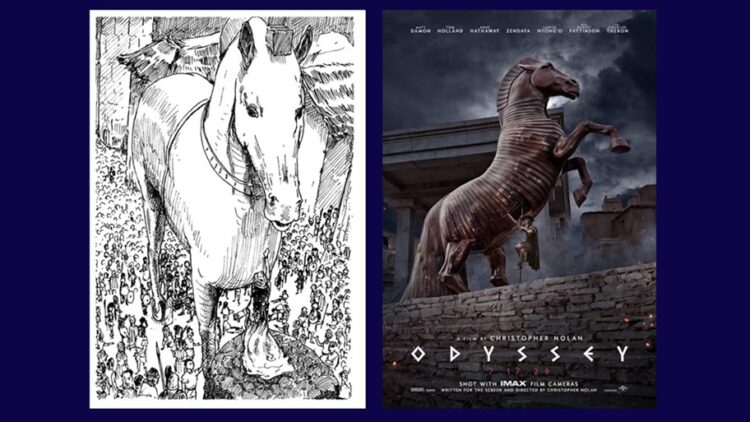
The Odyssey: Nolan and Solot Compared
by Michael Curtis
Michael Solot’s Odyssey translation is true to Homer, and because true, honorable. Nolan’s Odyssey movie betrays Homer because it is true to the Progressive rather than to the Classive, the tradition initiated by the Iliad and Odyssey. Nolan’s work is dishonorable, disrespectful to the characters, the characterizations, history and the story.
The Odyssey is a nostoi, a homecoming, a reestablishment of rightly ordered patriarchy. Following ten years of war and ten years of wandering, Odysseus returns to his rocky Ithacan home. While away, his wife’s virtue is tried, his son’s patrimony is consumed, and his house is dishonored by the lust, the misuse of eager men. More than this, divine order is out of balance.
Worse than the conditions of Odysseus’ home upon his return is the condition of our home, our Classive civilization. By envy, stabilizing patriarchy is fractured. By licentiousness, femininity feeds its flesh. By avarice, insatiable hordes invade. Pride mocks divine order and presumes supremacy until Pride squeaks when wetting itself on the flattening cushion of a hospital cart.
Guided by Emily Wilson’s feminizing mistranslation, Christopher Nolan’s film deceives honest Americans, and corrupts and rots civilization’s roots. And this betrays pride. Nolan, as in pantomime, invents a cartoon cutout Odysseus, a humorless, sexless, self-loathing old skirt, a diminished, disheartened, graying guy who sagging stares upon his scuffed Birkenstocks. You know, that simp who swallows its tongue before the emotional onslaught of his frizzy-blue-haired mistress and her droning bumper-sticker opinions.
You know that people who suppose superiority because they believe in themselves. Champions of revolution, Progressives destroy not only their children, they intend destruction of all who show to them their mirrored, hideous Dorian Gray faces. Revolution is their aim. Progressives intend to dominate, to subjugate the Odyssey, the Iliad, and all of our cultural heritage beneath the weight of solipsistic pedantry. But Progressives are sniveling, envious, minor artists who spurn growth in beauty, who lustily rut upon ugly decay.
Nolan’s Odyssey is a papiermaché copy of Homer’s hard-cut marble work-of-art. Nolan’s Odyssey is neither art nor entertainment. Like a burr in the eye, Nolan intends his vision to stick. Stuck in the mind’s eye, Nolan’s Homer will forever be a discordant rapper, Odysseus will be a Finnish Brit, Helen will be Lupita from the hood, and archaic Greeks will wear Batman armor. Those who do not know Homer will suffer the theft of their Classive inheritance.
To internalize 3,000 years of Classive civilization, I propose reading the book, exercising imagination and naturally forming an objective opinion, a personal vision of the hero and his story. Odysseus is virile. Odysseus is clever, endlessly inventive. Odysseus’ smile curls in sympathetic humor. His eye twinkles in delight. Nolan’s protagonist is dower, deceitful, dishonest, malignant in his stifling feminism. Solot’s Odysseus is Odysseus, a true hero, a man among men, a friend, father, husband, a faithful servant of the gods and of Divine Order.
I could forgive Nolan his artiness if the film was brilliant, even clever, but it is bald, boring, and transparent. As art, Nolan’s The Odyssey does not reward on close inspection, as does a picture by Rubens, a statue by Bernini, a drama by Shakespeare, a satire by Pope, or even a movie by John Ford. Solot’s art is as true as is his Odyssey translation and Solot gives us Homer in an accent familiar to Americans. Solot’s Odyssey, published December 2025, is available through the Society of Classical Poets and through both online and retail distributors.
An audiobook of Solot’s dactylic hexameter Odyssey can be accessed here. I should mention, I read the part of Proteus, Old Man of the Sea. From the promotion:
The Odyssey is now reborn in a fresh translation by Michael Solot as the robust, living work of art that it is. The standard academic approach to the poem presents it as a subject for classroom study, as something remote, antique, and difficult. But the Odyssey is easy, and if you haven’t been trained to know what to look for it is full of surprises, and often very funny. The Odyssey’s ease, its surprises, and its humor are all brought to light in Solot’s translation and in his commentary.
Michael Curtis is an architect, sculptor, painter, historian, and poet, who is currently Artist-in-Residence at the Common Sense Society. He has taught and lectured at universities, colleges, and museums, including The Institute of Classical Architecture, The National Gallery of Art, et cetera; his pictures and statues are housed in over four hundred private and public collections, including The Library of Congress, The Supreme Court, et alibi; his verse has been published in over thirty journals; his work in the visual arts can be found at TheClassicalArtist.com, his essays at TheStudioBooks.com, and his architecture can be found at TheBeautifulHome.org.















Refreshing reading, Michael. I’m happy to report I’ve not seen the movie. My friends who have seen it are disappointed by what they regard as silly sensationalism. These are ordinary older adults, tending conservative, some of whom read a much earlier Odyssey translation in high school. Your criticisms of the Nolan Odysseus strike home to the men among them. For myself, I am in the process of studying Aristotle, and I have seen the same progressive academic view of what he was not. A post-modernist atheist scientist? No, Aristotle was a true forerunner of authentic science. And as you say of Solot’s Odysseus, “a faithful servant of the gods and of Divine Order.”