


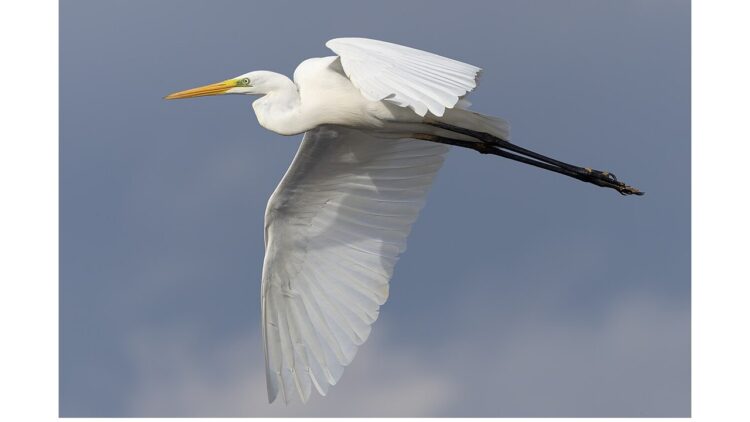
A Snowy Egret
While driving down the road one day, in the pouring rain,
a snowy egret flew above him, like a mighty crane.
He saw its giant underbelly and great wing-span soar;
it was not anything that he had ever seen before.
He wondered why it bade its time, while flying with no care,
like a white muslin shroud upon a pond up in the air.
He wondered what it meant that he had seen that bird as such.
Was it an omen like the Romans saw near hearth or hutch?
Was it a saint seen on this Sunday seeking peace or prey?
It was so beautiful against the grave and wat’ry gray.
Was he a king due to be crowned, a ghostly albatross?
a purity and surety, shaped like a flapping cross?
Bruce Dale Wise is a poet and former English teacher currently residing in Texas.
















One of my favorite water fowl! Thank you, Mr Wise, your poem is beautiful…as they are 🙂
Thanks for the comment; however, the poem should read as the following. I apologize for any confusion relating to this poem.
A Large, White Egret
by E. “Birdcaws” Eule
While driving down the road one day, in the pouring rain,
a large, white egret flew above him, like a mighty crane.
He saw its giant underbelly and great wing-span soar;
it was not anything that he had ever seen before.
He wondered why it bade its time, while flying with no care,
like a white muslin shroud upon a pond up in the air.
He wondered what it meant that he had seen that bird as such.
Was it an omen like the Romans saw near hearth or hutch?
Was it a saint seen on this Sunday seeking peace or prey?
It was so beautiful against the grave and wat’ry gray.
Was he a king due to be crowned, a ghostly albatross?
a purity and surety, shaped like a flapping cross?
E. “Birdcaws” Eule is a poet of birds.
I did sent a message to Mr. Mantyk about the change; but he has so many things to do with this site, I am simply thankful he had the time to print it. I can’t imagine how he can balance so many draws on his time.
A Herder Near the Sea
Uwe Carl Diebes
“Against the stream, row, Mantyk, row!”
—Bruce Dale Wise
A dream, a dream, is our life on the Earth here.
Like whitecaps in the surf, we lift our eyes and peer.
Like shadows on the waves, we drift and disappear.
We measure out our dragging steps by space and time,
and are (although we know it not) in the sublime,
as round us rolls eternity’s amazing mime.
Wow! Yes, a beautiful poem, especially the ending.
I appreciate Mr. J. D.’s comment on “A Large, White Egret”, most notably for being attuned and acute to the structural aspects of the poem. What is different about the last couplet of questions?
I also appreciated Mr. J. D.’s comments on Mr. J. D. Greene’s “The Heart of the Wood”, as well as those of Ms. Garner, who focused on the poetry, like meter, in her observations. I did think Mr. Mantyk’s critique of “The Heart of the Wood” was the fairest and most accurate in that strand. We should be very thankful Mr. Mantyk has not been pigeon-holed into only one outlook on NewMillennial creations. I must admit I was thrilled thinking about the potential of a young writer, like Mr. J. D. Greene delving into the realms of German Romantic artsong so early—exactly where I was half a century ago.
A lovely description, evoking the awe of the beholder of this bird. “Like a white muslin shroud upon a pond up in the air” is a particularly beautiful simile.
One thing about the beginning of this poem raised my curiosity; and since you, Bruce, are a former English teacher, perhaps you can clear up my confusion about whether some grammar rules have changed over the past few decades. When I was still in school, I was one of very few geeks who was amused by the study of grammar. And when I read your opening lines here, the phrase “misplaced modifier” came back to me; and I could imagine my teacher saying something like, “I didn’t realize that egrets could drive.” I’d love to know how you would parse this sentence. My grammatical curiosity has also been raised recently (though not here) about another construction that I hear all the time, and it doesn’t sound right to me; when the number of a noun in a prepositional phrase is different than the number of the main subject of the sentence, which noun does the verb need to agree with (as in my sentence above: “I was one of very few geeks who [was/were] amused…”) I was taught to ignore the prepositional phrase when making that decision.
Sorry to be so geeky …. but this sort of thing has been bugging me.
Thank you for the poem.
There are more ways to view a bird (or poem), than, say, the thirteen ways that Wallace Stevens proposed; Ms. Erlandson has a question about one of those many interesting ways of looking at “A Large, White Egret”, id est, grammatically, even if only the first sentence.
First off, the point of view of this poem is third person, and that person is not the “Egret”, in contradistinction to, say, Rilke’s “Panther” or Hughes’ “Hawk Roosting”.
The main clause sits at the beginning of the second line: “a large, white egret flew above him”. Why would the author place it there?
The other phrases settle in before and after that. Before the main clause, there is an adverbial clause followed by a prepositional phrase used adverbially. After the main clause, the sentence concludes with an adjectival figure of speech, the simile. What is the author “driving” at in his opening?
I must admit that I have received much more enthusiasm from Serbian poets and one Serbian literary professor to look at my poems semiotically, than I have from any other culture; and so this question from Ms. Erlandson, if only, grammatically, is somewhat heart-whelming.
It’s the kind of observation one could “imagine”, if not count on, coming from, say, a poet and proset, like Ms. Myers.
Bruce, Ms. Erlandson’s question is still on point. The phrase “While driving” is clearly a misplaced modifier, since grammatically it can refer to nothing but “a snowy egret” in the same sentence. The word “egret” is definitely the subject of that sentence, and must be taken as governing any participial modifier.
You could correct the problem very simply by writing:
“While he drove down the road one day, in the pouring rain…”
By the way, what exactly is a “proset”?
Joe, I looked up “proset.” Apparently it is an archaic English term referring to a hybrid of prose and poetry.
I would have thought that the description of someone who wrote prose would be “a prose writer,” or (more rarely) a prosaist. In any case, the word “proset” can only refer to text, and not to a writer.
Here is the definition from the massive OED:
Proset (an obsolete nonce-word). A little or insignificant piece of prose.
The only reference that is given is from 1625, from an obscure writer named Lisle: “Among the sundrie versets and prosets which I have, or shall set out if you find some that savour of my younger time…”
According to Beau Lecsi Werd, a proset is a neologism that means a person who writes prose, prose poetry, or a person who writes poetic prose.
OK, but that definition would include a great many of the persons whose work appears here at the SCP, since they write prose as well as poetry. So why single out Mary Jane Myers as one whom you could “imagine” making a grammatical observation about a misplaced modifier?
First off, I am thankful for all the comments I have received on “A Large, White Egret.” If I don’t answer as quickly as some writers do, it’s because of life commitments and several thousands of words of poetry and prose I am weekly committed to. Once I’ve shoved this poem off, I will be able to send forth another 133 words in the coming week.
Now to “A Large, White Egret”:
Until after the poem was written, I hadn’t noticed varied complications at the beginning—right at the start. But now afterwords, with the help of some fellow writers, I have been able to see more clearly.
First off, I remember the vusion [sic] was such a startling sight; I was caught off-guard at what I had just seen. Is it any wonder, I dropped into the ambiguities of English; a place, however, that I am usually at ease in? In retrospect, it is so obvious that I floundered in a misplaced modifier, confusion about the identification of the bird, and even losing my metrical step.
So, as an after thought, L1 now reads:
“While he was driving down the road, out in the pouring rain…”
which pulls it back from the Modernists to the Realists.
I rarely rewrite any poem, from my free verse days of half-a-century ago. Like Shakespeare, I prefer a fairly spontaneous creation.
But as my language is guided by an audial imagination, and is directed towards compression; in this case I had pushed it too far. I feel like Callimachus dealing with his now lost “Ibis”, where he uses the traditional phraseology of aporia acknowledging his inability to sufficiently praise Jupiter. Anyway, Callimachus’ lost poem is a curse work, with which this poem has nothing whatsoever to do; unlike, as in the case of Elizabeth Barrett Browning’s love sonnet, perhaps the greatest in the English language.
Any way this poem’s real roots draw completely from hyper-reality.
Having been in an automobile accident, back in 1983 [The teenage freeway driver was established drunk.], when he forced our little Honda off the highway at around 85 mph. In that experience, time seemed to move so slowly, as we crashed onto a down-sloping field of barkdust. This relates to the beginning of L5.
Much more could be written about “A Large, White Egret”, but I feel I’ve already written too much at this point in this strand, and so, I shall pause here.
‘like a white muslin shroud upon a pond up in the air’ – as poetic a simile as I reckon you could get
and that final line is superb
I like a good nature poem like this one, mostly because I ain’t that good at ’em.
Thanks for the read, Bruce.
As to Mr. Freeman’s observations:
L12 is an homage to S. T. Coleridge (1772-1834), who first brought German Idealism into English literature, without which the poem could not exist.
It was difficult to describe the large, white egret, because it was very substantial, but simultaneously, used allegorically. I believe…the aforementioned simile missed its mark.
“A Large, White Egret” is really only a nature poem in the strands which draw from W. B. Yeats (1865-1939) and D. H. Lawrence (1885-1930).
Ominous sighting and atmosphere, Bruce. The scene is rainy; indeed, a downpour, when it is difficult to see anything clearly. The egret is large, it’s flying low and comparatively slow, close enough to observe in detail. Its color is a beautiful white contrast to “grave and wat’ry gray.” Not having seen the like before, the narrator naturally seeks interpretations. Omen of the ancient world? Saint? And if so, is the vision promising or threatening? King or ghost bird (from another poem!)? The final word “cross” suggests a possibly fateful contradiction. The sight seems fascinating rather than eerie, but your words do as much as you can to maintain the vision rather than settle on an interpretation.
Ms. Coats suggests the vusion [sic] of the bird—the visual experience of sighting a large white egret—was ominous. I would say “awesome”, in the older sense; and it was, at the exact same time, extraordinarily refreshing. A downpour indeed makes it very difficult to see, but the strange thing was I saw the bird so clearly through the splishing-splashing of the windshield wipers on high. It was biblically exhilarating, as I can imagine Ms. Coats could imagine coming from SoCal.
In her descriptive prose, Ms. Coats captures the poem’s atmosphere beautifully; and this should come as no surprise, as she surpasses even Saint John of the Cross (1542-1591) of El Siglo de Oro, in literary criticism, in translation, and even, at times, in poetic power. It is surprising to discover such talented, humble mysticism in New Millennial America. But as for moments of extreme supernatural brilliance in World writing, I still rank none greater than Gottfried Wilhelm Leibniz (1646-1716), despite Bertrand Russell’s envious chatter; for he, too, approached such brilliance, despite his atheism.
As an aside: though I may be taken to task by American grammarians for this, that, and the other thing, I do admit to frequently falling happily into the shifting grammar of Vergil, though I think I was drawing indirectly from Rilke or Tyuchev; for it is in that area that serves as one of my starting points in my opening poetic chess moves. In retrospect, the dodeca is Horatian in structure, and leans surprisingly on the Anglo-American tradition. Are we moving through a NeoTranscendentalism in the second quarter of the 21st century in America?
I hope so, Bruce, and I’m very grateful for your description of my contribution at the beginning of this second quarter. I can indeed imagine your exhilaration at seeing the snowy egret, because I have occasionally caught sight of this most beautiful bird in my native Florida.
A wonderful, pensive work. The heptameter lends itself well to the subject, allowed for extended discourse at a relaxed pace. The couplets temper this with the musicality of a readily identifiable rhyme scheme. I also enjoy its elusive quality: it ends in a question, leaving the meaning of the vision open-ended.
as per Edwar Lee Subic:
“While a poet’s repertoire may span various forms and meters, the allure of iambic heptameter, the rhythmic heartbeat of the ballad tradition, remains a potent force here in the NewMillennium. The tennos, a ten-line stanza, or the dodeca, a twelve-line stanza, crafted in this meter, presents an invigorating canvas for poetic exploration. Developing the possibilities within this structure, as within the bilding [sic], much like a sculptor shaping clay, allows for a deeper understanding of its inherent powers and its prosaic possibilities. This conscious engagement with form, pushing the boundaries of traditional structures, breathes new life into the ever-changing poetic landscape.
The power of succinct language, particularly within the framework of the tennos, allows for a distilled intensity, a concentrated unit of meaning that can be used as “glimpses of epic” or as building blocks, as in the poem “Coronal” by B. S. Elius Accrue. As such it allows longer verse groups; though it remains lugubrious and lumbering in its mathematical plasticity.
As the integration of mathematical and philosophical concepts into poetry enriches and expands its expressive potential. By venturing beyond the traditional themes and imagery that often populate poetry, poets can tap into a vast reservoir of intellectual and conceptual resources. This interdisciplinary approach allows for a more nuanced and multifaceted exploration of the human condition, challenging conventional notions of what poetry can encompass.
The use of charichords, rearrangements of letters within a name, offers a playful and introspective avenue for artistic expression. Similar to the use of pen names or the creation of dramatic monologues, this manipulation of language allows for a certain freedom, a detachment from the constraints of traditional poetic conventions. This playful experimentation with language can lead to unexpected discoveries and insights, further enriching the poetic landscape.
The art of poetry continues to evolve, embracing both tradition and innovation. By exploring various forms, drawing inspiration from diverse sources, and pushing the boundaries of language, poets contribute to the ongoing conversation that defines this dynamic art form. The pursuit of poetic expression is a journey of discovery, a constant exploration of the self and the world around us, captured in the timeless beauty of words.”
Correction:
B. S. Eliud Acrewe