


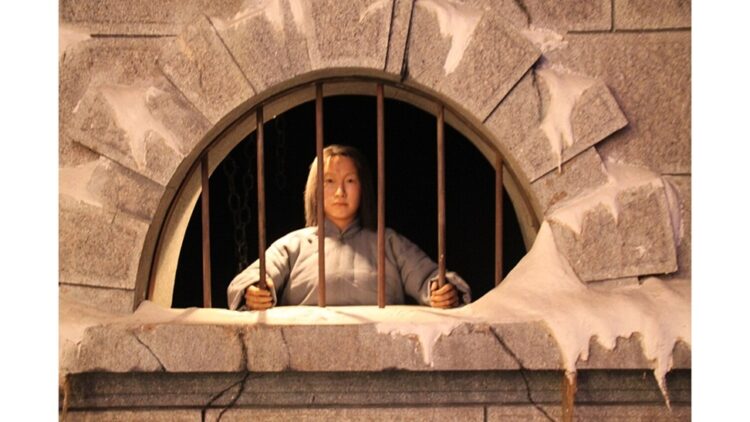
China Made
She sits before her grey machine,
_knits, cottons, or brocade;
with sweating she begins to sew
_to create China made.
Her stitches— even, fine, and tight
_without due accolade;
her nimble fingers graft and grind,
_in sewing China made.
I see her in my mental eye,
_I’m saddened and dismayed
because of all her sufferings, just to
_make my China made.
Oh, what a life this woman’s had,
_how grossly underpaid!
Because we like our stuff so cheap,
_so easy, China made!
How life is unfair to this soul,
_victim of global trade!
A slave of Communism’s chains,
_unfreely China made.
Oh, does she sew long slogging hours,
_her shopwork overstayed?
What freedom does she have at all,
_producing China made?
Again I touch my hemline, whether
_knitted or crocheted,
caressing all her handiwork
_in thanks for China made.
I’ve thought of her and think of her,
_the noble, strong bondmaid,
I and my clothing honor her,
_the woman China made.
Theresa Werba (formerly known to the SCP community as Theresa Rodriguez) is the author of eight books, including What Was and Is: Formal Poetry and Free Verse, and Sonnets, a collection of sixty-five Shakespearean, Spenserian, and Petrarchan sonnets. Her work appears in numerous journals, websites, and online publications, including the SCP Journal. She has been featured on Classical Poets Live where she discusses musicality and elocution in formal poetry. She is a contributing writer for Classical Singer Magazine. Werba’s background as a Classical singer informs her dramatic poetry readings which are available on Youtube @thesonnetqueen. Her website is www.theresawerba.com.


















I have been a seamstress all my life, it is my “third love” after singing and writing… I do feel a strong connection to the unseen hands and sewers that have made so much of what we use and wear today, in nations so far away… also both my paternal Jewish great-grandfathers, Abraham Wierzbolowski (which became Werblowsky and then Werba) and Moses Kaminsky Epstein, were tailors in the Pale of Settlement who emigrated in the 1890’s from Poland and Russia… so sewing is truly in my blood!!!
Thanks for this readable and thought-provoking poem. Good work, with a serious theme.
Thank you very much David!!
Such a deep emotional poem of the labors of so many women of China. Thank you for the notes sharing your personal interest in sewing. No wonder you could write with such consummate feeling.
Sorry Roy, I keep posting replies but not under the person I am trying to reply to!!! I do thank you very much for your kind comments!!!
Thanks very much, Roy!!
A powerful poem Theresa. The use of the refrain gathers cumulative strength and power; plus, the simple but ever effective use of the 4-3-4-3 ballad form: this could easily become, I think, a song which … you could sing! Well done.
Wow James, I honestly was not even consciously aware of the form, other than its auditory impression on me… but now that you point out the 4-3-4-3 ballad form, it’s no wonder I heard it in my head as a kind of music!!! What a great idea to create a song!!! It would be melancholy and reflective… the words are familiar and singable… you’ve given me much food for thought!!! Thanks so much for your comment and input!
You create a cascade of well-ordered logic, Theresa, in which an array of meaningful thoughts gradually appear. I think especially of stanzas 4 and 5. The word “life” links them. Stanza 4 tells of impoverished economic life–“grossly underpaid” though you’ve already established that the woman’s labor is quite competent and maybe even skilled. Beginning the next stanza, “How life is unfair to this soul” moves up to matters of the spirit. The soul gives life to the body, yet the life this body leads does not even dignify the woman’s physical nature. She must serve both “global trade” and the spiritual soul-denying ideology of Communism. The final line of the stanza uses the word “unfreely” to modify the refrain “China made,” thus calling to mind the many freedoms denied to slaves of globalism and Communism.
The emotion of the poem matches the logic. James Sale is right that you could sing this to some appropriate ballad tune, and apply many special emphases possible in performance of this fine piece.
Sorry Margaret, I once again put my reply in the wrong place, but I did reply! Not sure if it precedes or follows this reply but it’s here!!!
Margaret, I appreciate your detailed and thorough analysis very much! I do feel that I am trying to create a bridge of two souls separated by culture and circumstance. And yes, making a ballad of “China Made” would be the perfect next step as to where this poetic sentiment can go!
Superb poem, Theresa. I like the sharpness of the lines! And of course so thought provoking.
Thank you Rohini, I appreciate your kind words very much!!!
“My” China made caused me to stop and think.
The refrain was well used. Great concept for a poem and powerfully executed.
Thank you Michael very much!!!