


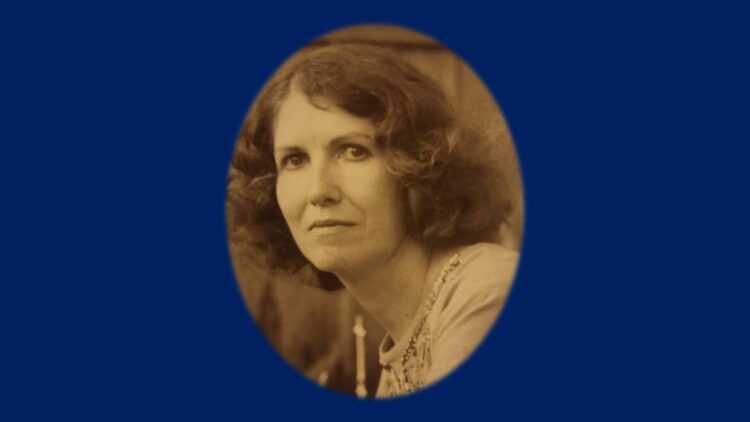
Sally Forth, Ms. Cook
“My holiday shall be
That they remember me;
My paradise, the fame
That they pronounce my name.
—Emily Dickinson
I’m well acquainted with a gal named Sally,
Whose verses span the hither and the yon—
She’s mapped more real estate than Rand McNally
And raises thoughts I tend to dwell upon.
God help the reckless man who dares to cross her
Or criticize unjustly her good friends—
She’ll wring him like a tea bag in her saucer
While she ignores his pleas to make amends.
Combative women, also, should be leery
Of challenging E.D.’s inheritrix—
Whose feminism’s real, not PC theory—
Unless they crave a trip across the Styx.
It isn’t her desire to charter ferries.
She’d rather live in peace and write a book
On human foibles, cats, and ripened cherries—
Or paint self-portraits signed by Sally Cook.
Competing Theories
“Avoid the void,” said Dr. Freud,
“Don’t let it swallow up your ego.
Let kids keep lids upon their ids,
Because wherever they go, we go.”
Said Jung, “I think it’s much too soon
To suffer your pedantic dicta.
So lighten up, you joyless pup,
Or we will ship you off to Sitka.”
“My mind detects a dire complex
That hints at issues with your father.”
“Until you’re with the pith of myth,
With your remarks I needn’t bother.”
While Sig went back to his cocaine,
Young Carl sought his Ouija board.
Though neither doctor felt much pain,
It’s never fun to be ignored.
C.B. Anderson was the longtime gardener for the PBS television series, The Victory Garden. Hundreds of his poems have appeared in scores of print and electronic journals out of North America, Great Britain, Ireland, Austria, Australia and India. His collection, Mortal Soup and the Blue Yonder was published in 2013 by White Violet Press.


















C.B., the poem about Sally Cook was heartwarming and sincere. What a wonderful tribute! Those of us who have read her poetry over the years share in your sentiments. “Kids, lids, and ids” in your second poem was sonorous and striking! Great work.
I’ve known Sally, Roy, for a long time, and we have appeared on pages of the same journal since 2004. She wrote a blurb for my second book (Roots in the Sky, Boots on the Ground, and I believe I returned the favor for one of her books. You must have noticed that the second poem begins with stanzas where A-lines alternate with lines with internal rhymes only. I wonder what a Jungian slip would look like.
Kip, you always hit us with great stuff — delightful, surprising, and always perfectly crafted. K.A.N.D!
Your poem about Sally is magnificent, and utterly correct in its portraiture of her. She represents a true feminism — tough, confident, ready to defend herself and her friends, deeply loving, and utterly and unapologetically female right down to her marrow. The picture that accompanies the poem shows not just Sally’s beauty, but also her intelligence, sharp perception, and her capacity for intuition that borders on the psychic ability called “second sight” by the Scottish people. She was born to be a great painter, and a poet to boot.
I will print out your poem and send it to her at the Rehab Center.
The poem “Competing Theories” is a wonderful snapshot exposition of the fight between Freud and Jung. It was a historically crucial battle, defining two polar ways of dealing with the human psyche. Freud only saw the personal and the familial roots of mental disturbance; Jung saw that such difficulties had to be understood as being paralleled and mirrored in a collective unconscious that linked us to a wider world beyond our personal experience. Sticking with Freud is like staying locked in your private bathroom. Going beyond him to Jung is like leaving that small space and entering a huge cathedral.
Reams of paper have been used to discuss the respective views of Freud and Jung. But Kip Anderson manages to fit the core truth about those views into sixteen absolutely polished and funny lines!
You might or might not remember this, Joseph, but the first poem here passed across your desk quite a few years ago when Sally and I were engaged in a conspiracy.
What you say about the Freud/Jung thing is pretty much spot on. Freud’s take on sexual “perversions” was quite limiting and probably arose from a staid upbringing. Jung realized that there was a lot more going on in the noosphere than could be explained by animal impulses. I recall an anecdote which describes the two of them in the stacks of a library discussing (what else?) the human psyche. Suddenly the wooden shelves produced a great C-R-A-C-K! (a “poltergeist” and a telling synchronicity), whereupon Freud was shaken to his core. Or so the story goes.
Kip, I don’t recall seeing the Sally Cook poem previously. But that may be the result of being an editor who had too much material to go through.
The incident of the sharp crack sounding was real. Jung even predicted it happening a few seconds before it did. It’s recounted in his book “Memories, Dreams, and Reflections.” Jung was very much aware of synchronistic phenomena.
Freud, as a child of the Enlightenment, was constitutionally averse to anything that was redolent of mystery, magic, the occult, or the unexplainable. He especially didn’t want any of that to invade his new science of psychoanalysis, which he insisted be established on a strictly scientific-empirical basis. This is why strict Freudianism today is a rather narrow and strangulated field, while Jungian thought has gone on to have a major worldwide effect in psychology, the arts, literature, and the study of mythology.
Love these poems, especially the first, beginning with its title,
which I find very clever. Sally must cherish the whole of it.
I believe, jd, that the main character (heroin) from an old comic strip was named Sally Forth. How much Sally Cook cherishes this poem will be up to her.
Competing theories is utterly delightful and definitely written. The recurrence of double internal rhyme is a stroke of brilliance. “‘Avoid the void’ said Dr Freud” is a killer opening line. The poem itself also reveals embarrassing truths about century-old psychoanalytic schools through humor.
“Sally Forth” is also an effective exercise at revealing truth through humor. All of us over a certain age, I think, remember the old old-school kind of woman described here – a force to be reckoned with.
Yeah, “Competing Theories” is definitely definitely written. I should also point out, Adam, that “joyless pup” and “young Carl” are plays on what their surnames mean in German. Using internal rhyme in contrast to end rhyme is something I’ve been playing with lately.
As Salemi has pointed out above, Sally Cook is seriously old-school. At one time she might have come off as new-school.
Kip, Jung himself pointed out that the surnames of the leaders of three major strands of psychological study had a synchronistic significance. Freud (“joy” in German) emphasized the importance of sexual desire; Jung (“young” in German) emphasized the importance of mythic rebirth; and Adler (“eagle” in German); emphasized the importance of soaring willpower. A coincidence? Maybe. But Jung often quoted the Latin saying “nomen est omen” (a name is a mystic sign).
The photo of Sally Cook that Evan has put up with this post is hauntingly beautiful. But how could it be otherwise? Her mother Berenice was as drop-dead-gorgeous as Aphrodite, and her father Donald was a strikingly handsome Anglo-Saxon.
I didn’t know that about Adler — talk about aptronyms!
And yes, Joseph, this is the best photo of Sally I have seen As Hank Williams said (sang), “Hey good-lookin’, whatcha got cookin’?”
Excuse my failure to proofread. I meant “deftly written,” not “definitely.”
No problem, Adam. I knew you meant something else, but I thought the “as is” version was damn funny. I usually discover my own typos only after my comment is posted.
Both of these were great. I’ve never met Sally, but now have a vivid picture of someone that I think I would like immensely. Conversely, I wasn’t forced to learn much about Sig or Carl but now have a vivid picture of them and I do not think I would have liked them at all.
I cannot think of a good reason, Warren, why you wouldn’t like her. Nobody forced me to learn about Jung or Freud, but it’s likely you would have found the former more personable.
These were both fun to read. A wonderful tribute to your friend.
I’m glad you felt that way, Michael, and I hope she will agree with the second part.
From what I know of Sally Cook, she’ll be well chuffed with your touching and humorous piece.
I don’t know what “chuff” means, Paul, and my dictionary gives me something you could not possibly mean. The online dictionary cleared that up, so there is hope.
What a sly but revealing comment. All you had to do was put ‘chuffed’ in Google (if you really didn’t know) and check the first half dozen sites, which all say ‘chuffed’ means ‘very pleased, delighted, or happy’.
The meaning your snarkily (if that’s a word) alluding to is very telling. How I garnered your hatred, I don’t know, but season’s greetings, anyway.
Always, Paul, I go to my printed dictionary first. There I found “chuff,” a noun that means a rude, insensitive person. Maybe “chuffed” is a mostly British usage. I did go online, as I mentioned, just before I typed the last sentence, which made me wonder what the OED would say about the etymologies of the two similar words with such divergent meanings. “Hatred?” Maybe you are projecting.
A beautiful tribute to Sally Cook, C.B., and I also appreciated the dialogue between Freud and Jung. Some, of course, might see it as a pointless dispute between contrasting charlatans, the dour, pessimistic Freud, with his emphasis on negative childhood experiences, and the optimistic and rather mystical Jung, with his collective unconscious and archetypes. Yet you keep it light and sympathetic.
I don’t think, Morrison, that such disputes are ever pointless. Attempts to understand the human psyche have been going on for millennia, and every now and then someone comes up with a useful idea. How is it even possible for an earthling to be mystical? Something is going on behind the curtain.
I do not think, Morrison, that any such disputes are pointless. For millennia we have been trying to figure out what makes the human psyche tick, and occasionally someone comes up with something useful. Something strange is going on, and it’s not a bad idea to try to get to the bottom of it. Ouspensky wrote a book in which he states that no western thinker has yet come up with anything that deserves to be called psychology. Maybe not, but for many years he was strongly influenced by a man named Gurdjieff, who was wrong about almost everything.
Mr. Handley-Schachler, there are many things to criticize in Sigmund Freud, and maybe even a few in the work of the brilliant Carl Jung, but calling them “charlatans” is puerile. These were men of great genius, and they were the first to shed light on the Stygian darkness of the unconscious mind.
C.B. Joe is right… you don’t disappoint. Your tribute to Dame Sally is beautiful. I’m sure she is reading it with joy.
The second is a great take on the two best-known shrinks! I am also intrigued by “nomen est omen.” My favorite shrink’s name, Frankl, means “truthful and brave.” His first name, Viktor, is also spot on.
As for “chuff,” apparently, search engines are tuned to your location. This is what I got when I searched “chuff”
https://duckduckgo.com/?q=chuff&t=ipad&ia=web&iax=definition
Of course, I know that chuffed means very happy because I live with a beautiful Englishwoman… and no English person can go 15 years without saying “chuffed.”
So I’m guessing, Mike, that “chuffed” is mostly a British usage. I’ll leave it to them because after all and before all they invented the damn language.
These are both terrific poems, Kip, which gave me great pleasure in the contemplation of your appreciation for Sally Cook’s poetry and character, as well as your economical yet highly accurate description of the conflicting views of the two thinkers who are probably the most important foundational contributors to the strange field of Psychology — a field which would like to think itself a science but which admits far too many subjective concepts to be taken nearly as seriously as its practitioners would like. I’m most definitely team Jung in this debate — in part because he leaves so much room open to spirituality and because he seems to understand the limits of his own field. I notice that those who do not understand those limits are legion and unusually prone to becoming ideologues.
I love the poem about Sally. The rhymes are stellar and the observations are quirky and charming. These lines were my favorite: “…Whose feminism’s real, not PC theory—/Unless they crave a trip across the Styx.” But the Sally/Rand & McNally rhyme grabbed me as did all of the character notes. You’ve made me anxious to see some of Sally’s paintings in addition to going back and reading more of her exceptional and insightful poetry.
Hey Brian, here are a few of Sally Cook’s paintings:
https://duckduckgo.com/?q=sally+cook+paintings&t=ipad&ia=images&iax=images
Also, Brian, here’s the cemetery poem… “All Are Numbered”
https://www.classicalpoets.org/all-are-numbered-and-other-poems-by-sally-cook/?utm_source=chatgpt.com
It’s absolutely superb. Thank you, for suggesting my reading this, Kip and thank you, Mike for providing it.
Freud in particular, Brian, was wont to hypostasize. Is there really an id or a superego, or are they merely tags to represent a constellation of psychic events and patterns? He was constrained and constricted, where Jung was wide-open and expansive.
Some years ago, published here was a virtual tour of Sally’s paintings from an exhibit in Buffalo NY. It might still be available. Maybe Mike knows. All I can say is that her paintings are every bit as good as her poems. Look for her poem that involves someone mowing the lawn in a cemetery.
Mike provided the “All Are Numbered” poem link along with a link to Sally’s amazing art. What an incredible talent Sally is! I would our paths had crossed more directly and much earlier. Even so, the great thing about poetry and painting is that through these artforms we can still commune across time as well as distance. I think that matters tremendously.