


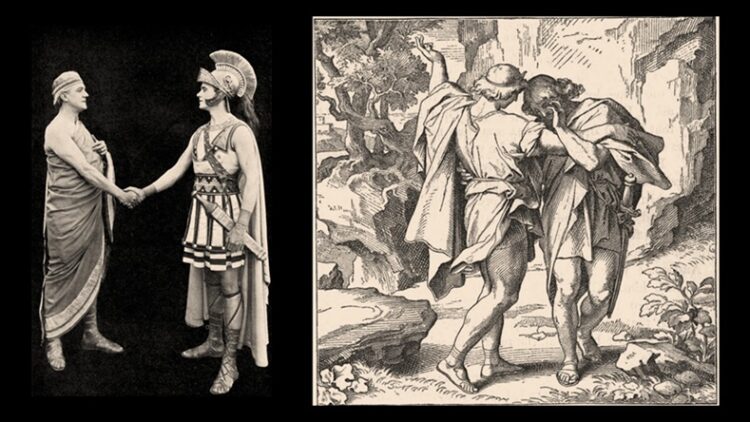
Damon and Pythias
The two spoke number lore with every breath,
Disciples of Pythagoras and friends,
But one was seized and chained, condemned to death
As loud opponent of tyrannic trends.
He felt a need that normally attends
Life’s end, to go and settle his affairs.
The tyrant said, “You may, but that depends
On someone to stand surety. Who dares
To let you wander worldly thoroughfares?
To die as you enjoy unearned reprieve?”
Damon dared, and friendship such as theirs
Astonished all. Late on the fateful eve,
Staunch Pythias returned for execution.
To free both was the tyrant’s resolution.
Jonathan and David
Prince Jonathan, soul-knit to David not
By love of body, but of covenant,
When first they met, made him extravagant
Gifts of his own regalia, that allot
Identity to friends no hostile plot
Could change, though both their interests dominant
Lay elsewhere. Time they had to share proved scant.
Strong fondness leaves the details long forgot.
Their farewell words of covenant renewal
Record the essence of affection dual:
“The Lord be between us, you and me forever.
I love you as my very soul, but say,
‘Now go in peace. The Lord sends you away.’”
They kissed; they wept; the Lord between them ever.
Margaret Coats lives in California. She holds a Ph.D. in English and American Literature and Language from Harvard University. She has retired from a career of teaching literature, languages, and writing that included considerable work in homeschooling for her own family and others.



















You’re a sonnet master, Margaret — very enjoyable reading! Plus some helpful lessons in Greek and Bible history. 😉
Thanks, Paul. The lesson I learned in reading for these poems was Jonathan’s unacknowledged heroism and confidence in God. Tried to do him justice here with the title “Prince” and by recognizing his role as senior self-sacrificing friend.
Margaret, two great matching poems on undying friendship and loyalty that stir the soul and challenge us to ever be faithful in life. The Greeks had the word, Agapē, for such selfless love. as the highest form of love—”a deliberate, sacrificial commitment to seek another’s good, regardless of emotion or merit. It’s the form of love most associated with God’s love for humanity and the love humans are called to extend to others.”
Thank you, Roy, for your appreciation of the poems, and for bringing up agape love. It certainly is the highest form of love, always seeking the good of the loved one, even to the point of the lover’s self-sacrifice. Sometimes agape is unconditional. The loved one may not reciprocate, in which case the lover demands nothing in return. It is most truly the love of God (though God wishes his love to be returned insofar as human beings are capable). In these two poems, the love of friendship seems very close to agape; it is returned loyally and faithfully. That was demonstrated by David to his friend’s children after Jonathan’s death in battle.
The Hebrew term for this highest love is hesed, often rendered lovingkindness. The word is used only for God in the Bible, and thus I have called the love of Jonathan and David “covenant love.” A covenant (Hebrew berith) is an agreement involving obligations, in which the steadfast loyalty and fidelity of covenant makers may approach the level of agape. The love of David and Jonathan also included deep emotion, not necessarily present in a covenant. But they did make and renew a covenant more than once, calling on God as witness and guide, which consecrated their friendship.
The friendship of Damon and Pythias had Pythagorean beliefs in the order of the universe behind it. But it too included individual emotion. No other member of their community stepped up as surety for Pythias’ period of freedom to settle his affairs, which might have led to Damon’s death if Pythias had not returned. So they felt a love which might have involved self-sacrifice–and was rare enough to deeply impress the tyrant into canceling the condemnation of Pythias. In fact, the story says he wanted to become a third member of their friendship group–but the two of them did not allow this!
I echo Paul and Roy’s praise, Margaret. Both are lovely and loving poems which focus on underremembered historical friendships and which highlight Agape love. Agape strikes me as an under-addressed subject for poetry — romantic love seems to generally dominate (as it also does in secular music.) It would be interesting to explore –from a literary standpoint — the reasons for this imbalance. To say one is secular and the other theological strikes me as only the beginning of the analysis rather than its conclusion.
My theory, Brian, is a realistically pessimistic view of human nature; we (or most of us, anyway) tend to make decisions emotionally, even decisions about what it feels good to write about. And since romantic love is more exciting than agape love, that topic is more often chosen.
Cynthia, that explains a great deal. Romantic love is not only more exciting, with more possibilities for passionate drama and narrative, but far more common in human experience than agape love. That makes it more “relatable,” and more likely to attract poet and audience.
I did, however, try to take a different “literary standpoint” in looking for friendship poems rather than love poems. Even in these, agape love seems to remain in the background. The most famous I could remember were Milton’s “Lycidas” and Dryden’s “To the Memory of Mr. Oldham.” Both are memorial poems for a young poet friend who died early. And since they belong to the elegy genre, they are naturally more about the deceased person than about the friendship. Indeed, both seem to lack personal feeling, which I consider more of a problem (bordering on insincerity) in Milton’s poem, because it touches so briefly on school fellowship while rambling on so very long in pastoral convention. This lack of concern for agape love is much more the case in a similar poem, Shelley’s “Adonais” on the death of Keats. Shelley and Keats were acquainted, but probably never friends, due to different temperaments and personalities. In this case, we’re dealing with two poets both of the highest rank, and Shelley is effective at proclaiming the eternal beauty of Keats’s poetry, without needing to pretend personal connection.
So where are the live friendship poems? I quoted one, by the unknown Thomas Edwards, in my essay on Spenserian or Scottish sonnets. Edwards urges his friend to a life of knowledge and virtue, with “Friendship, the sum of all our joys in one.” He presumes the friend agrees, and will not pursue the distracting ambitions Edwards advises against. Sounds like unnecessary advice in an easygoing relationship! The peace, calm, comfort, and stability of agape love inspire internal satisfaction, but these are not easy to put into memorable poetry. I have an anthology of American verse that includes a number of poems by the great American poets of the 19th century for one another’s significant birthdays. I’m sure these gave great pleasure at the time, but they are poems of praise that skirt the topic of individual emotion in the manner of their era.
One where the relationship was long and happy, and the emotion is deeply felt, is the Anglo-Saxon “Wanderer.” It is after the lord’s death, and the essential agape loyalty has turned to grief. Here’s the sense of irreparable loss in someone who was not an equal of the departed friend, but was one to whom the loss of individual companionship seems more important than even the loss of the old way of life. Whether we can rightly call that way “agape” does not, I think, come down to Brian’s secular/theological distinction. The imbalance between agape and romance poems exists for varied reasons, and probably will continue to exist.
And Brian mentioned secular music, by which I think he means popular music. Since I hardly know any of this, I looked up a long list of songs supposedly about friendship. In many of these, friendship is equated with romantic love. Listening to a few, I am convinced the singers–even when they sing about mutual help or sharing misery–have almost no concept of agape love. Not on any of the lists is Paul Simon’s 1970 “Bridge Over Troubled Water.” It is the exception in which friendship seems to be agape, taking unselfish delight in self-giving for the sake of the other.
Thanks so much, Brian, for finding both these friendship poems “lovely and loving.” Your notice that agape love seems “under-addressed” in poetry. And your suggestion to explore this situation from a literary standpoint has sent me looking for the best-known poems dealing with friendship. It seems good to place my ideas after Cynthia’s reply to you on the subject, taking up her perspective as well. Will do so as soon as I can!
Margaret C.
These poems express eloquently the emotional ties of deep friendship.
Margaret B.
Thank you, Margaret B! Always appreciate your reading and remarks.
Margaret,
Once again your mastery of metric cadence, married to smooth, natural conversational exchanges, shines. The history, expressed with deep emotional context, makes these both absolutely beautiful. Thank you.
Dusty, you’ve covered all the bases of appreciation. I’m immensely grateful for your reading and comments!
Beautiful poems, and well-told, moving stories, Margaret. In the first one, I like the way you’ve begun each new quatrain with one of the same rhymes from the previous one, weaving the lines together. This happened for the first two quatrains of the second poem, as well.
As it happens, Cynthia, the first sonnet is Spenserian, the second Italian, and that’s just the way their rhyme schemes go. Many people have complained that Italian sonnets are harder to write (in English) than English sonnets are, because English is a relatively rhyme-poor language. I’ve always disagreed with that contention, and Dr. Coates has eloquently made my point. We are all old-time friends here.
Right, C. B., “Damon and Pythias” is a Spenserian sonnet, which has a more “intertwined” version ababbcbccdcdee of the usual Shakepearean sonnet rhyme scheme. And I would call “Jonathan and David” a French sonnet, which has more rhymed couplets than the usual Italian sonnet rhyme scheme. As Cynthia noticed, the Italian octave rhymes abbaabba, but the sestet is usually cdcdcd or cdecde, while French who use the same abbaabba for the octave prefer ccdeed for the sestet, giving the French pattern a total of FOUR rhyming couplets. I chose the French and Spenserian patterns as best suited to creating an image of close friendship in the very rhyme scheme of each sonnet!
Thanks, C. B., for describing these sonnets as eloquent. Their rhyme scheme may make Italian sonnets very slightly more difficult to write than English ones, but considering everything that must go into a sonnet, the added challenge seems negligible.
Glad you like the storytelling, Cynthia. These classic close friendships are naturally moving. Rhymes schemes were intended to support the closeness idea, as you noticed. C. B. and I discuss the technicalities below!
Margaret,
Regarding Damon and Pythias, my reaction was surprise when Damon stepped up for his friend. I think the pace of this poem is very friendly to my inexperienced ears, so it was enjoyable to read.
We’re all surprised, Laura! You’re right that this one is the easier to read. Thanks for taking the time and leaving the comment.
The poem, Jonathan and David, was also moving. It reminded me of a woman with whom I had a casual friendship, but she arrived at a time of my dire need without solicitation. Soon after, she moved away and we lost contact with each other. To this day, her empathy and generosity of her time taught me a valuable lesson that I try to emulate to this day. I like the pace of this poem too.
I can see how “Jonathan and David” would remind you of a friend arriving suddenly in time of need. Those two were always willing, although later not always able, to lend assistance to one another. Thank you always for your help, and for reading and commenting here!
I love the pairing: Classical and Biblical — complements just as the friends they describe. Damon and Pythias is a sadly unremembered tale that illustrates not just true friendship but also justice — the tyrant Dionysius, after all, was a patron and sometime follower of Plato. You capture that in the closing line of your sonnet. But what present-day academics have done to David and Jonathan is even worse — and you dispel those notions right out of the gate (a necessary and deftly-done task). You emphasize the spiritual nature of their bond with a healthy paraphrase of scripture. I love what you’ve done not just with the stories but how you have portrayed them in verse.
Thank you for the comment, Adam, and I’m sorry to take so long answering. Biblical really IS classical in English literature: there’s no book so influential or so often quoted as the Bible. I’m glad you like my rescue of David and Jonathan, achieved by going directly to the texts about them. So much true manly affection there, beautifully expressed as few men would do in any era–but love in the Lord is what makes theirs a most remarkable forever friendship.
As for Damon and Pythias, you are right that it is a tale of justice as well. Dionysius was a tyrant, but we often forget that tyranny was an acknowledged form of government in the ancient world–not the evil that the word always implies today. The Pythagoreans opposed it because they considered their own brand of communal harmony socially superior. Clearly this tyrant does not believe Pythias is enough of a friend to return when he could have made his escape from prison and death by leaving Damon to his fate. But when Pythias behaves justly, the tyrant responds with a just reward to both of them for virtuous behaviour. Great ending!
Margaret,
I enjoyed reading both of these poems. You have a great ability of putting historical/biblical stories into verse, which sounds daunting to me since it requires a great knowledge of the subject matter. I’ve never heard of the French sonnet, so thanks for sharing that information in the comments. Thanks for sharing these poems.
Paul, thank you so very much. I’m sorry to have left your comment unacknowledged for several days. Knowledge of the subject matter may sound daunting, but I myself did not know Jonathan and David so well until I re-read passages of the Bible where their stories occur. You can do that with any subject that attracts you. Glad you liked hearing of the French sonnet. Since its basic Italian form forbids a rhyming couplet at the end (where most of our English sonnets have one), the French sonnet stands out to us as having the rhyming couplet in lines 9-10, where we expect the sonnet to turn and take a new direction. Hope mine looked effective there!
As we’re now at the Holy Week turn of time, I wish you a beautiful celebration of the holydays. Since we are almost neighbors, please (only if you wish!) contact me at the address offered some time ago. If you want to get in touch, but have lost it, please ask Evan Mantyk next time you make submission.
Dear Margaret,
How much we enjoyed reading and re-reading the rich yet bold dichotomy expressed in these poems!
I agree with the lovely comment above and we feel blessed as you share these gems.
Thank you for the detailed explanation also!
Dear Margaret,
We enjoyed the reading and rereading of your poems. Such chilling yet delectable food for thought!
I agree with Paul’s comments.
We’re so blessed as you share these gems.
Thank you,
Loretta
Thanks, Loretta and Fermin! I understand what you mean about the dichotomy. Much appreciate both of you responding to these gems on friendship, and treasure the two of you as friends of mine.