


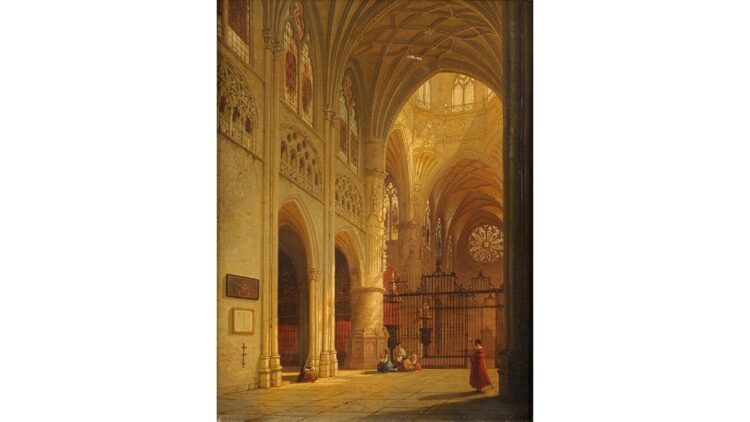
Reverie
I genuflected, claimed a pew.
_The nave was silent-dim.
Polychrome glimmers, stained glass threw:
_a stagy shark’s-tooth scrim.
I shivered in the frigid air
_dampened by walls of stone,
bowing my head, attempting prayer.
_But faith, I could find none.
The church’s statues seemed to be
_quaint artifacts entombed,
Christ’s cross a gothic travesty
_from Orphic myths exhumed.
The ancient books of miracles
_had decomposed to dust.
Saints’ haloed heads were grinning skulls,
_odd objects of disgust.
Abruptly, soft male voices soared
_from somewhere high above,
as if a celestial host adored
_the Father, Son and Dove—
sweet monophonal melodies
_first sung by holy priests
in past enchanted centuries
_of daily sacred feasts.
They practiced, local boys and men,
_for Sunday’s Latin Mass:
Gregorian chants within our ken,
_the earthbound to surpass.
My mind relaxed, began to float,
_conjured Our Lady’s face.
Patrician psalms, from times remote,
_infused my soul with grace.
Mary Jane Myers resides in Springfield, Illinois. She is a retired JD/CPA tax specialist. Her debut short story collection Curious Affairs was published by Paul Dry Books in 2018.















Yes, Mary Jane, music does have remarkable healing properties when everything around seems commonplace or drab or comfortless. It seems to supply something we never knew was missing, and this captures the experience perfectly. Thanks for sharing.
Dear Martin
Thank you for your kind comments.
Most sincerely
Mary Jane
Mary Jane, this is a beautiful poem for a Sunday morning. Your wonderful words are as enchanting as the healing power of psalms and songs. Worship is more than images. It is emotions of an eternal celestial nature that become stirred by music.
Dear Roy
Thank you for your kind comments. Your characterization of Gregorian chant as “healing” summarizes exactly what my poem is trying to express.
Sincerely
Mary Jane
This is beautifully written. I love the naturalness of the rhyme, flow of the poem, and its respect for the subject. Very nicely done!
Dear Zumwalt
Thank you for your kind comments. I love to experiment with the “old-fashioned” poetic forms!
Sincerely,
Mary Jane
This is exquisite ballad meter. The sundering division in feeling between the first two stanzas and the last two, where an honest (and almost brutal) confession of indifference is followed by an uplift via Gregorian chant, is extremely effective.
The poet creates a nice parallelism between line 3 and line 7 of the last stanza, where “Gregorian chants” are structurally echoed in “Patrician psalms.”
Dear Joseph
Thank you for your kind comments. To create this poem, I shamelessly stole the form from “The Darkling Thrush” by Thomas Hardy. He wrote 4 stanzas of ballad meter, with a depressed narrator in the first 2 stanzas, who hears a beautiful birdsong at the beginning of stanza 3. The birdsong completely changes the narrator’s feelings in the final 2 stanzas. I thought of the way Gregorian chant always is so uplifting for me. I realized Hardy’s poem could serve as a perfect template to express (albeit imperfectly) my own internal experience with chant.
Thank you for the comment about the parallelism in the last stanza. That effect came from my unconscious: I did not specifically set out to create it!
Sincerely
Mary Jane
Mary Jane this is so beautiful. It truly is the music that stirs our hearts to faith. And you have expressed it so well in this gentle smooth poem. Thank you.
Rohini
Thank you for your kind comments. Gregorian chant is so wonderful, isn’t it?
Sincerely
Mary Jane
A very carefully designed daydream, Mary Jane, with graceful awakening brought about by several means. The speaker knows what she is doing: genuflecting to acknowledge the real presence of God in the sacred space, and claiming a pew where she attempts prayer, but she fails to find faith in herself. In fact, the reverie in the second stanza turns into a nightmare, with seemingly diabolical misperception of things to be seen in a church. Abruptly, though, the situation changes. How? I see three means of grace at work here. Music is only the first, though it is essential, because music imitates and expresses emotion. A softening and sweetening of emotion is the speaker’s primary need. She gets it through the faith of others, the men and boys present for choir practice. Their music is not a performance. In practice, the singers make mistakes, review, repeat, and try to perfect their singing. As the speaker hears them, she receives grace through their labor of diligent faith. There is one thing more: history. The particular kind of music, Gregorian chant, calls forth “enchanted centuries of daily sacred feasts” “from times remote.” In fact, it enables the speaker to exchange her nightmare of faithlessness for a vision of her own as her relaxed mind conjures Our Lady’s face.
The poem does not say what is troubling the speaker’s mind as she comes to the church. It could be a temporary temptation against faith, like hearing arrogant secularist conversation from coworkers. It could be a personal tragedy, like an unexpected death in the family. It could be longterm doubt or habitual wrongdoing she despairs of correcting. But the poem reveals sources of heavenly healing in the emotional beauty of church music, the example of faithful persons, and the recollection of sacred history, in which the speaker can take up her part.
Margaret
Thank you for your kind comments about the poem, and for your thoughtful analysis of how God’s grace works. As you express it: “Music is only the first (means of grace) , though it is essential.” I am practicing now with our local church choir (2x weekly–quite a commitment!) for Holy Week. I never analyzed exactly how choir practice “works”–but your analysis is profound. Somehow, in some mysterious way, choir practice both expresses and actually strengthens the faith of the singers. Yes, we “try to perfect our singing,” all for the glory of God. That singing is not a secular performance, but an offering up of our best efforts to God, or as you express it so beautifully, a “labor of diligent faith.” We are hopeful that the singing uplifts all who are present at the Mass or at the particular service (e.g., Tenebrae).
Sincerely,
Mary Jane
Your poem, speaking of the spiritual power of music, is itself musical, using the “common meter” of many hymns. I agree with Margaret that the poem expresses heavenly healing. It also immediately brought to my mind “Because I could not stop for death, he kindly stopped for me.” I imagine that your word, “faith”, could be put in the place of Dickinson’s “death”, in the sense that, in this reverie, it seems that faith has stopped for the poet (though she has also made an effort to stop for it). Beautiful poem.
Dear Cynthia
Thank you for your kind comments. I had not thought of Dickenson–and I love that wonderful poem. I’m intrigued by the reference. Yes, faith seems to have “kindly stopped” for my narrator.
Sincerely,
Mary Jane
I’m not the best of Christians, but on occasion have attended the local church in Nouakchott, where the congregation celebrates its faith with ritualised ceremony interspersed with singing and dancing of a more African nature. It’s very uplifting, MJ, just as your poem is.
Dear Paul
Thank you for your kind comments about my poem. I still have on my shelves a 1965 Philips 33 LP of the Missa Luba, a Mass “Congolese style.” I bought the LP sometime in the late 60’s. Occasionally I play the record on my brand-new turntable (now with BlueTooth!) It’s absolutely gorgeous music, and a wonderful expression of Christian faith.
Sincerely
Mary Jane
The contrast in this poem is noticeable: the stillness and solemnity of the church with the inner movement from faithlessness to grace. It is not the sights, but the music that ultimately spurs the change in the narrator, testifying to the power of that medium. You give us a deeply personal yet universal experience.
Is this a true story, and is the church by any chance St. Katherine Drexel?
Dear Adam
Thank you for your kind comments. The poem is not strictly speaking “autobiographical.” I am not recollecting any specific dramatic “epiphany.” Rather, I am describing in generic terms the positive feelings I experience from listening to (and singing) Gregorian chant.
I am a member of St. Katharine Drexel parish here in Springfield. There are two churches in our parish: Sacred Heart (with Latin Masses) and St. Patrick. I attend the 10:30 Latin Mass at Sacred Heart.
We are fortunate to have four gorgeous old-style churches here in Springfield:
1) My church, Sacred Heart (built by German immigrants in the 1880’s–a “Bavarian jewel box”;
2) Blessed Sacrament (neo-Gothic, built 1930, recently renovated);
(3) St. Francis on Laverne Road, built 100 years ago by Franciscan nuns and now administered by Norbertine priests. This church is an architectural marvel, and one of the “highlights” of our city (together with the Lincoln sites) https://hospitalsisters.org/userfiles/sites/303/files/Church%20booklet_June%202014.pdf ;
4) Cathedral of the Immaculate Conception–Greek Revival style (1928).
Sincerely
Mary Jane
This is EXCELLENT, Mary Jane. It may be my favorite one yet!
Chelsea
Thank you so very much for your kind comments.
Most sincerely
Mary Jane