


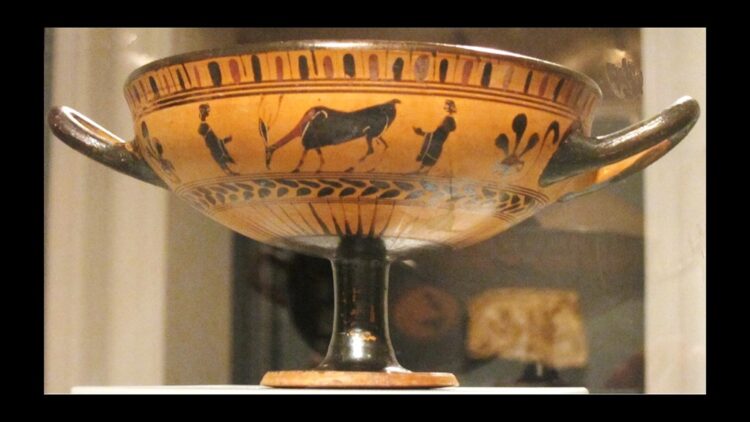
Directions to a Cup-Maker
by Anacreon (573-495 B.C.)
translated from the Greek by Joseph S. Salemi
Skillful craftsman, make this thing:
A cup to hold the gifts of spring.
Duplicate, in silver chasing,
Spring’s first rosebuds, whose fine tracing
Renders drink a pure delight.
I implore you, get it right:
Put in nothing strange or bold,
Or a story best untold.
Rather, carve great Zeus’ son
Bacchus, the wild drunken one;
The Cyprian, whose mystic rites
Give wedlock all its moistened nights;
Put Eros, but without his bow,
And Graces with their smiles aglow,
While beneath a thick-leafed vine
Rich in grapes unplucked for wine,
Bring together handsome boys
Whom Phoebus might not scorn as toys.
Wine and Roses
by Anacreon (573-495 B.C.)
translated from the Greek by Joseph S. Salemi
Roses of the Loves combine
With the Dionysian wine;
The circle of our brows enclose
With the perfect-petalled rose
As we drink and laugh at these
Darlings of the errant breeze:
Rose, the very best of flowers,
Rose, the care of spring’s sweet hours,
Roses that the gods enjoy,
Rose that Aphrodite’s boy
Places by his pretty cheeks
Where the down of first youth peeks
As he dances and embraces
All the lithe and supple Graces.
Bacchus, god of unleashed urges,
Garland me with lyric surges.
By your dwellings me you’ll find
Decked with chaplets rose-entwined.
There with some big-bosomed girl
I shall dance in frenzy’s whirl.
Translator’s Note
The Anacreontea is a collection of poems, but they are certainly not by the Ionic poet Anacreon (573-495 B.C.) They are later compositions by other ancient Greek poets writing in Anacreon’s style, and dealing with his preferred subjects. Anacreon’s poetic tendencies had become what modern comedians call a “shtick,” or a recognizable trademark character and choice of topics.
His subjects were usually what we’d call “Wine, Women, and Song”—that is, feasting, lovemaking, drinking, and other playful activities. Because these are perennial human habits, poets continued to write in Anacreon’s style long after his death. The sixty or so poems that we have are mostly short and lyrical, ranging from seven lines to twenty-five lines, but with others that are more than thirty or forty lines. There are some that are sad and meditative, but always in the context of melancholic remembrances in the midst of celebrations.
The two that I have translated here are typical of what one finds in the Anacreontea. The first asks a cup-maker to design and create a drinking cup with images of Bacchus (the god of wine and drunkenness), Aphrodite (the goddess of beauty and sexual intercourse), Eros (the god of erotic madness), and the Charites (the three Graces, or representatives of female loveliness, charm, and movement). It ends with a call for “handsome boys” (likely the eromenoi or male adolescent lovers that some older men favored). The poem presents a perfect amalgamation of drinking and erotic pleasure.
The second poem puts together two favorite subjects of the Anacreontic tradition: wine and roses. Here the god of wine is called by his other name (Dionysus), and the speaker asks that Dionysus be united with “the Loves,” which are to be understood as miniature manifestations of Eros, pictured as small winged children bearing bows and arrows. These little Loves are the origin of our modern image of the small god Cupid, and the Renaissance Italian putti. The Graces are mentioned again, and the poem ends with the speaker imagining a dance with a big-bosomed girl. But the major focus of the poem is on roses—they are specifically mentioned six times, along with references to garlands and crowns made from roses.
I have tried to stay close to the original text’s meaning, but doing so in English rhyme does force one to compromise somewhat. When necessary I have expanded the meaning in such a way as to allow rhyme, but at the same time maintain overall fidelity to what the poems actually say. Ever since the Anacreontea
became popular in seventeenth-century England, dozens of poets have attempted this, with varying levels of success.
Greek Original
Directions to a Cup-Maker
Καλλιτέχνα, τόρευσον
ἦρος κύπελλον ἤδη
τὴν πρῶτ’ ἡμῖν τὰ τερπνὰ
ῥόδα φέρουσαν ὥρην
ἀργυρέην διπλώσας
ποτὸν ποίει μοι τερπνόν
τὰς τελετὰς παραινῶ,
μὴ ξένον μοι πορεύσῃς,
μὴ φευκτὸν ἱστόρημα
μᾶλλον ποίει Διὸς γόνον,
Βάκχον Εὔιον ἡμῖν,
μύστιν τε νάματος Κύπριν
ὑμεναίους κροτοῦσαν
χάρασσ’ Ἔρωτας ἀνόπλους
καὶ Χάριτας γελῶσας
ὑπ’ ἄμπελον εὐπέταλον
εὐβότρυον κομῶσαν
σύναπτε κούρους εὐπρεπεῖς,
οἶς ἂν Φοῖβος ἀθύροι.
Wine and Roses
Τὸ ῥόδον τὸ τῶν Ἐρώτων
μίξωμεν τῷ Διονύσῳ
τὸ ῥόδον τὸ καλλίφυλλον
κροτάφοισιν ἁρμόσαντες
πίνωμεν ἁβρὰ γελῶντες
ῥόδον ὢ φέριστον ἄνθος
ῥόδον εἴαρος μέλημα,
ῥόδα καὶ θεοῖσι τερπνά,
ῥόδον ᾧ παῖς ὁ κυθήρης
στέϕεται καλοὺς ἰούλους
Χαρίτεσσι συγχορεύωνˑ
στέψον οὖν με, καὶ λυρίζων
παρὰ σοῖς, Λυαῖε, σηκοῖς
μετὰ κούρης βαθυκόλπου
ῥοδίνοισι στεϕανίσκοις
πεπυκασμένος χορεύσω.
Joseph S. Salemi has published five books of poetry, and his poems, translations and scholarly articles have appeared in over one hundred publications world-wide. He is the editor of the literary magazine TRINACRIA and writes for Expansive Poetry On-line. He teaches in the Department of Humanities at New York University and in the Department of Classical Languages at Hunter College.









Your somewhat salacious poems selected for translation are remarkable reminisces of an age of wine and roses (at least for some). As one who has had to translate in several languages, I admire your intellectual capabilities and translation skills. Your notable notes provided my needed insight into the context of your translations. One must have some latitude when translating, yet I have the sense you did not stray far, if at all, from the original.
LTC Peterson, I’m sure that your translation skills are much wider than mine. You were tasked with handling important and lengthy documents connected with military intelligence and diplomacy, so you were held to a much higher standard of accuracy in detail than is imposed on poetic translators.
I tried my best to maintain accuracy of rendering in these two samples from the Anacreontic corpus, but we poets have the advantage of many shared poetic conventions, idiomatic turns of phrase, and plausible synonyms when we are translating from another language. We can get away with a lot.
Dr. Salemi, I greatly appreciate your outstanding translation capabilities and know it is of a high order. TI hope you do not mind but this may be of interest to you:
1.) In two assignments in Germany, I had to pass myself off as a native German speaker and dress like one. It turns out my accent was Bavarian, which was fortunate because that is where I was assigned for five years. I had to eat in restaurants with the fork in my unnatural left hand and scrape the food with a knife over the back of the fork like they did. This is actually the continental (European) style of dining and not the “cut and switch” like we use. I bought some German neckties in which the diagonals ran the opposite way of ours.
2.) After six years of military duty, when I took the Army language exam, we had a half hour to memorize a fake language and then attempt to translate it on the fake language exam. I scored so high, they gave me a choice of four languages: Chinese, Japanese, Russian, or Arabic. Given my racial profile they wanted me to learn Russian.
3.) I was an honor graduate (top) of the US Russian Institute where for two years I had to study and take examinations on everything from Russian literature, geography, and history to Soviet military subjects. This was after a year at the Defense Language Institute in Monterey.
4.) I spent seven years in Russia, during which as you surmised, I translated documents and had to operate in many cities. One person concluded my accent was from the St. Petersburg area, since it was so correctly spoken.
5.) I had a perfect written and speaking final exam score in Vietnamese at Fort Bragg and served as the interpreter for the morning briefings by South Vietnamese officers of two Generals in the Delta. I was the single honor graduate of my course at Fort Bragg.
6.) I was detailed to an Army unit to assess which German documents captured in WWII we should keep.
7.) Even after I retired, my organization had me work an intelligence organization to interpret details from German (measurements/layers, etc.) on how to take out multilayered underground bunkers in Iraq. I coordinated with Eglin AFB. in making a making a new weapon. My efforts resulted in the first two bunker buster bombs that successfully destroyed the major one in Baghdad filled with Hussein’s high-level officials. These were two GBU‑27 Paveway III laser‑guided bombs. 408 were killed that the news called civilians, but they had to be of the privileged class to be there.
8.) My mother was an English and Latin teacher.
Wow! Thanks for the translation! Appreciate how you modernized these works, and took the time to provide such an informative and well-written translator’s note. Very well done!
I’m glad you enjoyed the translations and the note. Many thanks!
These are highly skilled translations, Joe, of poetry which is refreshingly frank in their vaunting of sensual delights. I always enjoy the opportunity to recognize the humanity of the ancients — one of the things you present so well. Over and over, you prove by choice of material and your handling of it that the ancients were not made out of marble but of flesh and blood. The “moistened nights” of wedlock made me blush a little, as did the use of adolescent boys and objects of desire. Yet there is a strange unself-consciousness (I won’t say innocence) to these ancient views that seems to make the present times seem all the tawdrier.
Thank you, Brian. The ancients did not have a Puritan hangover about sex, which they saw as simply a natural drive (taking many forms) that was under the control of the goddess Aphrodite, her son Eros, and the semi-comic figure of Priapus. As in all cultures, there were some social taboos about it and some disapproved manifestations, but the ancients rationally understood that trying to pass unenforceable laws to control it was absurd.
I don’t know a lick of Greek, but both are beautiful poems that stand on their own. I like your phrasings. In the first poem: “silver chasing”; “thick-leafed vine Rich in grapes unplucked for wine”; “moistened nights” (it’s sexual, yet subdued, with a touch of innocence); and in the second poem, “circle of our brows”; the repetition of roses and the line “Rose, the care of spring’s sweet hours”; and “chaplets rose-entwined”. It occurred to me that in the olden days (I’m thinking here of our founding fathers) young men were expected to learn Greek and Latin. Today? Not so much, if at all.
Thank you, Cheryl. I wanted my translations to capture the sheer celebration of beauty (both natural and artificial) that the two poems show. There’s a strong hedonistic streak in the Anacreontea that is not just about erotic self-indulgence, but also about the absolute value of roses, wine, dancing, merrymaking, and the love of beautiful objects. Describing an ideal drinking cup, filling it with an excellent vintage, and intoxicating yourself with the scent of roses and the fumes of wine, are what have made the appeal of these poems long-lasting.
I was particularly taken by ‘Directions to a Cup-Maker’, since my mug for tea and coffee is decorated with a Union Jack which is supposedly a message. Make of it what people may, I bought it from a tourist stall while showing foreign visitors around London.
The allusions, also, in this poem, of Greek deities is not too esoteric as often happens in poems referring to this era.
Furthermore, I like the idea of a customer giving instructions for a personalised drinking vessel, a type of service so rare these days.
Thank you, Paul. It was certainly possible in the ancient world, as it is today, to have an item made-to-order or personalized. But in this poem I’m sure that the whole idea is simply a fictive poetic conceit that allows the poet to display his skill in wordcraft, and to ring the changes on roses, lovemaking, drinking, and references to the gods of pleasure. Anacreontic poems were practically a genre back then.
What saddens me most is that the roses I cultivate do not have the evocative powers of the ones described in these poems. And the vines growing in my yard never yield wine-grapes, but are essentially weeds. The good news is that Bacchus and Eros often stop by to lend me their counsel. I usually don’t comment on translations, but sometimes I have to bend to an ineluctable force majeure.
Kip, I understand that cultivating roses is a complex task, even for highly experienced gardeners. With aphids and Japanese beetles and too much rain or not enough, it’s a real crap-shoot. I suppose that the perfect roses you see in florist shops are the products of hothouses.
In India they make a rose-flavored ice cream. And Sally Cook always sang the praises of rose-hip tea.
These are first-rate translations. They are, first and foremost, faithful to the original, but even more, they preserve the sense of revelry the original conveys with its short lines that flit from idea to idea. The choice of couplets was well-advised; although the original is unrhyming, it does give a strong hint of couplets in its endings. You did an excellent job of bringing the poet of wine to life.
Many thanks, Adam.