• Submit Poetry
  • Support SCP
  • About Us
  • Members
  • Join
Wednesday, June 17, 2026
Society of Classical Poets
  • Poems
    • Beauty
    • Culture
    • Satire
    • Humor
    • Children’s
    • Art
    • Ekphrastic
    • Epic
    • Epigrams and Proverbs
    • Human Rights in China
    • Music
    • Performing Arts
    • Riddles
    • Science
    • Song Lyrics
    • The Environment
    • The Raven
    • Found Poems
    • High School Poets
    • Terrorism
    • Covid-19
  • Poetry Forms
    • Sonnet
    • Haiku
    • Limerick
    • Villanelle
    • Rondeau
    • Pantoum
    • Sestina
    • Triolet
    • Acrostic
    • Alexandroid
    • Alliterative
    • Blank Verse
    • Chant Royal
    • Clerihew
    • Rhupunt
    • Rondeau Redoublé
    • Rondel
    • Rubaiyat
    • Sapphic Verse
    • Shape Poems
    • Terza Rima
  • Great Poets
    • Geoffrey Chaucer
    • Emily Dickinson
    • Homer
    • Henry Wadsworth Longfellow
    • Dante Alighieri
    • John Keats
    • John Milton
    • Edgar Allan Poe
    • William Shakespeare
    • William Wordsworth
    • William Blake
    • Robert Frost
  • Love Poems
  • Contests
  • SCP Academy
    • Educational
    • Teaching Classical Poetry—A Guide for Educators
    • Poetry Forms
    • The SCP Journal
    • Books
No Result
View All Result
Society of Classical Poets
  • Poems
    • Beauty
    • Culture
    • Satire
    • Humor
    • Children’s
    • Art
    • Ekphrastic
    • Epic
    • Epigrams and Proverbs
    • Human Rights in China
    • Music
    • Performing Arts
    • Riddles
    • Science
    • Song Lyrics
    • The Environment
    • The Raven
    • Found Poems
    • High School Poets
    • Terrorism
    • Covid-19
  • Poetry Forms
    • Sonnet
    • Haiku
    • Limerick
    • Villanelle
    • Rondeau
    • Pantoum
    • Sestina
    • Triolet
    • Acrostic
    • Alexandroid
    • Alliterative
    • Blank Verse
    • Chant Royal
    • Clerihew
    • Rhupunt
    • Rondeau Redoublé
    • Rondel
    • Rubaiyat
    • Sapphic Verse
    • Shape Poems
    • Terza Rima
  • Great Poets
    • Geoffrey Chaucer
    • Emily Dickinson
    • Homer
    • Henry Wadsworth Longfellow
    • Dante Alighieri
    • John Keats
    • John Milton
    • Edgar Allan Poe
    • William Shakespeare
    • William Wordsworth
    • William Blake
    • Robert Frost
  • Love Poems
  • Contests
  • SCP Academy
    • Educational
    • Teaching Classical Poetry—A Guide for Educators
    • Poetry Forms
    • The SCP Journal
    • Books
No Result
View All Result
Society of Classical Poets
No Result
View All Result
Home Poetry

‘The Throne at Knossos’: A Poem by Adam Sedia

March 20, 2026
in Poetry, Beauty
A A
31
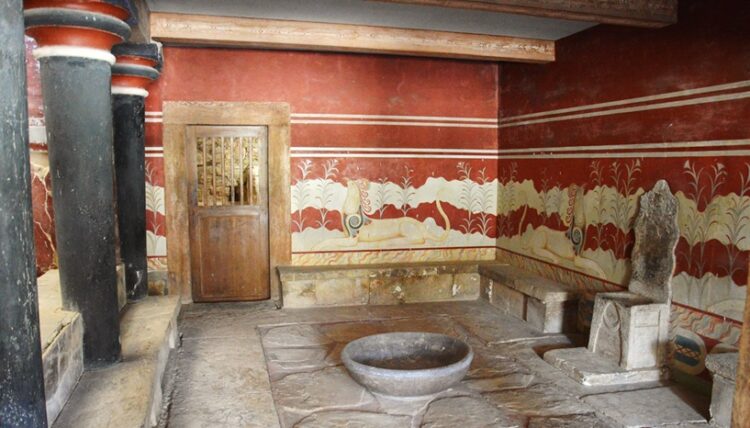
photo of the throne of the King of the Minoan Palace of Knossos, Crete (public domain)

photo of the throne of the King of the Minoan Palace of Knossos, Crete (public domain)


The Throne at Knossos

Kings, nations, empires, tongues have passed,
Through fourscore centuries, but you last,
_Carved from immortal stone
Long before Caesar was to reign
Or king of England, France, or Spain:
_Europe’s most ancient throne.

Within this crimson-frescoed hall,
Enthroned on your majestic, tall,
_White alabaster seat,
Great Minos sat, gave law to guide
His sea-borne empire stretching wide
_From sun-drenched, sea-kissed Crete.

His dauntless captains took the helm
To Cyprus and to Pharaoh’s realm
_And made his riches wax;
His warships stormed Achaea’s shore
For victims for his Minotaur,
_Slaves to his double axe.

Throne, palace, kingship, empire passed,
Forgotten; years and dust amassed.
_But now again they rise
And coyly let their tales unfold
Of glories of that realm of old
_To wonder-stricken eyes.

Here Europe’s majesty first shone
And sat in state upon a throne
_To rule the azure seas,
Proud prototype of thrones to come,
The light of Greece, the might of Rome,
_And ermined dynasties.


Adam Sedia (b. 1984) lives in his native Northwest Indiana and practices law as a civil and appellate litigator. He has published four books of poetry and his poems, essays, and fiction have appeared in various literary journals. He is also a composer, and his musical works may be heard on his YouTube channel.

ShareTweetPin
The Society of Classical Poets does not endorse any views expressed in individual poems or commentary.
Read Our Comments Policy Here

RandomPoems

poem/sale/culture
Alliterative

‘Dunblane Cathedral’: A Poem on the 20th Anniversary of a Massacre, by Joseph Charles MacKenzie

March 26, 2016

. Dunblane Cathedral On the massacre of sixteen children and their teacher at the Dunblane Primary School near Stirling, Scotland,...

‘Anthony Comstock: An Extended Dactylic’ by Joseph S. Salemi
Culture

‘Anthony Comstock: An Extended Dactylic’ by Joseph S. Salemi

February 25, 2024

. Anthony Comstock: An Extended Dactylic Higgledy, piggledy, Anthony Comstock, the Toughest enforcer of morals to date, Couldn’t stand looking...

Next Post
‘Damon and Pythias’ and Other Poetry on Friendship, by Margaret Coats

'Damon and Pythias' and Other Poetry on Friendship, by Margaret Coats

‘Prayer (5:00 a.m.)’ and Other Poetry by Jeffrey Essmann

'Prayer (5:00 a.m.)' and Other Poetry by Jeffrey Essmann

‘Tinian’: A Poem by M.D. Skeen

'Tinian': A Poem by M.D. Skeen

Comments 31

  1. Michael Curtis says:
    3 months ago

    Ah. Thank you for the tour through time, the tour through mind.

    Reply
    • Adam Sedia says:
      3 months ago

      You are most welcome.

      Reply
  2. BDW says:
    3 months ago

    This is a “flawed” poem (i.e., in the sense of T. S. Eliot) but powerful in that it touches, Milton, Romantics, like Coleridge, Wordsworth, and even Poe. It drips of deep allusion with an impressive, monosyllabic, Keatsian diction. The aabccb stanza is, on the whole, nicely done—albeit Romantic/Victorian to the core—and in this respect a surprising NewMillennial find. It is a remarkable expansion in the direction and extent of Mr. Sedia’s work. Though this is only a guess, I would say it has come about due to his cursory inspection of various epics and his developing talent that has brought him to this unique space.

    Reply
    • Adam Sedia says:
      3 months ago

      Thank you for your kind words on the poem. Two things more than anything produced this work: a fascination with ancient history, and reading about the Minoans since childhood, and the current European crisis, which is at its root a crisis of confidence and identity. I thought some words to instill a realistic pride would be helpful. As for form, it kind of fell into place as I wrote it.

      Reply
  3. Susan Jarvis Bryant says:
    3 months ago

    The Throne at Knossos reminds me of the poetic prowess of one of my favorite poems, Thomas Gray’s Ode on the Death of a Favourite Cat, Drowned in a Tub of Gold Fishes. I like its elegance, beauty, clarity, and delicate touch of irony. It speaks to me. In an age quick to forget its history, your poem serves to remind me that beneath the new normal there lies the enduring “throne” of shared beginnings. Adam, this poem is superbly written and a privilege to read. Thank you! I particularly like stanza 2 – I see the picture your words paint in all its majestic glory, and the music of your words adds to the experience.

    Reply
    • Cynthia L Erlandson says:
      3 months ago

      Susan, I do see a metrical similarity between Adam’s beautiful poem and Thomas Gray’s. Thank you for alerting me to his “Ode on a Favourite Cat”, which I hadn’t read before but enjoyed very much just now!

      Reply
    • Adam Sedia says:
      3 months ago

      I am very familiar with Gray’s poem, but I confess it was not in my mind when I settled on the form for this one. I didn’t have a set form when I started and the form really fell into place as I wrote it (though I am incredibly grateful for and flattered by the comparison to Gray, who really is one of the best poets in English). You took exactly what I hoped to convey with this poem: a reminder of the truth in an age of destructive self-flagellation. Thank you!

      Reply
  4. Joseph S. Salemi says:
    3 months ago

    Knossos could indeed be considered the oldest European city and seat of empire — one dating back to Neolithic times. The labrys or double-axe was an important religious-political symbol for that empire.

    The poem is most carefully constructed, and clear. It might be considered as much like the Anglo-Saxon poem about “The Ruin,” but that poem was sad and tinged with death, while this one celebrates the beginning of European triumph.

    Reply
    • Adam Sedia says:
      3 months ago

      Thank you. You sense exactly the tone I wish to convey. I remember as a child seeing a picture of that throne in a book with the caption, “Europe’s first throne.” The thought struck me and stayed with me all those years. With the recent insanity among Europe’s ruling elite, I thought those sentiments would be worth setting into a poem.

      Reply
  5. Bhikkhu Nyanasobhano says:
    3 months ago

    Yes, all these have passed, yet why is it that we are charmed by this brief panorama? Part is the very compressed telling of majestic history and part the sheer beauty of language that together make a potent answer to those who question the contemplation of the past. Just listen, imagine, and be enriched. The throne is empty, but it lasts and calls up visions. In the dismal dust of modern life, who would not delight to have “wonder-stricken eyes”?

    Reply
    • Adam Sedia says:
      3 months ago

      Thank you, particularly for finding “sheer beauty” in my language. That is the highest compliment a poet can receive.

      Reply
  6. Cynthia L Erlandson says:
    3 months ago

    This is a wonderful poem. I love the form, as well as the way you’ve compressed so much history — as well as universal thoughts about the passing of history — into such a brief poem. I’m particularly taken by the line, “From sun-drenched, sea-kissed Crete”, for its concise description, but also for its emphasis on all of the syllables except for the first one. It’s very effective.

    Reply
    • Adam Sedia says:
      3 months ago

      Thank you! That line was one that I instantly thought, “This is a keeper.” I’m glad to see you agree.

      Reply
  7. Brian Yapko says:
    3 months ago

    A stunningly beautiful poem, Adam. The historical imagery is wonderfully evocative. Given the present devolved state of Europe it is painful to be reminded of its gloried and storied past, but embedded in this pain is the reminder that the various civilizations of Europe have not as many rises as falls.

    Reply
    • Brian Yapko says:
      3 months ago

      Correction: JUST as many rises as falls. And who knows? Maybe an even better ratio than that! Especially if one considers the longevity of Rome and, even moreso, Byzantium as Rome’s successor.

      Reply
    • Adam Sedia says:
      3 months ago

      Thank you, Brian! You hit the nail on the head: it is exactly the present devolved state ( as you aptly put it) of Europe that inspired me to set these impressions into poetry. And as you also observe, this is as much about continuity as it is about inevitable decay and fall: not only does the throne itself endure, but so does the authority and the civilization it represents.

      Reply
  8. Paul Millan says:
    3 months ago

    Adam, thanks for sharing this well crafted poem that teaches us about the past. I enjoyed reading it.

    Reply
  9. Roy Eugene Peterson says:
    3 months ago

    Adam, in your outstanding poem, you were wise to include the enigmatic Minotaur and double axe symbol of Knossos that appeared everywhere in that ancient realm as a symbol of power.

    Reply
    • Adam Sedia says:
      3 months ago

      How could I not? It would be like writing about Ancient Egypt without mentioning the pyramids. Thank you for the kind words.

      Reply
  10. James Sale says:
    3 months ago

    A very impressive poem – I like the grand historical sweep, alongside the mythical allusions: the birthplace of something now mystical but which leads to those even greater Western empires later, but which – like them – all fall. The language is rich – Of glories of that realm of old / _To wonder-stricken eyes. – feels deeply Keatsian. I like this a lot.

    Reply
    • Adam Sedia says:
      3 months ago

      Thank you, James. A compliment from you is truly an honor. A comparison to Keats is about as complimentary as a comment can be. I have always admired Keats but never consciously tried to imitate his tone, including here. I suppose the “day-dreamy” vision of the lost Minoan empire invites a comparison to Keats.

      Reply
  11. C.B Anderson says:
    3 months ago

    The words of this poem seem to echo down the corridors of antiquity. Unlike the case of “Ozymandias” we don’t end up with a mere ruin, but rather a persisting legacy. Very cool!

    Reply
    • Adam Sedia says:
      3 months ago

      Thank you! You caught on exactly to the sense I hoped to convey.

      Reply
  12. Cheryl Corey says:
    3 months ago

    Adam, having spent much time studying the history of Crete, I’m delighted to read your poem. Were it not for the catastrophic earthquake at Santorini (formerly Thera) and resulting tsunami, who knows what further influence Crete would have had in history; and let us not forget the role of Sir Arthur Evans, whose excavations unearthed Knossos.

    Reply
    • Joseph S. Salemi says:
      3 months ago

      Evans unearthed the first great trove of tablets in the two unknown languages that he called “Linear A” and “Linear B.” He catalogued the tablets and spent years trying to decipher them, but had no luck. After his death, others discovered that Linear B was an ancient variety of Greek. Linear A remains undeciphered.

      Reply
      • Cheryl Corey says:
        3 months ago

        As far as I know, the Phaistos disc has never been deciphered either.

        Reply
        • Joseph S. Salemi says:
          3 months ago

          There have been many creative stabs at it, but no one seems to know what the thing really says.

          Reply
    • Adam Sedia says:
      3 months ago

      I believe it was Sir Arthur Evans himself who called my subject “Europe’s first throne.” At least it appears described that way in nearly every work I’ve read. The Minoans are tantalizingly mysterious, the foundational civilization of Greece and Europe, with strikingly beautiful remains that are tantalizingly silent. Linear A and B share some common characters, enabling partial decipherment, but the main stumbling block is that we don’t know the Eteocretan language (Homer alludes to it, and we have some fragmentary later inscriptions in the Greek alphabet, but not enough bilingual records to establish a vocabulary). Interestingly, the Egyptians traded with the Minoans (whom they called Keftiu – whence the biblical Caphtor as the Philistines’ homeland), and recorded a couple lines of prayers “in the language of Keftiu” — but again, not enough to enable translation or even identify the language family. Hieroglyphic Cretan (e.g. the Phaistos disc) is even more challenging due to its sparse corpus.

      Reply
  13. Margaret Coats says:
    3 months ago

    Majestic meditation on a rediscovered object exuding power over the imagination! Your poem, Adam, leads the reader back to days when the ancient throne was seat and symbol of real power over the Mediterranean–and leads forward to contemplation of the imperial powers that succeeded it. Your relatively brief work thus reviews the Western civilization centered in Europe, and for this you need the august conclusion you provide. That final stanza sweeps from the classical world with a memorable and significantly descriptive line, “The light of Greece, the might of Rome.” The final “ermined dynasties” help the reader continue thinking toward the colder northern empires that followed. As Brian Yapko notes, it is difficult not to think of the troubled situation in Europe today, where the imperial impetus seems to have dissolved. Your words range much more widely than the ancient sea-going vessels.

    Reply
    • Adam Sedia says:
      3 months ago

      Thank you, Margaret. You’ve caught exactly what I wanted to convey. As a European descendant not that far removed from the continent and seeing the self-destructive insanity gripping Europe, I had to write something uplifting. The caption “Europe’s first throne” I read in a book some three decades ago stuck with me and served as ready inspiration. Minoan Crete may have been remote in time and region from the great European empires of recent centuries, but it is the ancestor — the “prototype” — of all the civilizational glory that followed. It is only a pity we cannot read their Linear A records.

      Reply
  14. BDW says:
    4 weeks ago

    That is not what I meant at all.

    Reply

Leave a Reply Cancel reply

Your email address will not be published. Required fields are marked *

  1. C.B. Anderson on ‘Faux Pas’ and Other Poetry by C.B. AndersonJune 16, 2026

    As for Don Paterson, Susan, check out the link I provided after Norma's comment, for starters. As for the rest,…

  2. Joseph S. Salemi on Horace Odes I.11 and III.30, Translated by Mary Jane MyersJune 16, 2026

    Brian, I agree that there is a problem with some modern words when dealing with ancient texts. Not ALL modern…

  3. C.B. Anderson on ‘Faux Pas’ and Other Poetry by C.B. AndersonJune 16, 2026

    I hold nothing against wine, Margaret. I like a chill vinho verde with seafood and other light dishes, and I…

  4. Brian Yapko on Horace Odes I.11 and III.30, Translated by Mary Jane MyersJune 16, 2026

    Mary jane, thank you so much for undertaking these translations. It is a much-needed effort and a great contribution to…

  5. Norma Pain on ‘The Dryads’: A Poem by Patricia Rogers CrozierJune 16, 2026

    Some poems seem to have a life of their own and lead us to a natural end. The Dryads is…

Subscribe to Daily Poems

Enter your email address to subscribe to this blog and receive notifications of new posts by email.

Join 1,592 other subscribers

Recent Poems

  • ‘Chastity’: A Sonnet Sequence by Justin Dasher
  • Horace Odes I.11 and III.30, Translated by Mary Jane Myers
  • ‘The Bird with the Ugly Voice’: A Poem by Scharlie Meeuws
  • ‘The Dryads’: A Poem by Patricia Rogers Crozier
  • ‘Stories of Saint Anthony’: Poems by Margaret Coats
  • ‘An Englishman to World Cups Past’: A Poem by Paul A. Freeman
  • ‘Faux Pas’ and Other Poetry by C.B. Anderson
  • ‘Trip to Italy: A Poetry Travel Journal’ by James A. Tweedie
  • ‘Spring Song’: A Poem by Rohini Sunderam
  • ‘The Eagle’: A Poem by Bruce Dale Wise
  • ‘Good Night’ and Other Poetry by Kevin Ahern
  • ‘Mothiavelli’ and Other Poetry by Susan Jarvis Bryant
  • ‘Poetic Justices: The Poetry of United States Supreme Court Justices’: An Essay by Adam Sedia
  • ‘Blur’ and Other Poems by Anna J. Arredondo
  • ‘The Cottage on the Ridge’ and Other Poetry by Martin Rizley
  • Catullus’s Poems 5 and 101, Translated by Mary Jane Myers
  • ‘Undeclared College Major’ and Other Short Poems by Russel Winick
  • ‘The Sowers’: A Poem by Gabriele D’Annunzio, Translated by Joseph S. Salemi
  • ‘Three Kittens Went to Kitten-Garten’: A Poem by Roy E. Peterson
  • ‘The Number 217: A Glimpse of Armageddon’: A Poem by Paul Martin Freeman
  • ‘The Heart of the Wood’: A Poem and Song by Joseph David Greene
  • ‘Twelve Labors More Part II. The Music of the Spheres’: A Poem by Evan Mantyk
  • ‘Today’ (A Tetraquartet) and Other Poetry by Paul Millan
  • ‘Chaucer’s Medieval Hangover Advice and Cure’: A Poem by Paul A. Freeman
  • ‘April Flowers Bring May Showers’: A Poem by Cynthia Erlandson
  • ‘O Come, Holy Ghost’: A Pentecost Poem by Johanna Donovan
  • Cato of Utica: Canto I of Dante’s Purgatory, Translated by Stephen Binns
  • ‘Cherry Blossom’: A Poem by Lauren V. Leon
  • ‘Home’: A Poem by Jeffrey Essmann
  • ‘Tempus Fugit, Carpe Diem, Memento Mori’ and Other Poems by C.B. Anderson

Categories

  • Acrostic
  • Alexandroid
  • Alliterative
  • Art
  • Best Poems
  • Blank Verse
  • Chant Royal
  • Classical Poets Live
  • Clerihew
  • Covid-19
  • Deconstructing Communism
  • Educational
  • Epic
  • Epigrams and Proverbs
  • Essays
    • Interviews with Poets
    • Poetry Reviews
  • Featured
  • From the Society
  • Great Poets
    • Dante Alighieri
    • Edgar Allan Poe
    • Emily Dickinson
    • Geoffrey Chaucer
    • Henry Wadsworth Longfellow
    • Homer
    • John Keats
    • John Milton
    • Robert Frost
    • William Blake
    • William Shakespeare
    • William Wordsworth
  • Human Rights in China
  • Limerick
  • Love Poems
  • Music
  • Pantoum
  • Performing Arts
  • Poetry
    • Beauty
    • Children's Poems
    • Culture
    • Ekphrastic
    • Found Poems
    • High School Poets
    • Humor
    • Riddles
  • Poetry Challenge
  • Poetry Contests
  • Poetry Forms
    • Curtal Sonnet
    • Haiku
  • Poetry Readings
  • Rhupunt
  • Rondeau
  • Rondeau Redoublé
  • Rondel
  • Rubaiyat
  • Sapphic Verse
  • Satire
  • Science
  • Sestina
  • Shape Poems
  • Short Stories
  • Song Lyrics
  • Sonnet
  • Symposium
  • Terrorism
  • Terza Rima
  • The Environment
  • Translation
  • Triolet
  • Video
  • Villanelle

Quick Links

  • About Us
  • Submit Poetry
  • Become a Member
  • Members List
  • Support the Society
  • Advertisement Placement
  • Comments Policy
  • Terms of Use

Welcome Back!

Login to your account below

Forgotten Password?

Retrieve your password

Please enter your username or email address to reset your password.

Log In
No Result
View All Result
  • Poems
    • Beauty
    • Culture
    • Satire
    • Humor
    • Children’s
    • Art
    • Ekphrastic
    • Epic
    • Epigrams and Proverbs
    • Human Rights in China
    • Music
    • Performing Arts
    • Riddles
    • Science
    • Song Lyrics
    • The Environment
    • The Raven
    • Found Poems
    • High School Poets
    • Terrorism
    • Covid-19
  • Poetry Forms
    • Sonnet
    • Haiku
    • Limerick
    • Villanelle
    • Rondeau
    • Pantoum
    • Sestina
    • Triolet
    • Acrostic
    • Alexandroid
    • Alliterative
    • Blank Verse
    • Chant Royal
    • Clerihew
    • Rhupunt
    • Rondeau Redoublé
    • Rondel
    • Rubaiyat
    • Sapphic Verse
    • Shape Poems
    • Terza Rima
  • Great Poets
    • Geoffrey Chaucer
    • Emily Dickinson
    • Homer
    • Henry Wadsworth Longfellow
    • Dante Alighieri
    • John Keats
    • John Milton
    • Edgar Allan Poe
    • William Shakespeare
    • William Wordsworth
    • William Blake
    • Robert Frost
  • Love Poems
  • Contests
  • SCP Academy
    • Educational
    • Teaching Classical Poetry—A Guide for Educators
    • Poetry Forms
    • The SCP Journal
    • Books

© 2025 SCP. WebDesign by CODEC Prime.